Istanbul 2018
Day 3: Monday 25 June 2018
Istanbul – Hagia Sofia
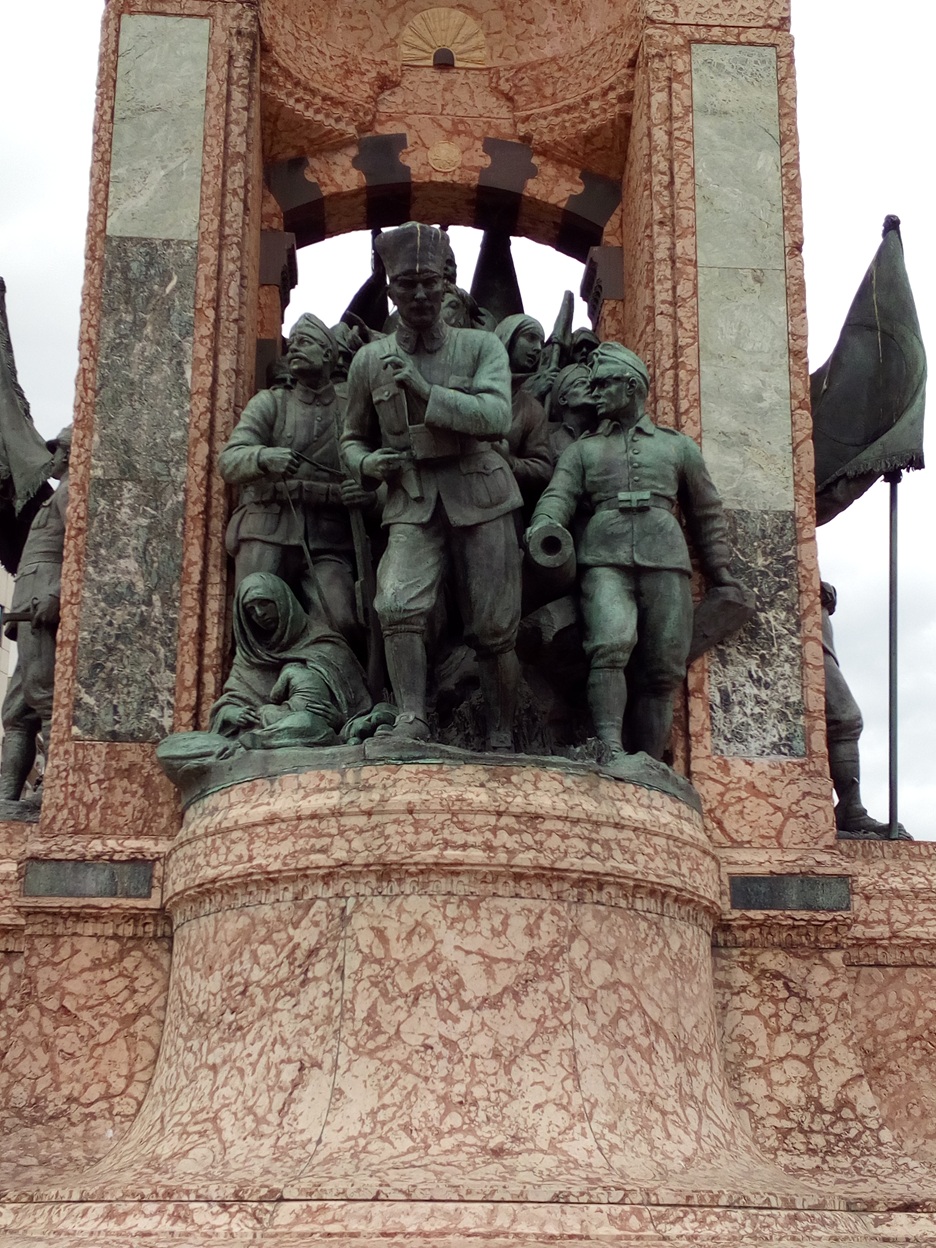
Republic Monument (Turkish: Cumhuriyet Anıtı), Taksim Square, 1928, by Pietro Canonica. The monument commemorates the Turkish War of Independence.
The Turkish War of Independence
This war was fought between 19 May 1919 and 24 July 1923 between the Turkish National Movement under Ataturk against Allied and separatist forces. At the end of the First World War, the Ottoman Empire collapsed, leading to the loss of lands outside modern Turkey, in the Middle East and parts of the Balkans. As a result, the Republic of Turkey was created, bringing about nationalist revolutionary reform.A power vacuum resulted in Anatolia, and the Allies agreed to allow a Greek peacekeeping force to occupy Smyrna (İzmir). Mustafa Kemal, aka Atatürk, led a movement to oppose the Ottoman Istanbul government, which had signed the Treaty of Sèvres. This treaty was unfavourable to Turkish interests.
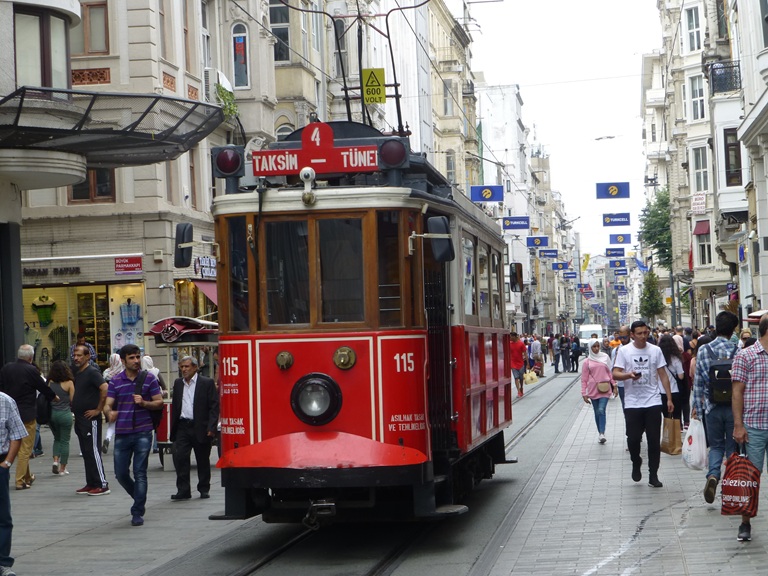
Istanbul tram
The modern tram system of Istanbul opened its first line in 1992. In the 1960s, the old tram system was shut down in favour of fossil-fuel vehicles. This proved to be a disaster, with high levels of pollution, congestion, and slower moving traffic than before.
In 1990, İstiklal Caddesi (Independence Avenue) became a pedestrian and tram route, running the heritage Taksim-Tünel Nostalgia Tramway, operating on İstiklal Caddesi between Taksim and Tünel. Rolling stocks are the pre-1966 trams.
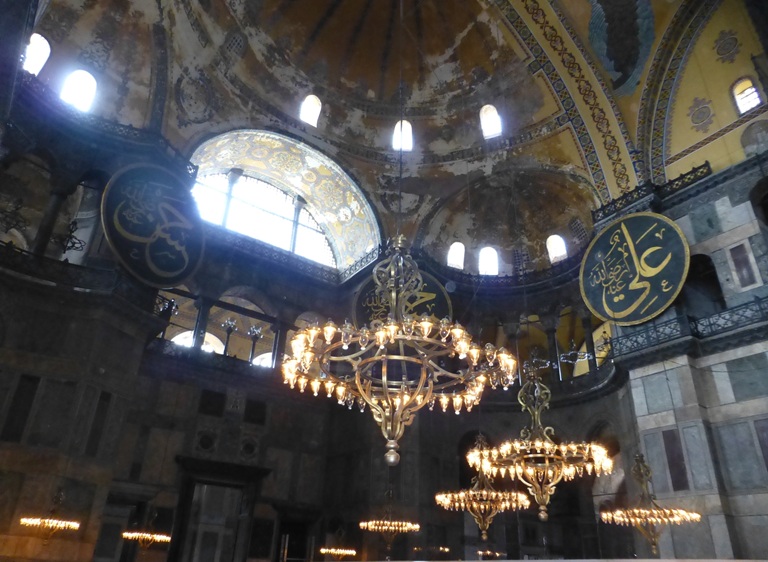
Hagia Sophia (Ayasofya) Grand Mosque is a mosque, museum and former church, dating back to 537 CE, during the reign of Justinian I. At this time it was the world´s largest interior space, and the first to utilise a pendentive dome (the positioning of a circular or elliptical dome over a square or rectangular room). There had been two previous churches at this site.
After the fall of Constantinople to the moslem Ottomans, in 1453, it was used as a mosque,with added minarets. In 1935, it became a museum, and in 2020, it was redesignated a mosque, with the upper floor serving as a museum.
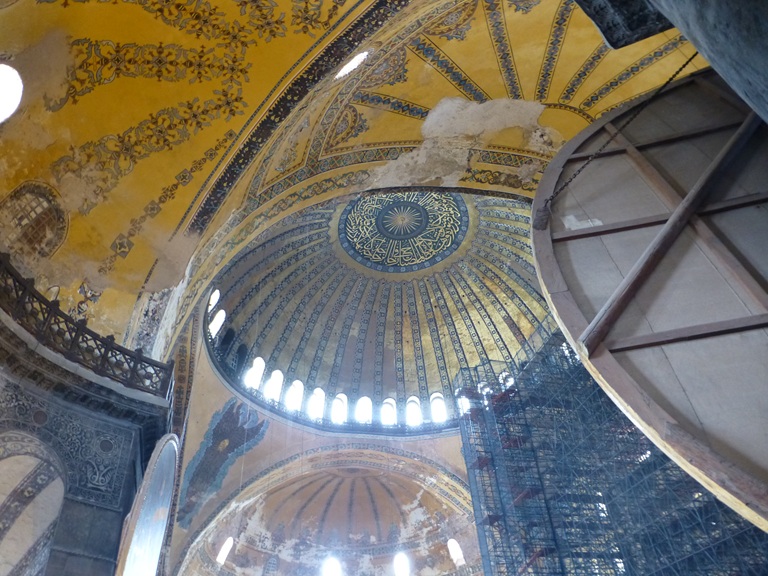
Hagia Sofia’s domes.
The interior is lined with green and white marble, purple porphyry, and gold mosaics.
The church attracts over 3 million visitors annually. Despite this, it was converted into a mosque in 2020. This was the result of Turkish president Recep Tayyip Erdoğan’s nationalist and populist agenda. In 2014, the pope acknowledged the Armenian genocide. Given the president’s populist view that denies that the genocide ever happened, it is said that the pope’s and the UNO’s acknowledgement accelerated the process to turn the church into a mosque. While we were in Istanbul, Internet access to Wikipedia was shut down in Turkey, in protest against its reporting of the UNO’s recognition of the Armenian genocide.
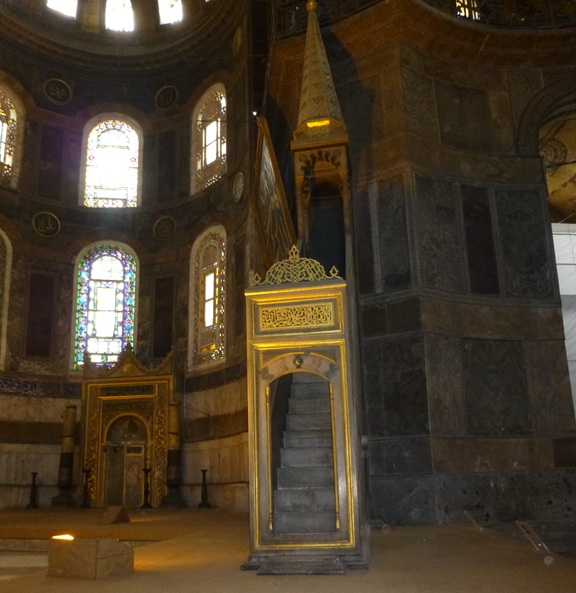
The minbar in the Hagia Sofia
A minbar is the pulpit from which the imam delivers sermons. On the left is the mihrab, a niche in the far wall of the mosque indicates the qibla, the direction of prayer towards the Kaaba in Mecca. Since the Hagia Sophia was built as a Christian cathedral, i.e. along the east-west orientation, when a church is adapted to a mosque, the mihrab and minbar can be off-centre. The degree of this depends on the latitude and longitude of the mosque.
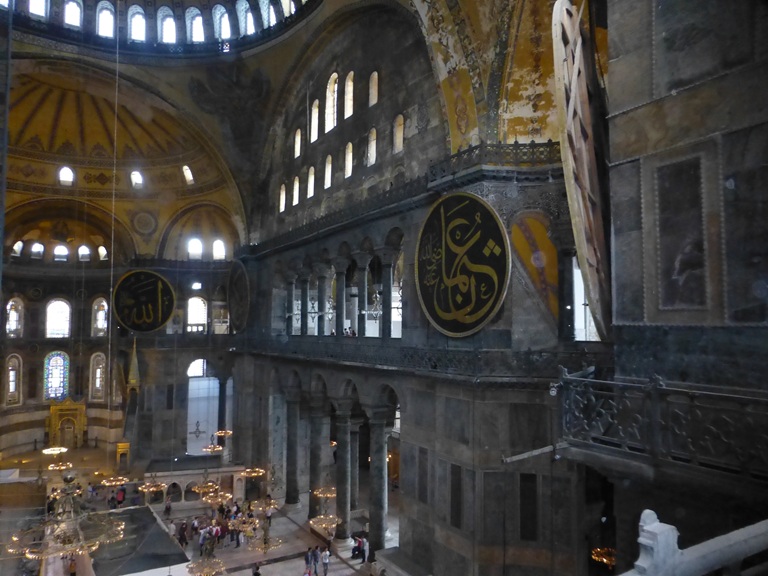
Hagia Sofia was designed by the Greek geometers, Isadore or Miletus and Anthemius of Tralles. It was originally called the Church of God´s Holy Wisdom, as had the previous two churches on the site, the last of which had been destroyed during the Nika riots*. It was the largest cathedral in the world for nearly 1000 years, until the Seville Cathedral was built by 1520.
*The Nika riots took place in 532 CE, the year building began on Hagia Sofia, leading to half of the city of Constantinople being burned or destroyed, and the deaths of tens of thousands. The riots were the result of hooliganism within the Hippodrome chariot race factions, known as demes, the ‘Blues’ and the ‘Greens’, demanding the release of members, who had been condemned for killings in previous riots. It was the culmination of dissatisfaction of emperor Justinian I’s handling of a war against the Persians, corruption, and high taxation.
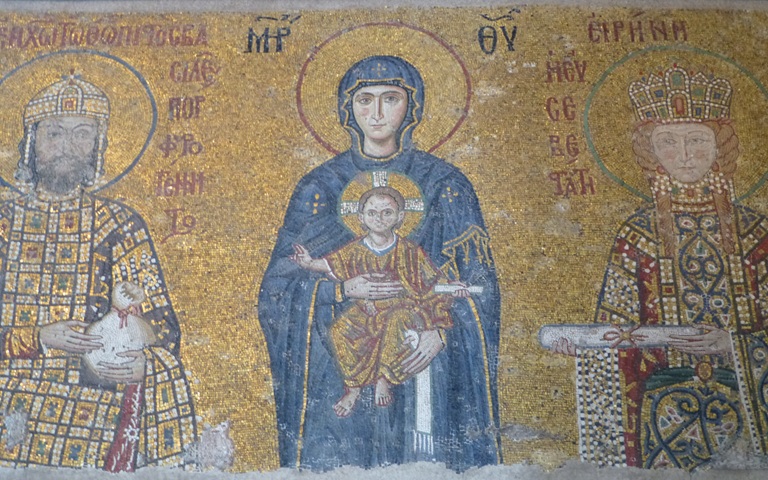
Hagia Sophia (Ayasofya) became the quintessential model for Eastern Orthodox church architecture. It was built in 532-537 CE, under the instructions of the emperor Justinian I, and was a major Christian cathedral until Constantinople fell to the Ottomans in 1453, at which point it became a Sunni Moslem mosque till 1934. In 2020, it became a mosque again, and its upper floor, where this photo of wall mosaics was taken, is a museum.
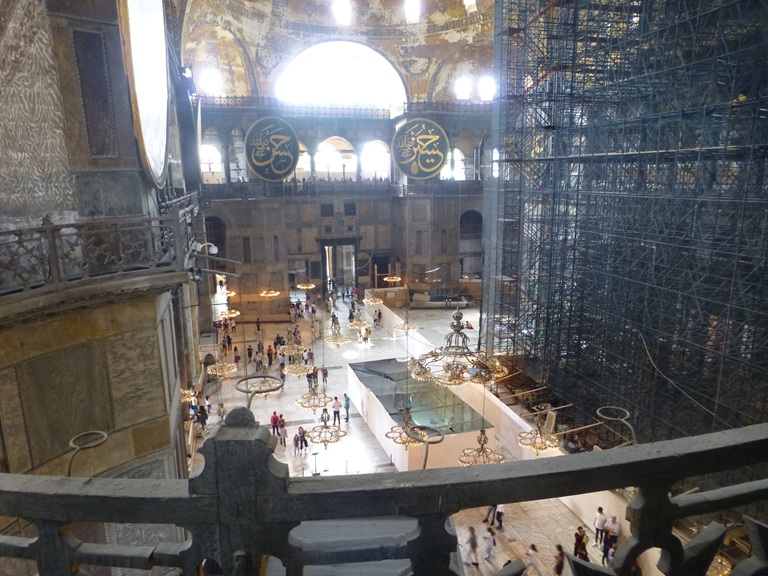
For almost a thousand years, Hagia Sofia it was the largest interior space in the world, reaching 55m high, 82m long and 73m wide.
Enrico Dandolo (1107-1205, reigned 1192-1205), the doge of Venice who led the Fourth Crusade and the 1204 Sack of Constantinople, was buried in the church. In April, 1204, crusaders captured and sacked the city, and established the Latin Empire. This resulted in the cathedral being converted to a Catholic cathedral till 1261, when it was restored to the Eastern Orthodox Church.
The eight large medallions are inscribed with the names of Allah, Muhammad, the Rashidun (the first four caliphs), and the two grandsons of Muhammad. These were added in the 1840s, during renovations led by the Ticinese (Swiss-Italian) architect brothers, Gaspare and Giuseppe Fossati.
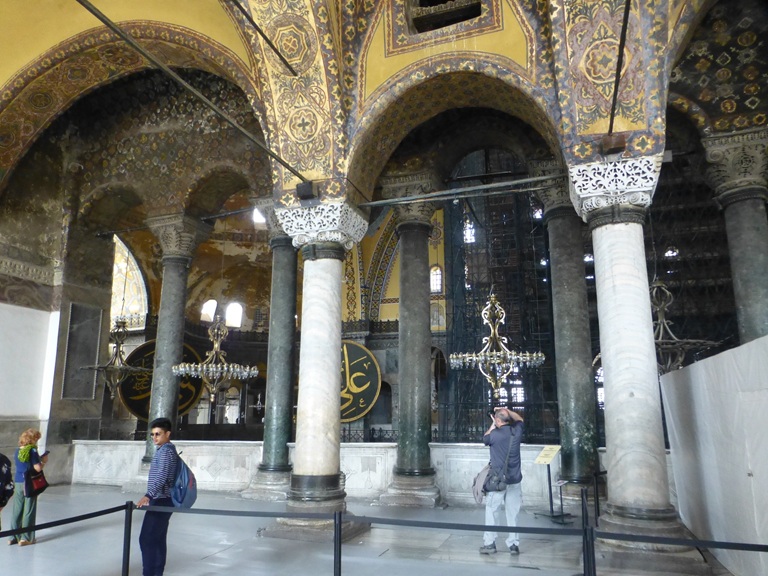
Hagia Sofia interior. Over just five years, more than ten thousand people were employed in the construction of the cathedral, with columns and other marble elements being imported from all over the Mediterranean. When the building was completed, Justinian I (the Great) is reported to have stated: “Solomon, I have surpassed thee”.
Some of the basket capitals atop the columns are engraved with monograms of Justinian and his consort, Thedora.
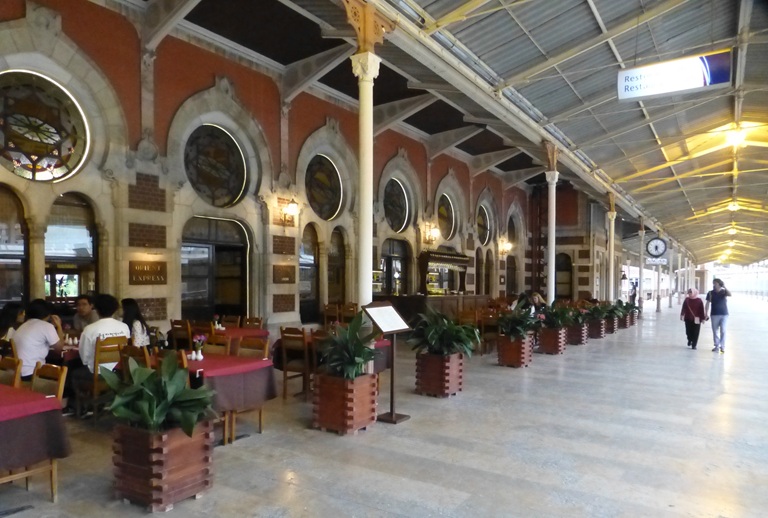
Sirkeci railway station (Turkish: Sirkeci garı). This station is the terminal on the European side, while Haydarpaşa Terminal is on the Asian side. It was built in 1890 by Oriental Railway, as the eastern terminus of the Orient Express, operating between Paris and Istanbul, from 1883 till 2009. It reopened after works on the line, in 2024.
In 2013, a new underground station was opened, to serve the trains travelling under the Bosphorus to the Asian side.
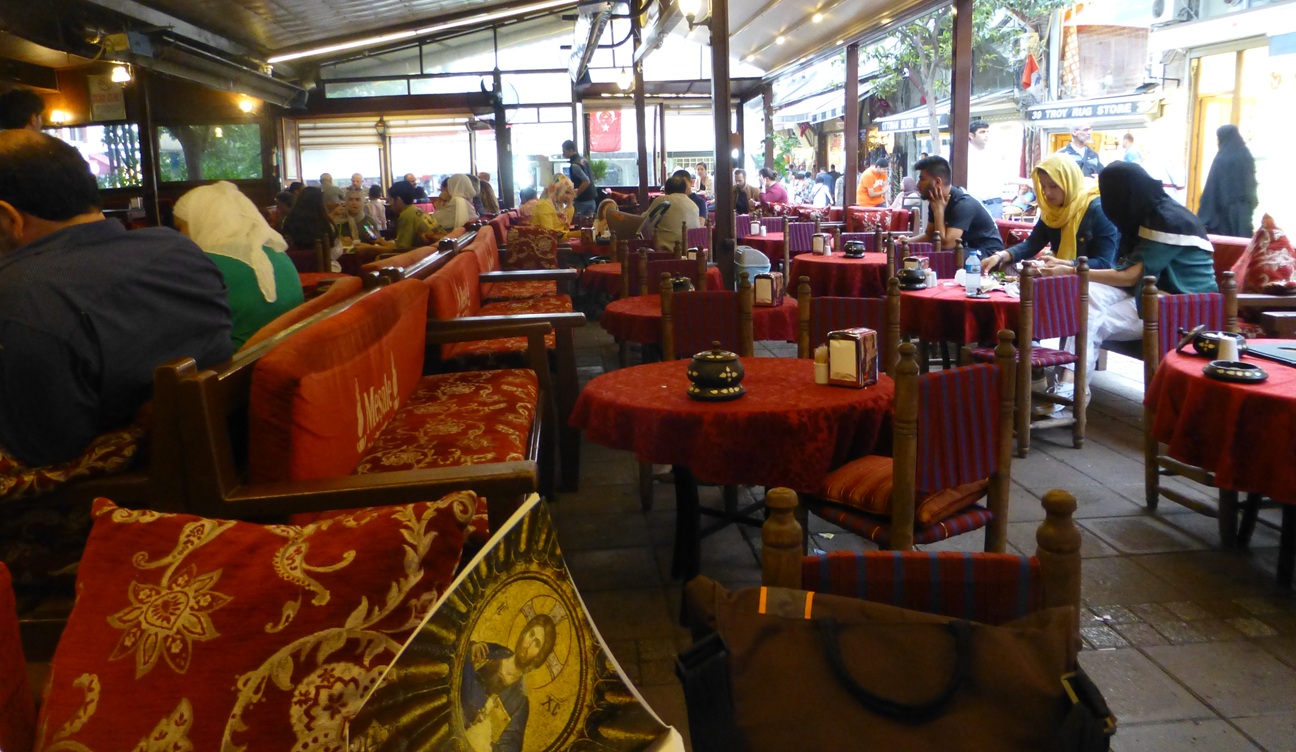
Istanbul hookah lounge, also known as a shisha bar or den. Shisha means flavoured tobacco. The hookah is the communal pipe. To avoid tobacco bans in various countries, the tobacco-based shisha can be replaced by tobacco-free mu‘assel, a mix containing molasses, vegetable glycerol and various flavourings. An Arabic word for hookah is Argilah ( أرجيلة ).
Travel Diary
Then we walked to the Topkapi walls, passed newly restored wooden Turkish houses on the wall next to Gülhane Parki, and found a great place to eat Turkish Delight and baklava. We watch an Arab family, the women covered almost completely, and then on to the famous Orient Express railway station, Sirkeci Gari. Then it is back to Seraglio Point and past the Sultanahmet Mosque, aka Blue Mosque, to have dinner on low sofas while we listen to Turkish music, and watch the Whirling Dervish dances.