Romania-Bulgaria 2023
Day 2: Friday 25 August 2023
Sibiu, Romania
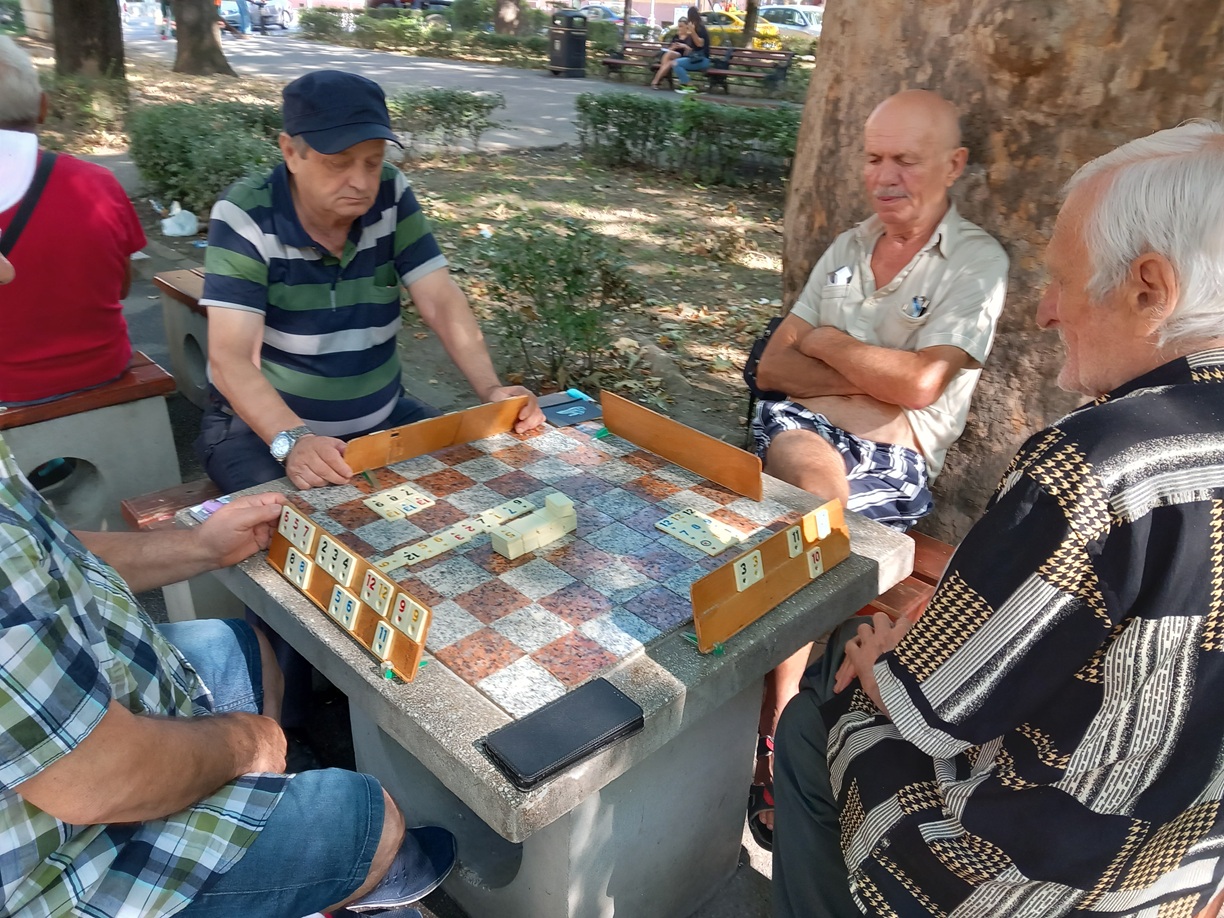
Men playing a game of Rummikub in a park. This game, remi in Romanian, was invented by a Romanian Jew called Ephraim Hertzano, who fled to Palestine in the 1940s. After humble beginnings, the game became Israel´s best-selling export game, and by 1977 it was the most popular commercial game sold in America. It is nice to see the game return to Romania, on such a pleasant day, in such a idyllic spot.
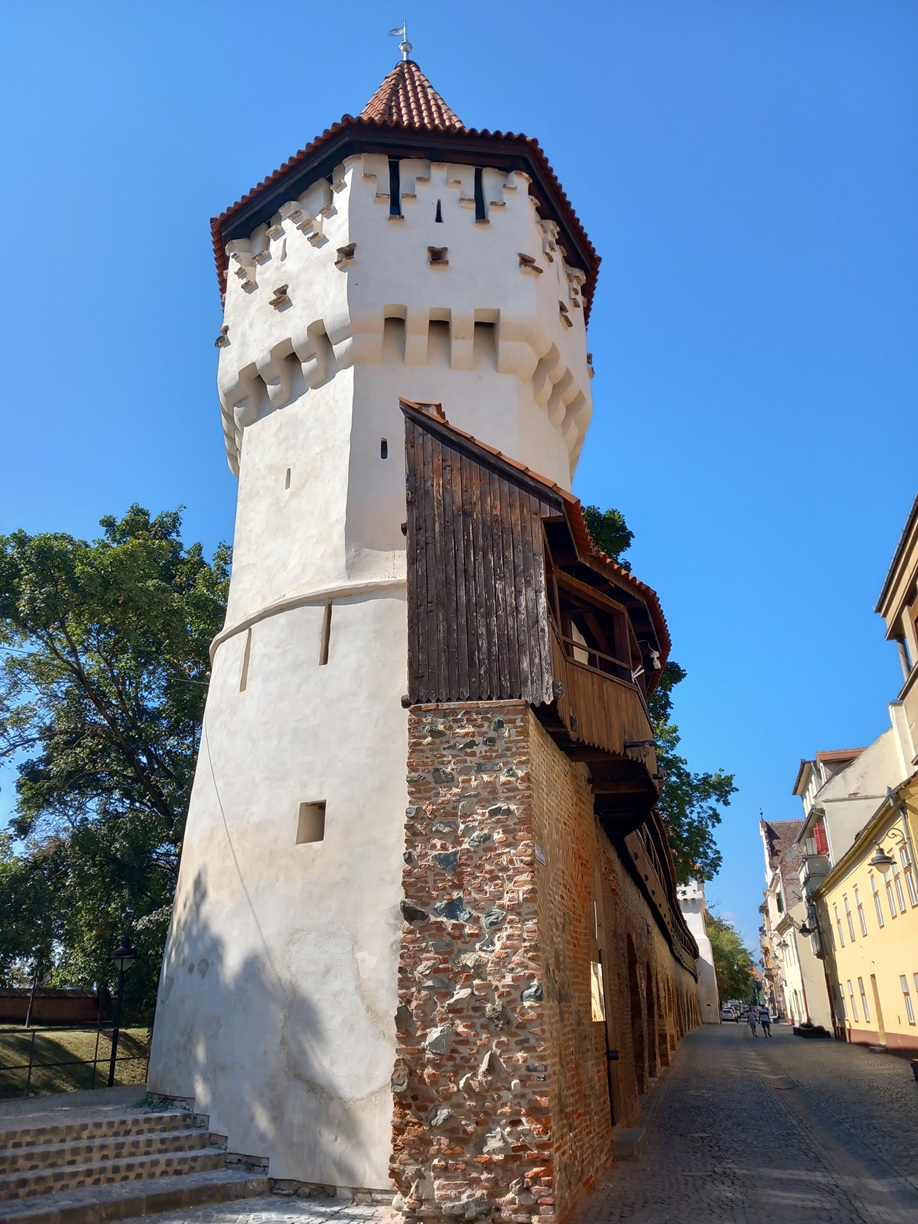
Sibiu medieval wall and gate tower
A regular feature of Transylvania, and testimony to the fragility of security, are fortified villages and towns, including fortified churches. There had been as many as 300, and today about a 150 are left. Many are recognised as UNESCO World Heritage Sites.
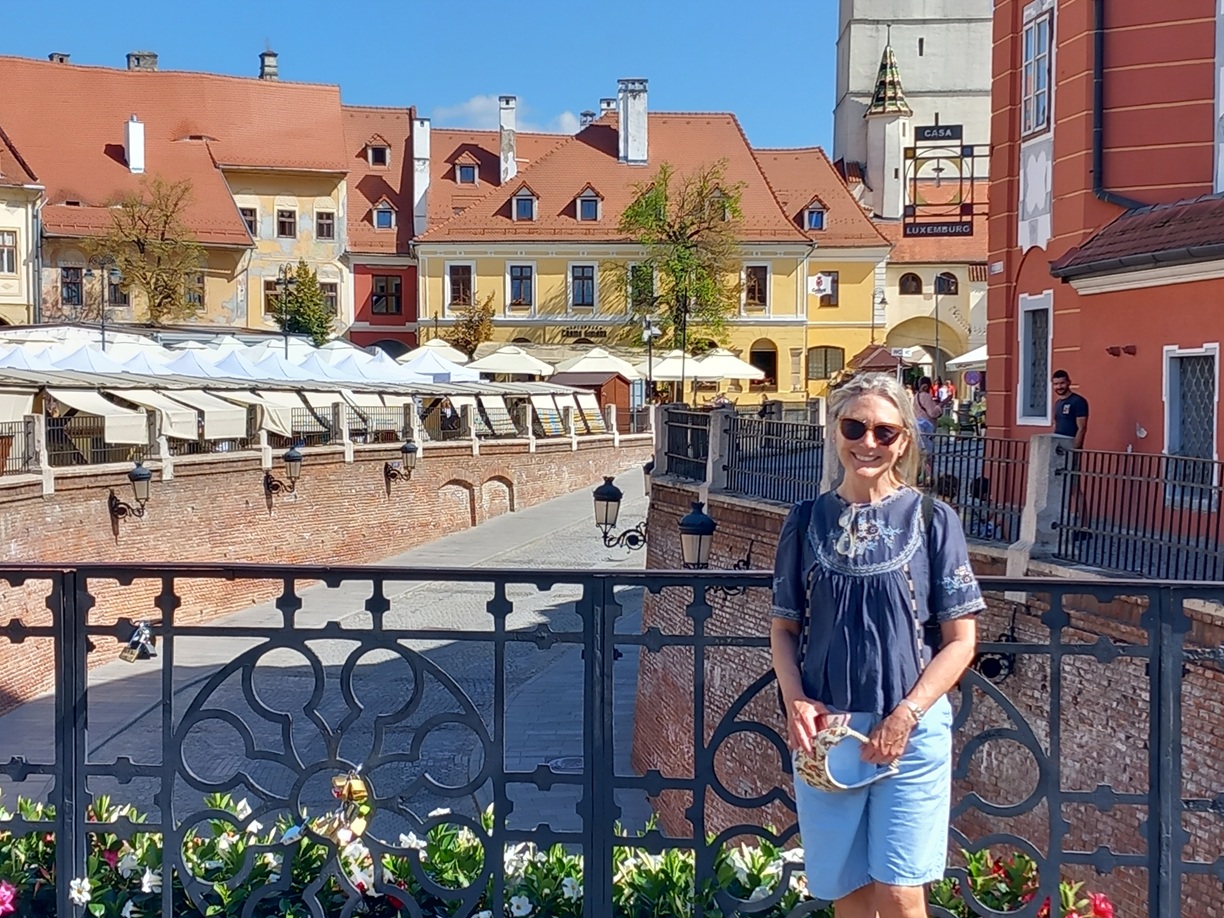
Bridge of Lies, Sibiu. The first cast iron bridge in Romania, erected in 1859, has many legends associated with its name. Lovers, merchants, even mermaids (it is said there used to be a waterway beneath the bridge) could not tell a lie on the bridge or risk either being thrown from it, or the bridge collapsing. However, the more likely, if mundane, explanation is that the name is a misinterpretation of the German name, Liegenbrücke, which means Bridge that is lying (down), rather than Lügenbrücke, which would have been the mendacity version.
For the record, Cindy passed the ordeal unscathed.
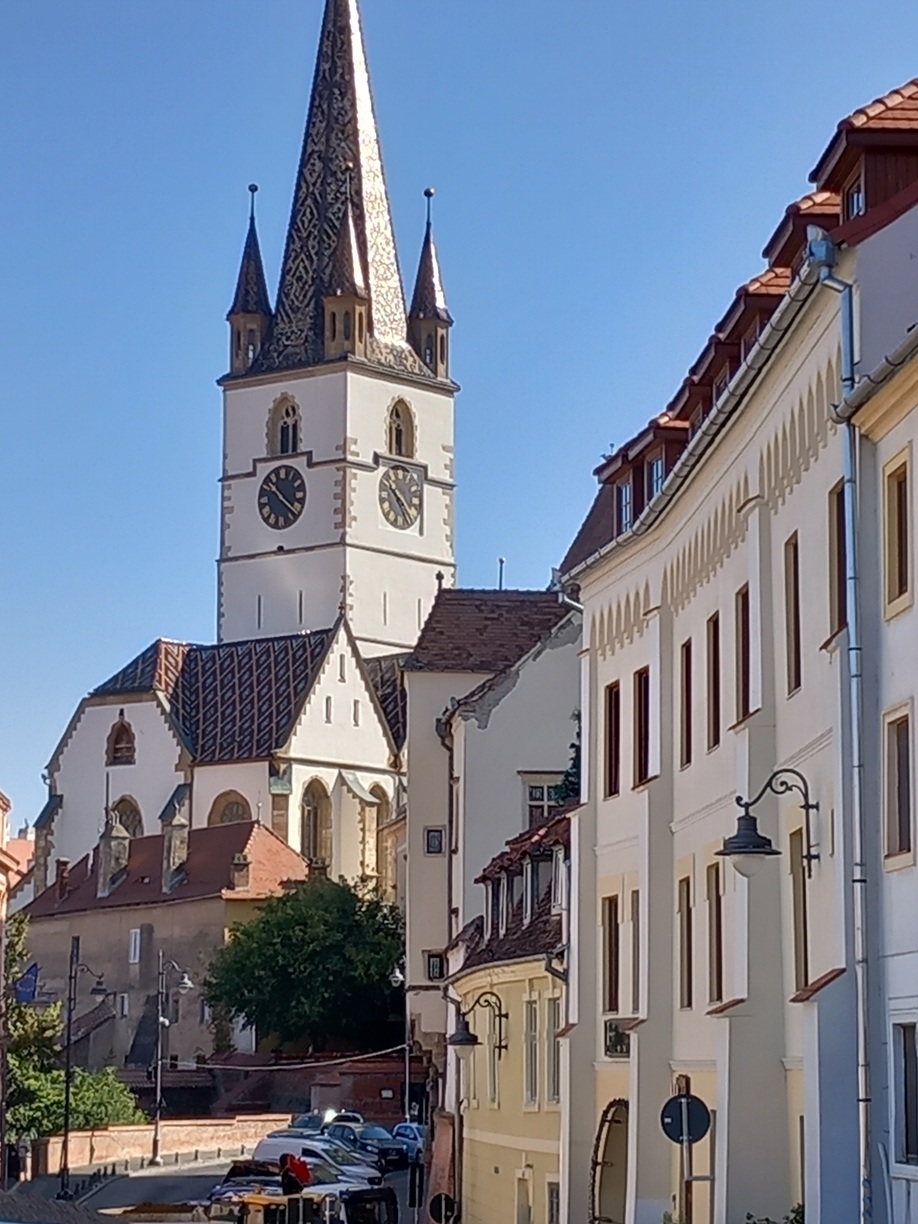
Evangelical Lutheran Cathedral, Sibiu
This impressive Gothic landmark was built between 1371 and 1520. It reaches 73m above Huet Square, central Sibiu, making it the highest in Transylvania. It has four turrets, which supposedly warn strangers that the city has the power to exert the death sentence. Legend has it that the bronze baptismal font was cast from Ottoman cannon captured in 1437.
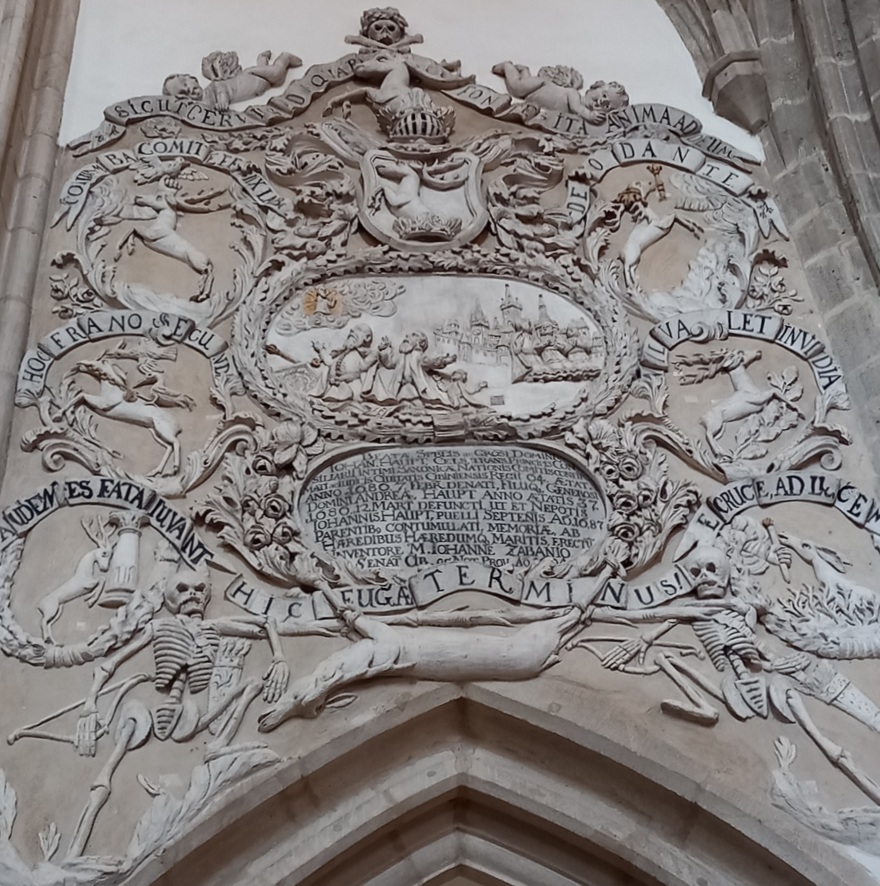
Door archway decoration in the Evangelical Lutheran Cathedral, Sibiu.
The church is very austere, so it was a surprise to find this ornate relief. Within this elaborate Baroque work can be seen tributes to deer hunting and the founding fathers of Sibiu, kneeling in fervent prayer outside the walls of the city. I am still curious as to why there are skeletons armed with bows around a slain deer….. in a church. Such are the whims of the rich patrons!
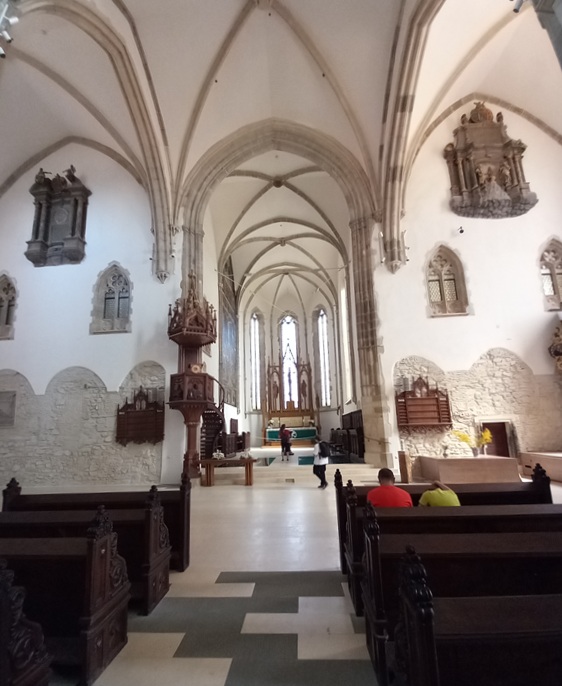
Lutheran Cathedral interior.
The tombstones that covered the graves were dismantled from the church nave in 1853 and incorporated in the walls of the church ferula, thus obtaining a gallery of 67 tombstones, unique in Romania. There are many epitaphs to dignitaries buried within the church. This practice ended in 1803, with the last being Samuel Freiherr von Brukenthal. He was the Habsburg governor of the Grand Principality of Transylvania, 1774-1787, and the founder of the large palace in Sibiu which houses the Brukenthal National Museum, which we visit later. He also founded the school opposite the cathedral.
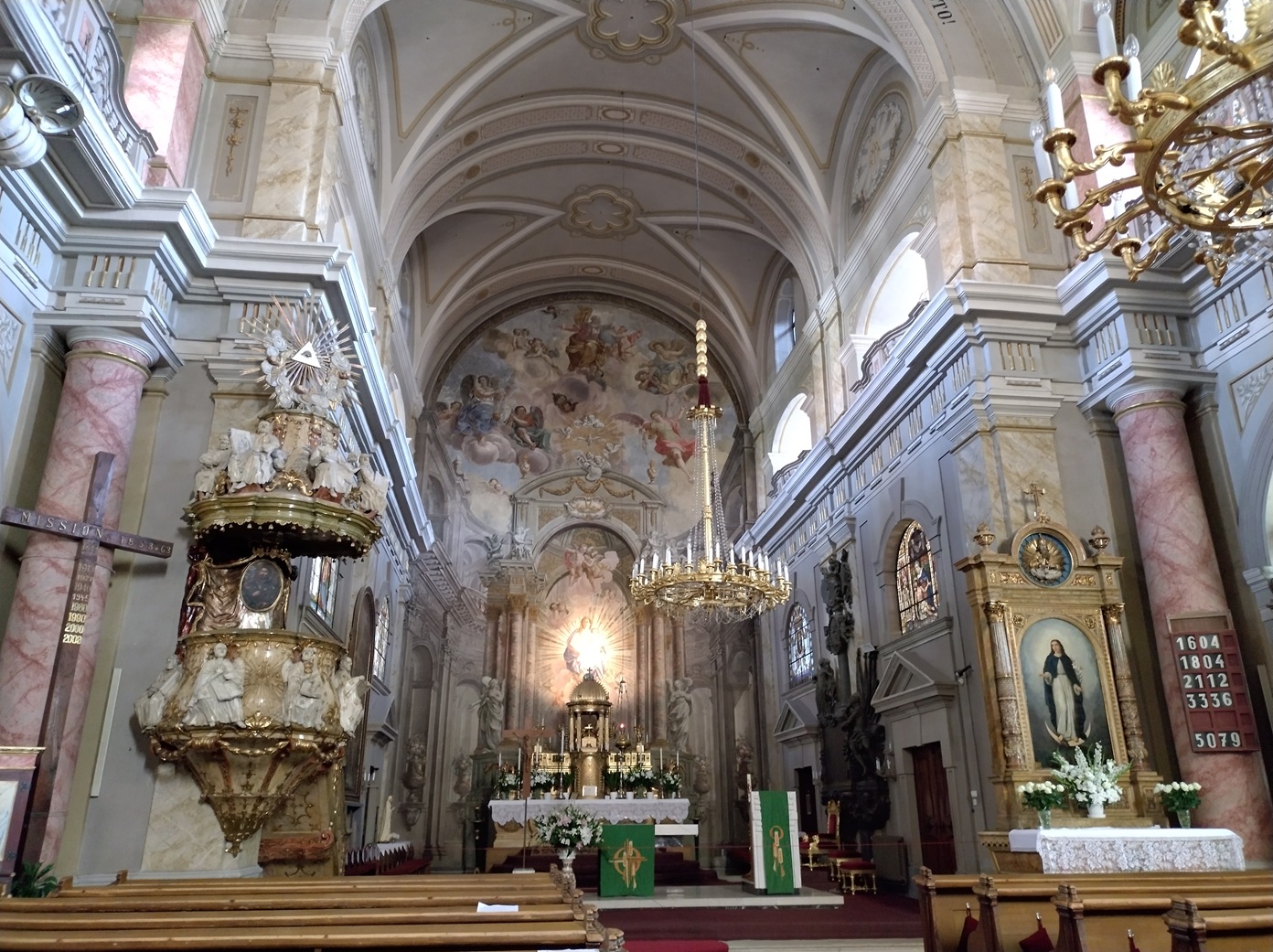
The “Sfânta Treime (Holy Trinity)” Roman-Catholic Church
Located between the two main square of Sibiu, this 18th century church is constructed in the Viennese Baroque style, and has been in service since 1733. Given the then high proportion of Germanic people, Sibiu converted to Lutheran protestantism following the Reformation in the 16th century. However, a small community of Catholics continued, and the Jesuits monks aided them to construct this building.
With an austere exterior, its interior has lateral alters divided by Dorian doubled columns.
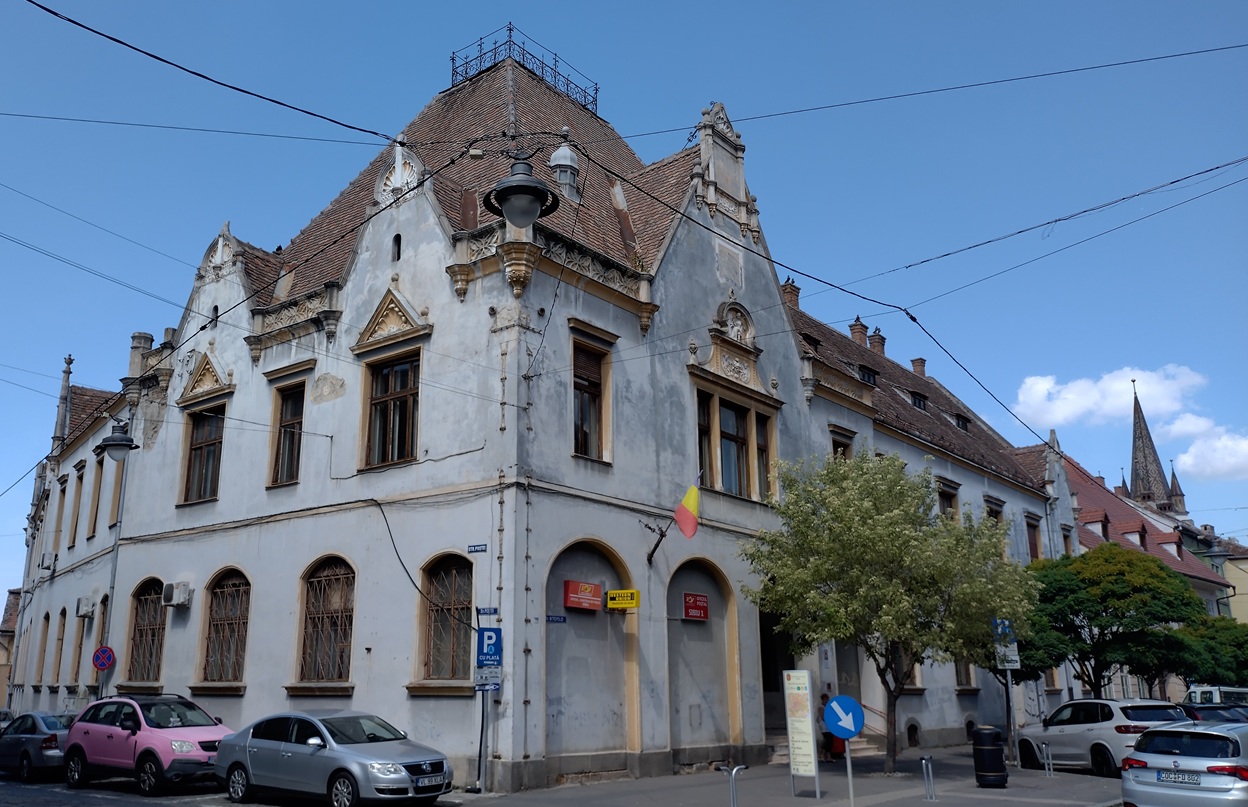
Post Office, Sibiu. To find this post office took us a while, and gave us an idea of how non-tourist Romania functions. These buildings are typical of Sibiu outside the town centre. Not well-maintained on the whole, but pleasantly characteristic.
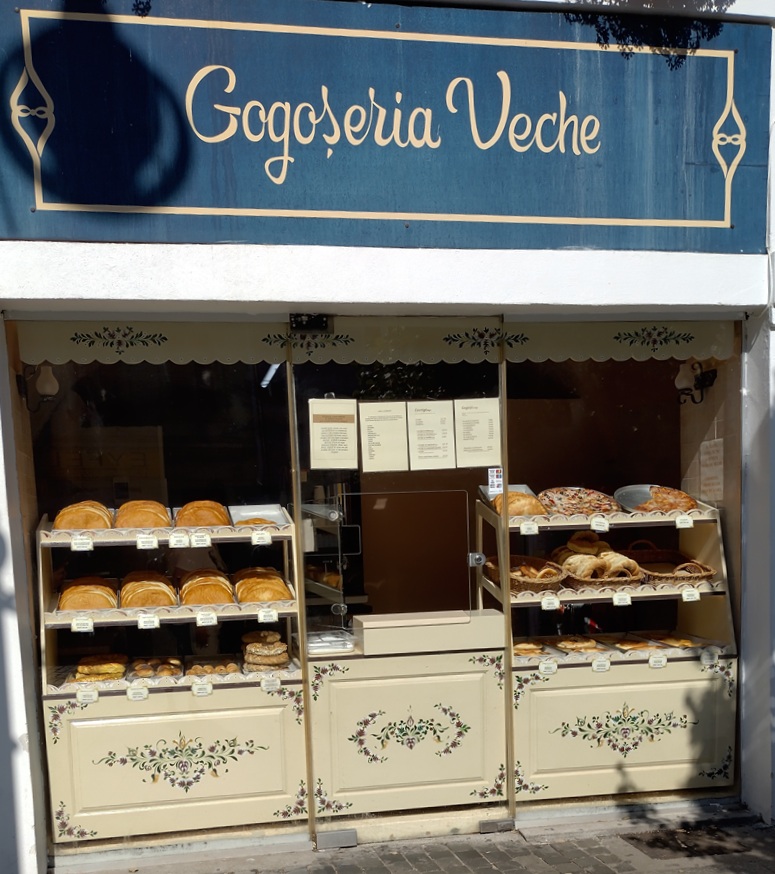
“Old Doughnut Shop”, Sibiu
One of the images we retain of communist regimes are long bread queues. This pleasant little bakery, the name of which translates as “Old Doughnut Shop”, outside the tourist centre offered a small but interesting range of goods.
Romanian Cuisine
(Romanian: Bucătăria românească) Given its geographical location, sandwiched between western and Ottoman regions, Romania demonstrates this through the mix of foods, which have a lot of similarity with Moldovan cuisine. Maize, potatoes and cheese (Brânză) are staples of Romanian cuisine. On menus we can find Turkish meatballs (perișoare in a meatball soup), moussaka (eggplant, potatoes, minced meat) from Greece, and schnitzel (șnițel) from Austria.There is also a Transylvanian Saxon cuisine, which apparently came with Luxembourgish immigrants!
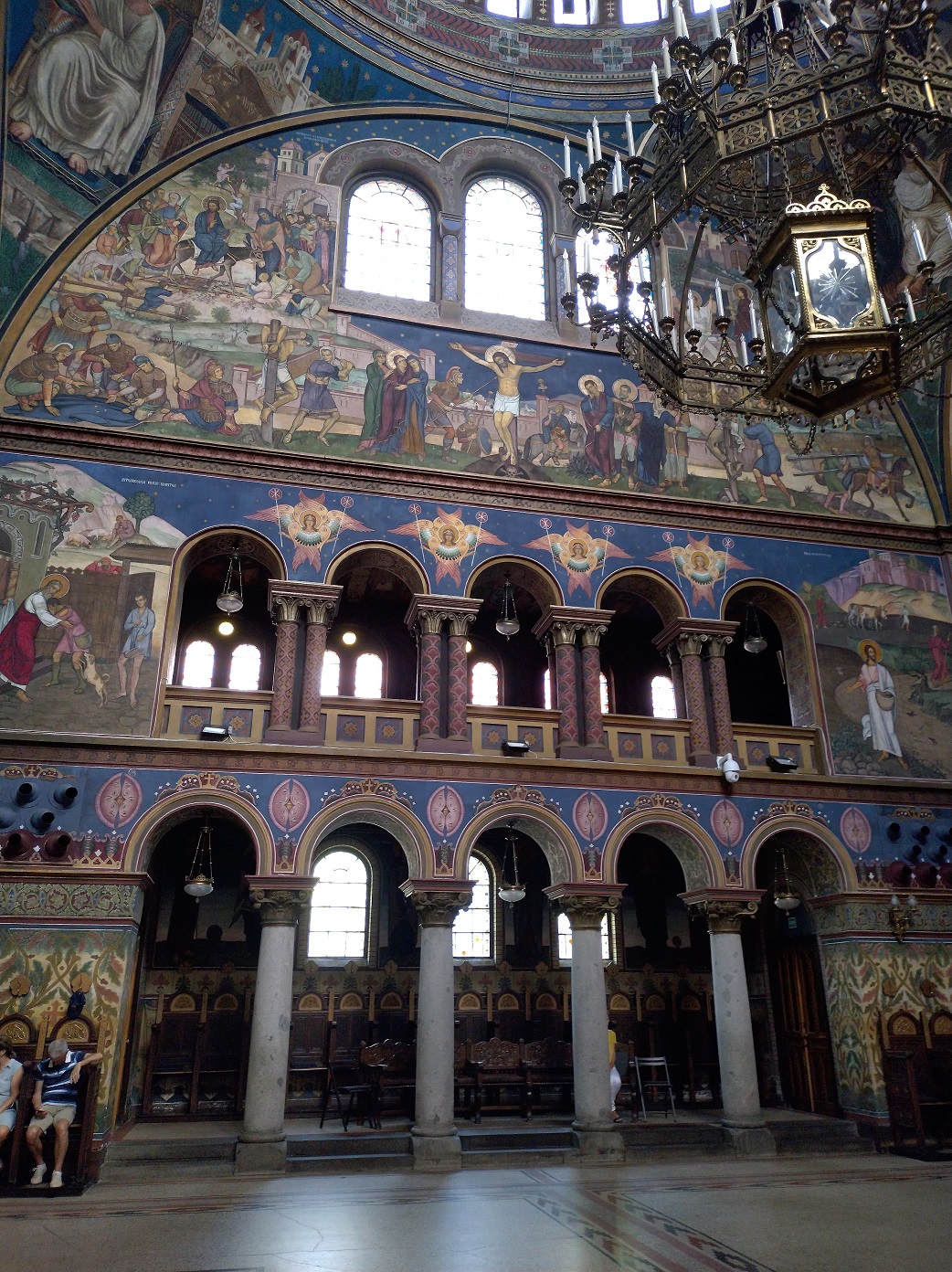
Orthodox Cathedral (Catedrala Ortodoxă), Sibiu
Built 1902-4 by Sibiu architect Iosif Schussnig, in the Byzantine Revival style. It drew on inspiration from the Hagia Sofia in Constantinople, Transylvanian and Baroque architecture.
The iconostasis, the screen decorated with icons that divides the sanctuary from the nave of an Eastern Orthodox church, the kliros (the choir area seen here in the photo), and the pews were made in Bucharest, and the dome and iconostasis were painted by Octavian Smighelschi, a native of the village of Ludoș, Sibiu County.
The three original bells were taken by the Austro-Hungarian army during WW1 to melt down for cannons, and were replaced in 1926.
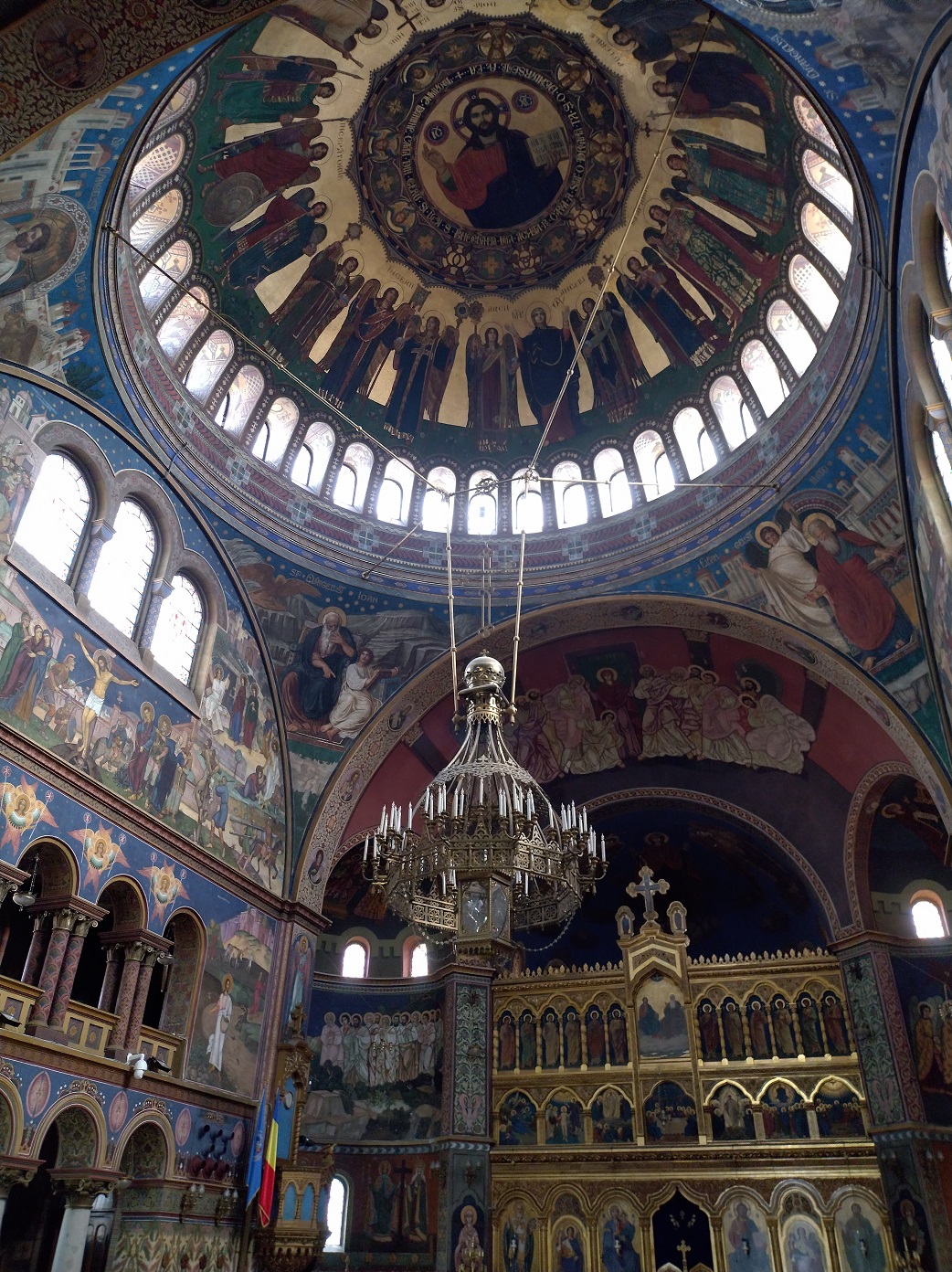
Dome of the Orthodox Cathedral, Sibiu. There is a semicircular vestibule and stained-glass window. The round mosaics depict Jesus and the Four Evangelists. It is the closest we have come to walking around the inside of a graphic novel….

Iconography in the Orthodox Cathedral, Sibiu
Interesting how this iconography follows the tendency of other confessions in depicting the Christ child as a miniature adult.
The confessional distribution reflects accurately the region’s turbulent history. Whereas Evangelical Lutherans composed 42% in 1910, today it is more like 2%. Eastern Orthodox, on the other hand, have surged from 18% in 1910, to over 90% today. Roman Catholics have fallen in the same period from one in 5 to one in 50.
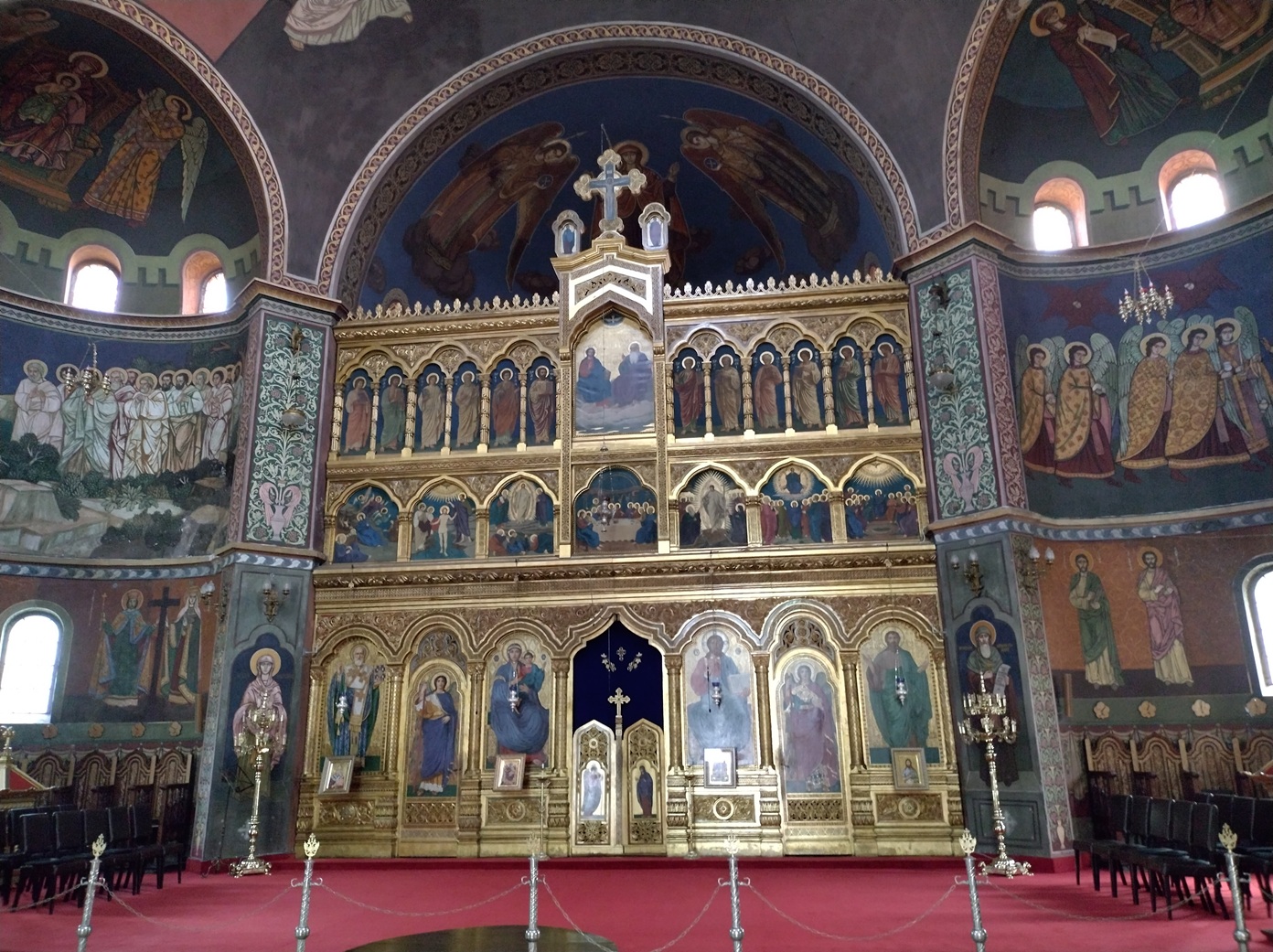
Iconostasis, Orthodox Cathedral, Sibiu
This screen depicts the twelve apostles. An iconostasis is a feature of Eastern Christianity, and is a wall of icons and paintings depicting religious scenes. Structurally, it separates the nave, the central ‘main aisle’, from the sanctuary of the church. Rather than being in the shape of the long vertical of the cross, in these orthodox churches, the nave is symmetrical beneath the high dome. The sanctuary can be any sacred place, but in Christian churches it is the area around the alter, which is holy because the physical presence of the deity is believed to be in that area, effectively creating a hierarchy within the physical church.
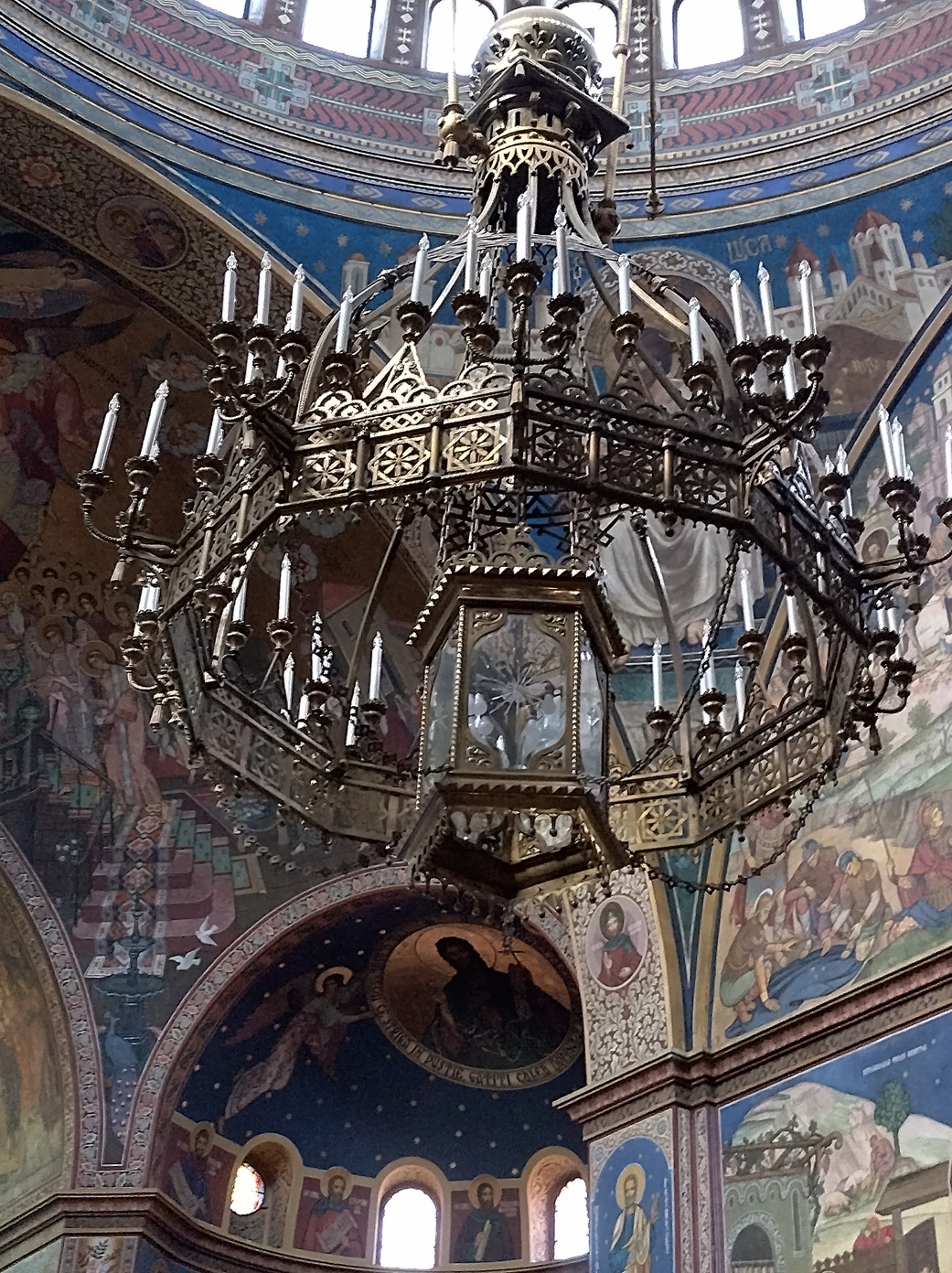
Chandelier, Orthodox church, Sibiu.
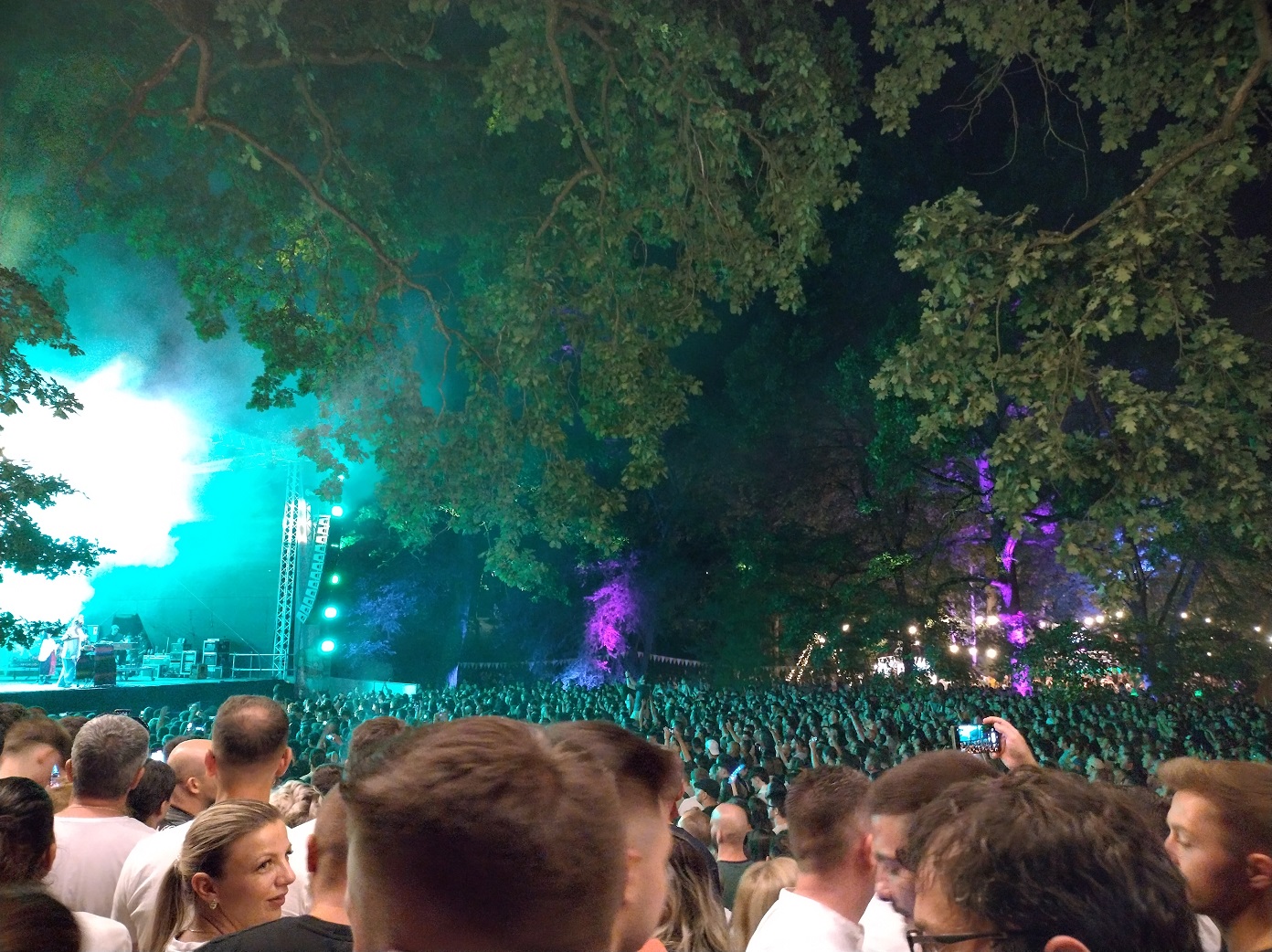
Rock concert Sibiu
In 1992, the population of Sibiu was 170k, and has decreased since to the current population of 134k. However, there was a surge in population from 2011 till 2017, when the population returned to the 170k peak. Of the current 134k inhabitants, 109k are ethnic Romanians. The number of ethnic Germans has fallen from a peak of 25,400 in 1977, to the current 968.
Unfortunately, Romania is no exception to the lure of nationalist politicking. With false news and information flooding social media, under the guidance of Russia, the threat of a right-wing, pro-Putin anti-democratic takeover is very real. Let’s hope these people, who have only recently wrested the right to free speech and democracy from a brutal dictatorship, do not throw it away again, like Hungary has.
Travel Diary
We slept late, thankfully. Breakfast was pleasant with a very nice man hosting. There was a lot of meat, dried meats, sausages. No muesli or cereals. We walked the periphery of the old town, south side where there are 3 (count them!) defensive ’rings’; one monumental, still intact wall, and an inner section with a walkway. Sun, up and bright, clear sky, too hot, so we followed the shade back to the main square, Piata Mare, where we found the palatial info office, displaying maps and chose the history museum. Smallish but full of relics, displaying the phases: prehistoric, bronze, iron, Dacian, Roman, Ottoman, Hungarian, the armoury generously stocked, pewter, bronze, glass galore.
We saw only a few easily-identifiable Roma people (a large woman and 2 small children).
Clever new word to drop casually into conversations: autocephalous= self-headed as in the Eastern Orthodox Catholic Church
Instead of a big lunch we crossed the road to a cool cafè; Cindy opted for a mint lemonade and for me a banana bread concoction. Later 2 lemonades at the hotel: mint and fruit. We walked to the 3 most impressive churches: Orthodox, Evangelical, Catholic. The Evangelical is the one we see from our bathroom window, and is very austere, sand-toned masonry, no decoration, light and airy. The Catholic church is as gaudy as ever, with murals and frescoes depicting the usual gory stories. The Orthodox had only a few straight-back chairs against the wall and nothing in its spacious square interior. The performance end had indeed a backdrop of wooden panels, depicting the 12 Apostles and the rest, with 2 entrance doors camoflaged in the complex. It was very beautiful inside and we watched devotees come in to kiss and lightly touch the icons and paintings protected behind glass.
Then a longish walk through the more modern periphery to the train station where we forked out an extortionate 32 Leu ( Fr.5. 40) for 2 tickets to Sighisoara the next day. Back to the hotel for a long rest, playing with phones. Then dinner in the main square (Piata Mare) at La Turn (tower) with live music (singer (female), electric piano, guitar). Cindy has trout, for me beef and polenta (nothing special). Our friendly, tattooed waitress spent a year doing a hospitality internship in San Diego. She recommends a ‘party’ in a park to the south east. So, we listened to a few more oldies by the very good singer, who appreciated our fanning, then found our way the 2 km to the very extensive leisure arena park, at the business end of which is a large stage (called ’Focus’), and a light show, with a heavy Romanian rock and rap band playing possibly cross-over music: cross between sheepdog Romanian folk and rottweiler heavy beat repetitiveness. A couple of the singers were wearing folk dress, or genetically modified reminiscents of such.
The crowd was dense and very enthusiastic. They seemed to know all the songs, singing along when prompted in the Queen style. We inched forward through the well-behaved, civil, yet wildly happy throng. Quite enjoyable to be immersed in youthful energy. There were also some very young children, privileged by shoulder-perch views on their jiving parents. Noticeable was the homogeneity of the crowd, as in all of Sibiu, the lack of black faces, or even Asian. I imagined Romania is not top of the list of preferences for migrants, but also I suspected eastern European countries have an impermeability to non-natives as a general policy, as they struggle to establish themselves post domination.
Proud to have photos and videos as evidence to show Sean, we wended our way back through the still in-flooding thousands of people back to the hotel. Even the police (saw only 2) were very young (girls even). The population here in Sibiu does seem to be youthful, more so than Western Europe. There seems to be a strong pride in their cultural identity – the music suggests ‘we have always been downtrodden, now it is our time’. So far we have seen nothing suggesting support for Ukraine – not like we saw in the Baltic states.