Romania-Bulgaria 2023
Day 3: Saturday 26 August 2023
Sibiu, Romania – Sighisoara, Romania
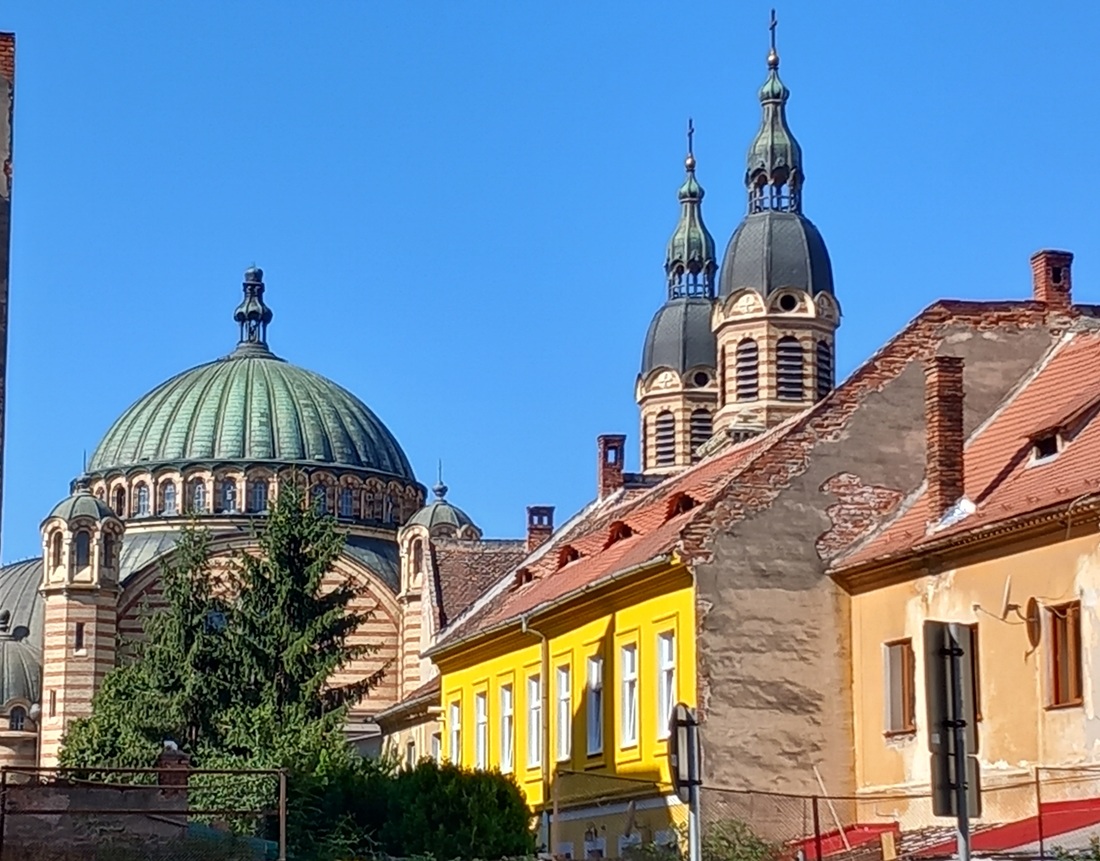
View of the Orthodox Cathedral from a sidestreet in Sibiu. By far the most tastefully lavish building in Sibiu, we opted to visit it twice.
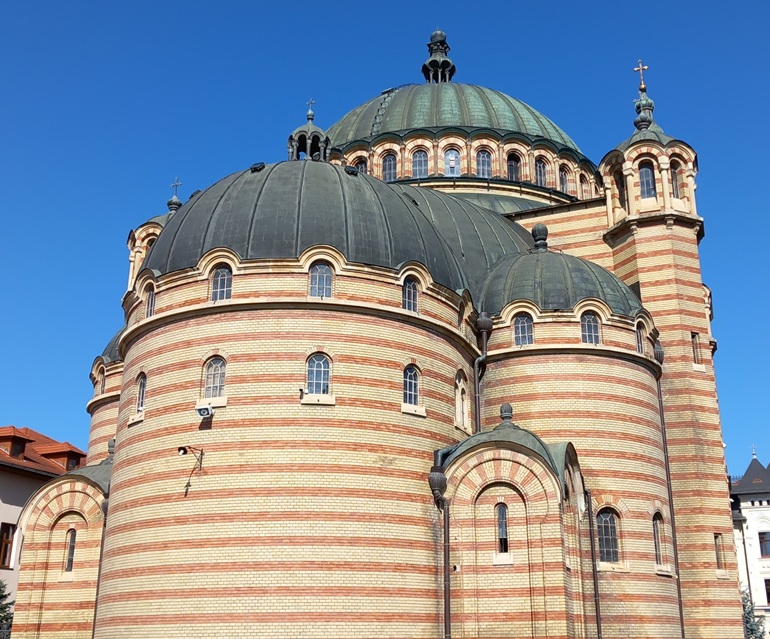
Orthodox Cathedral from the outside, showing the nested cupolas. A clever design which brings the public into a round theatre like rapport with the show, more intimate than the stand-offish rostrum and long nave of non-orthodox churches.
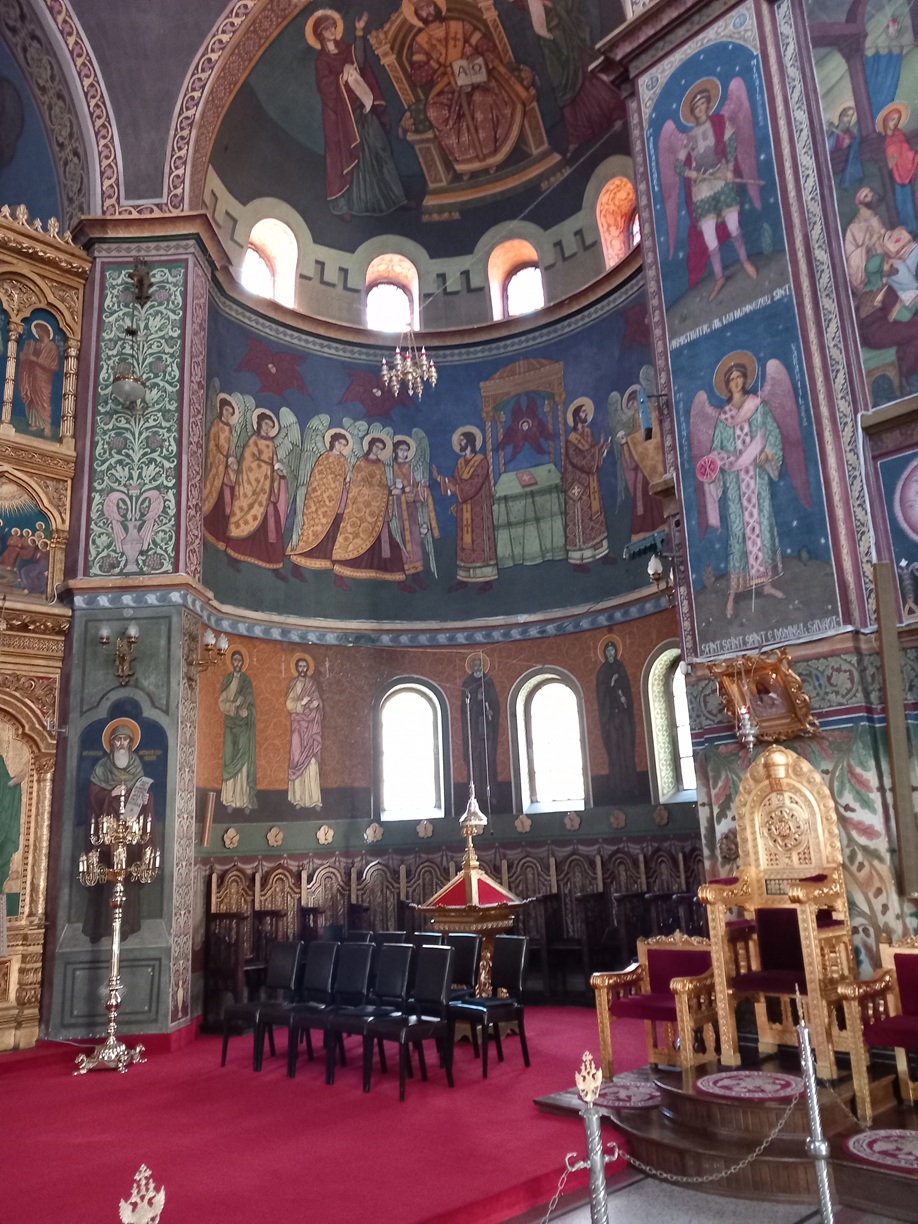
Orthodox Cathedral interior. Even though over a hundred years old, the paintings are as fresh as ever, and depict the stories in an attention-grabbing way, like any graphic novel.
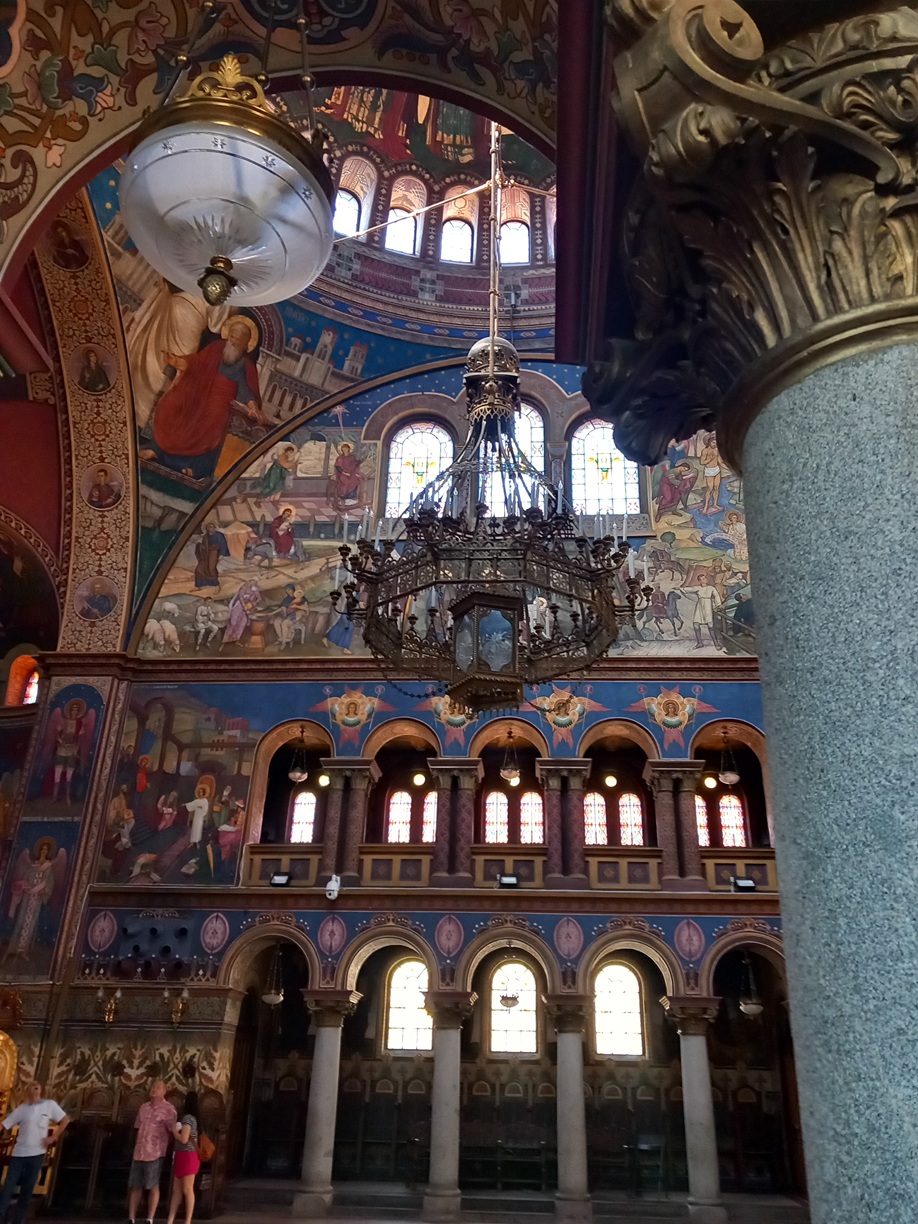
Orthodox Cathedral main dome. Unlike Western Christian churches, which represent the cross in their construction, this church is a series of domes around one central, circular dome.
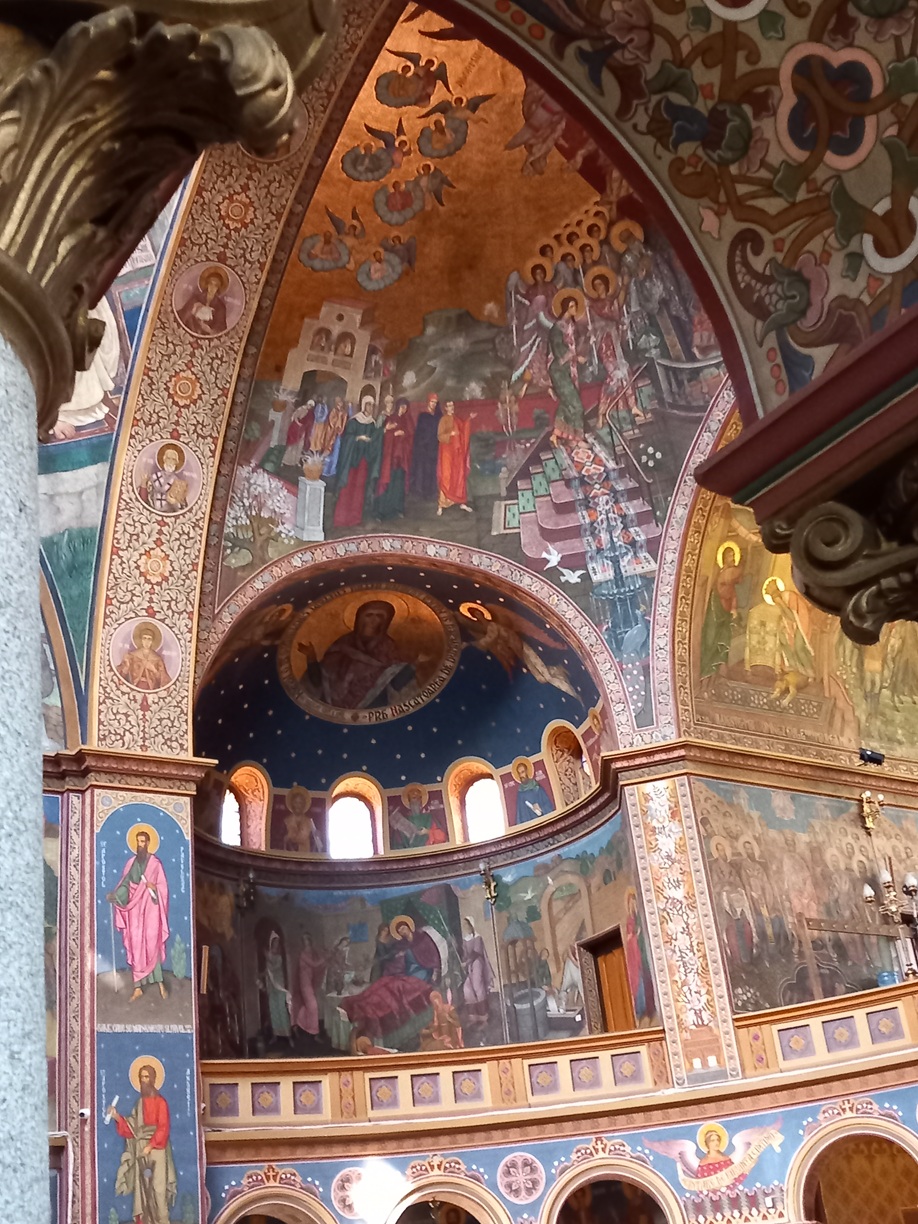
Orthodox Cathedral corner dome. The use of gold towards the heavens is a feature also of western religious art.
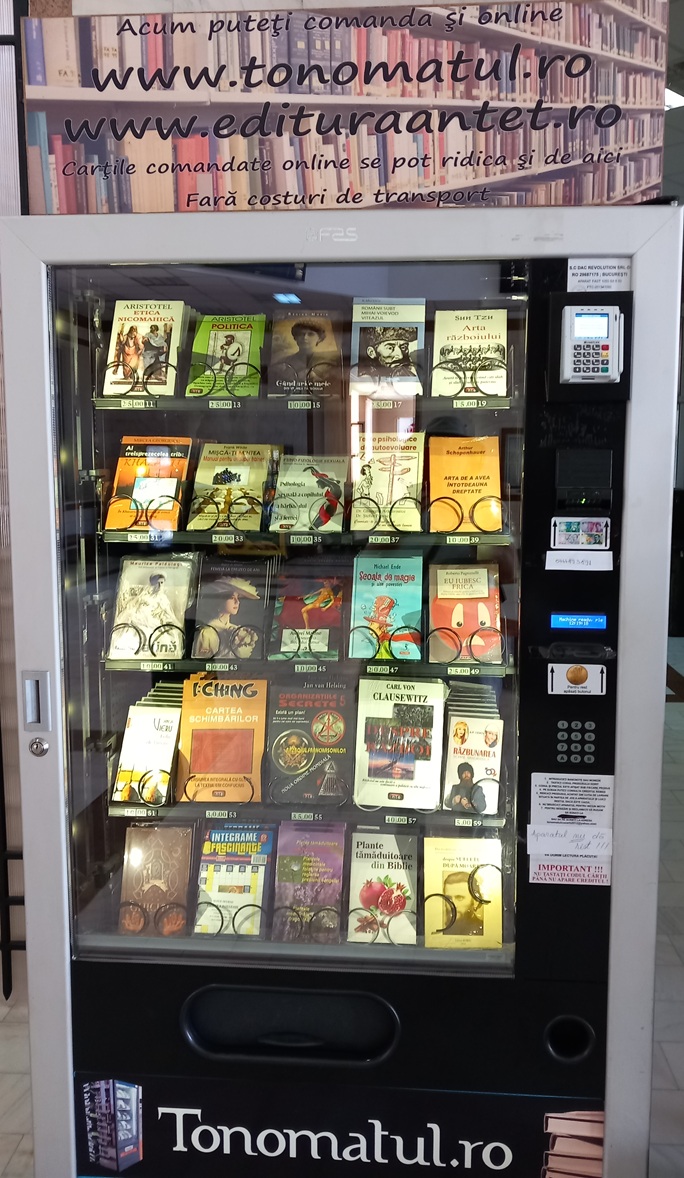
A book dispenser at the station in Sibiu. We loved this concept. Books instead of chocolate bars!
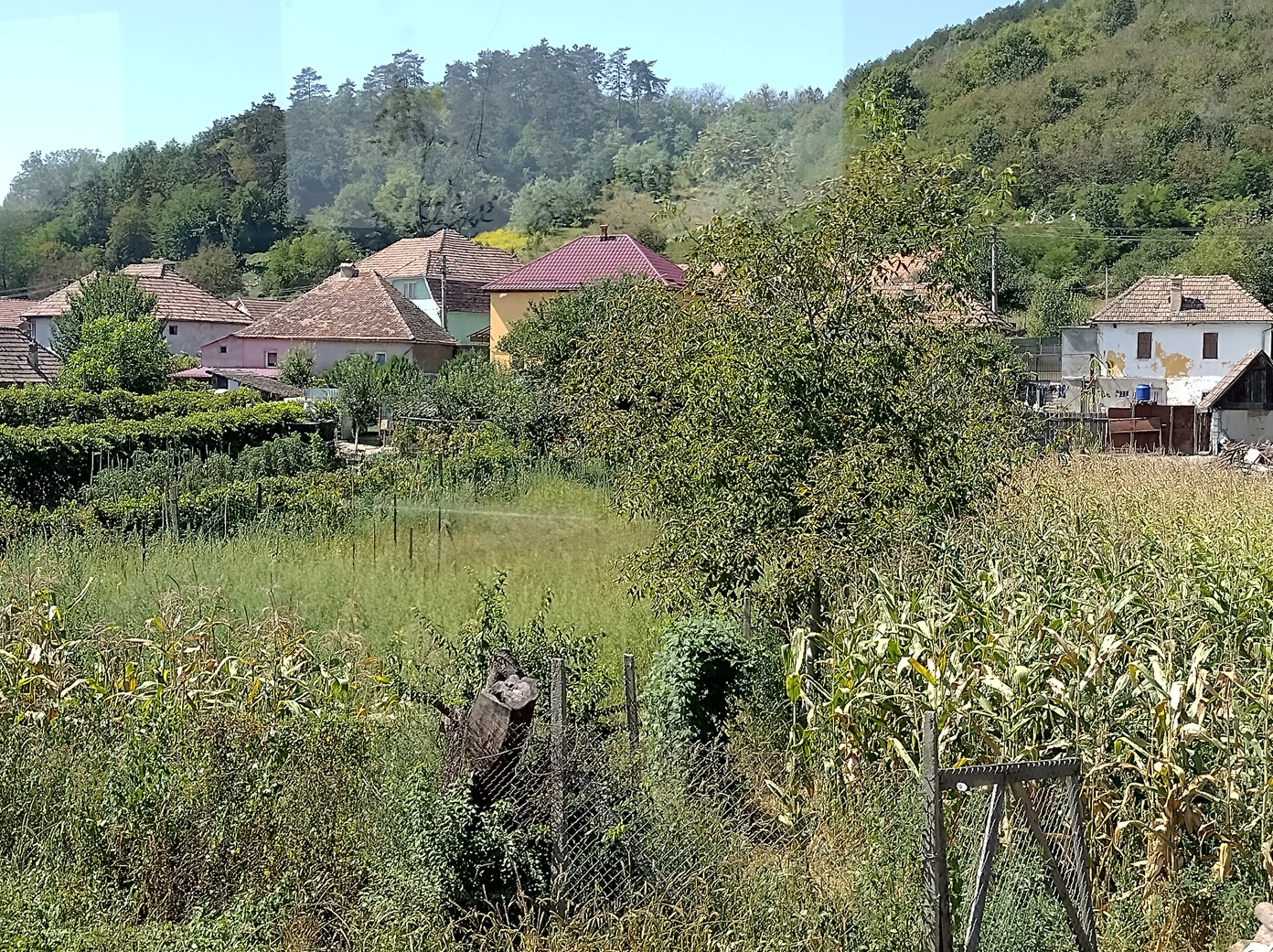
Transylvanian countryside on the way to Sighisoara, central Romania.
The recent era of suppressive, communist dictatorship, the Socialist Republic (1947-1991), can be seen in the brake applied to progress, particularly outside the major cities. Nicolae Ceaușescu, the general secretary of the Romanian Communist Party from 1965 to 1989, ruled as absolute dictator, and believed in not indebting the country. This led to Romania remaining one of the least developed of nations, even amongst the other economically-stunted Eastern Bloc nations.
The population today is about 19 million, and its density of 80 per square kilometer is relatively low. The country continues to lose its young to immigration, seeking better fortunes in the wealthier parts of the EU. The current GDP is around US 22k dollars nominal, and US 50k PPP (purchasing price parity, meaning a unit of money in Romania will buy twice what it can in the USA).
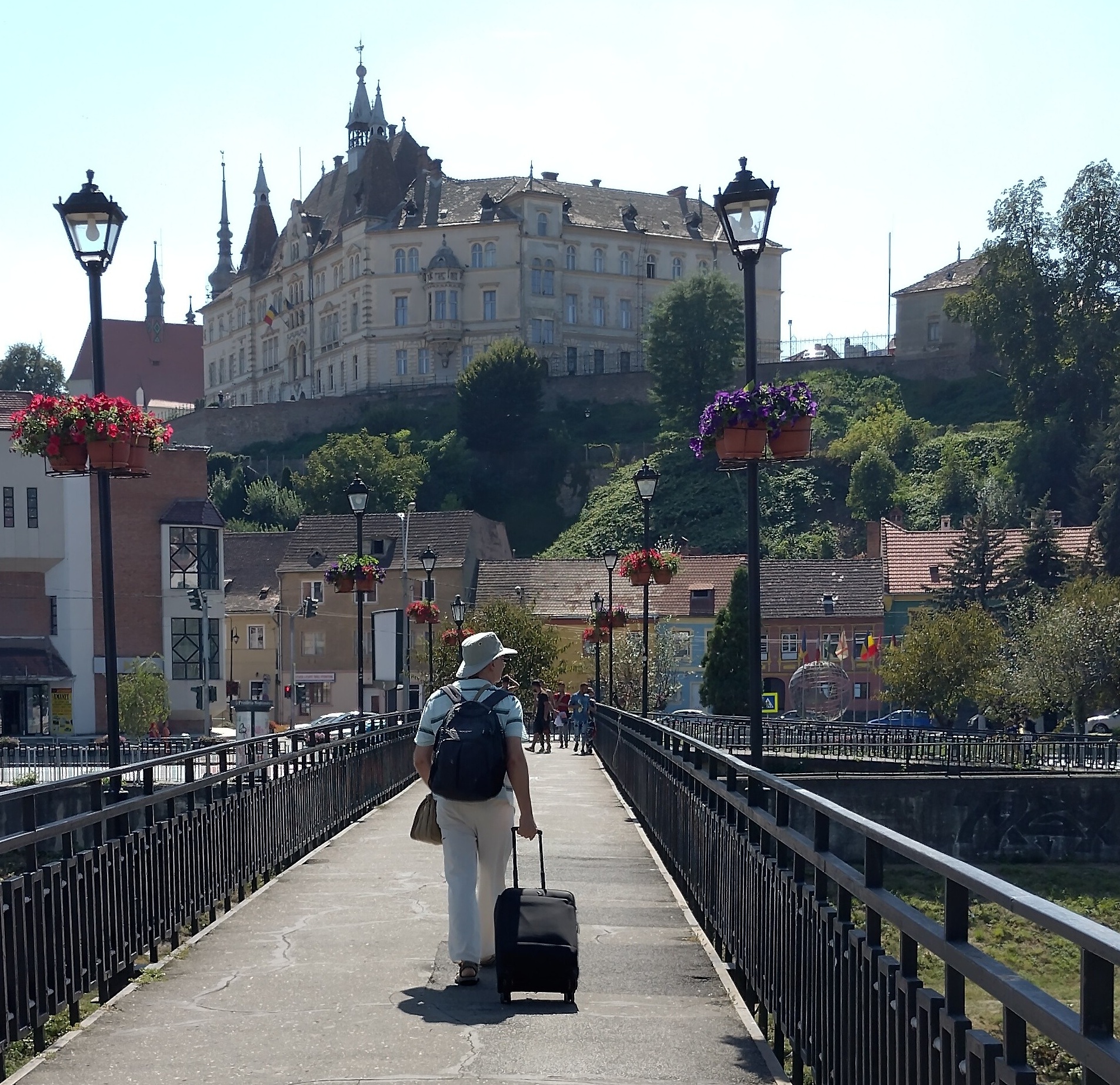
The City Hall of Sighişoara (Primăria Sighișoara), dominates the Târnava Mare River valley
Built between 1887 and 1888, this impressive building has a Baroque hall, which is a venue for the Academic Music festival and other concerts.
Sighisoara has a population of 24 thousand, and its well-preserved medieval citadel was made a UNESCO World Heritage Site in 1999, as a testament to the Transylvanian Saxon history and culture. Despite its low population, the town has a colourful history as an important strategic fortress and urban centre, attracting tradesmen and craftsmen from western Europe. There is a medieval festival in the town each July.
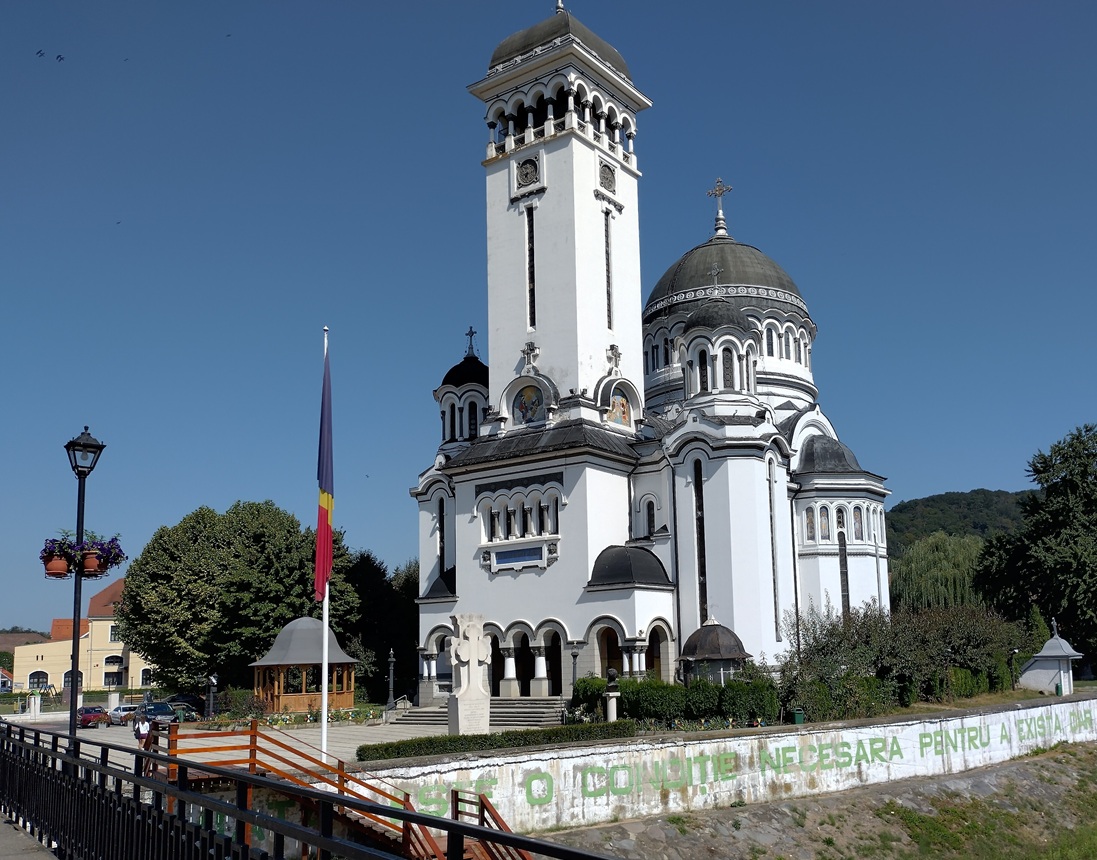
“The Holy Trinity” Church (Biserica Ortodoxă „Sfânta Treime”), Sighisoara
This Romanian Orthodox Church is located on the northern bank of the Târnava Mare River. It was built in 1934-7 in the Neo-Byzantine style.
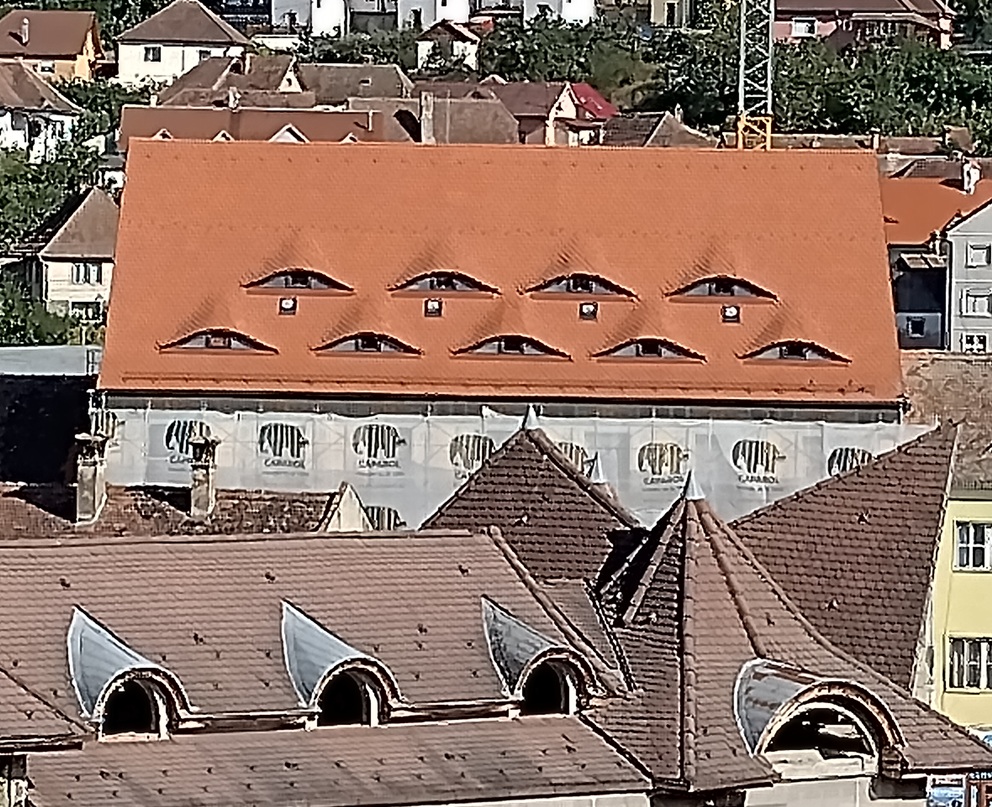
View of more Eyes, seen from the ascent to Sighisoara Citadel.
Sighisoara dates back to the 12th century, when it was founded by Saxon settlers. These came initially primarily from Luxembourg and the Niederlands, during the medieval Ostsiedlung (eastern settling), and then later from parts of Germany. These waves of immigration continued till the mid-1800s. The Saxon influence is clearly visible in the architecture, and the predominance of German on the tombstones in the Saxon cemetery, in the high town.
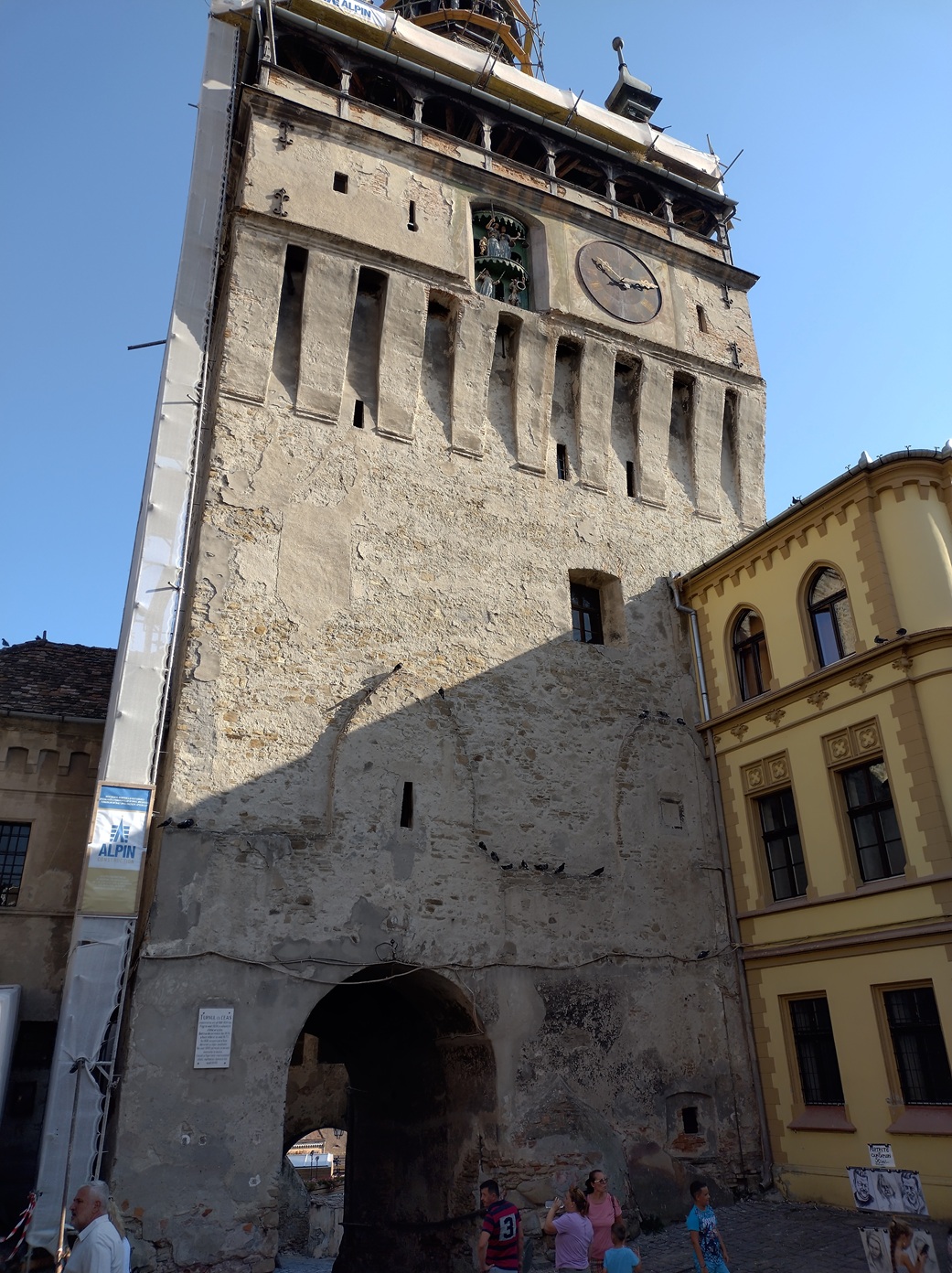
Stundturm, Turnul cu Ceas, or Clock Tower, the tallest of the entrance towers to the citadel of Sighisoara
It is an impressive 64m high, and houses a history museum. It defended the main gate of the citadel, and served as the town hall till 1656. It was constructed around the turn of the 14th century. The tower was rebuilt after a fire in 1676, introducing some Baroque features, including a clock with carved figures on a rotating platform.
The town has a 9.3m wall around it, built from the 14th to 17th centuries, as a defence against Ottoman attacks. There are 9 extant towers of the original 14, which served as premises for the various craft guilds, for which the town is famous: Rope-makers, Butchers, Furriers, Weavers, Tailors, Jewelers/Goldsmiths, Tinsmiths, Tanners, Blacksmiths, Locksmiths, Fishermen, and Shoemakers.
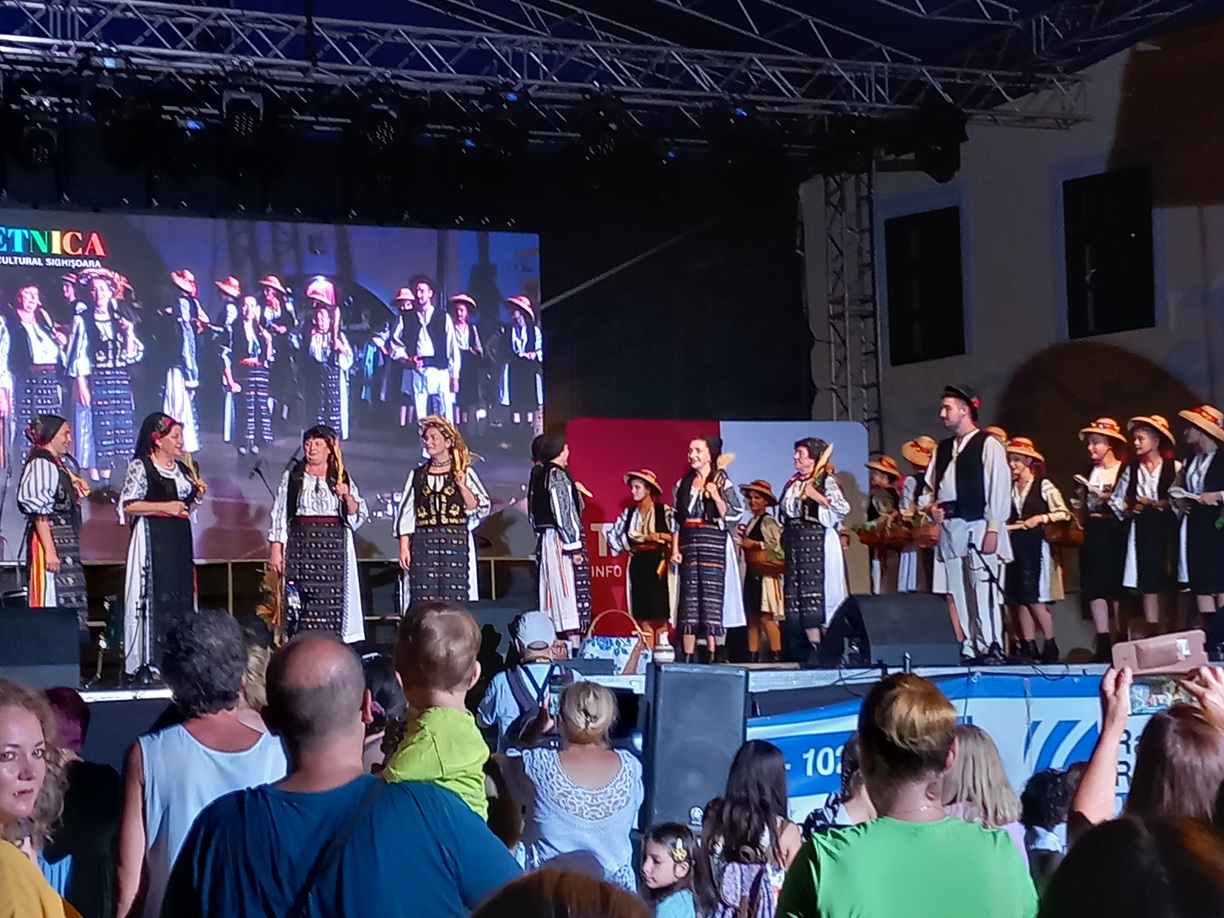
Sighisoara Folk Festival. Over the day, groups from all over Romania performed traditional songs and dances. There was a growing audience, very appreciative, and a very bonamie atmosphere. The next day we share a train compartment with a journalist who had travelled from Bucharest to report on the festival, taking a break from her usual subject of politics.
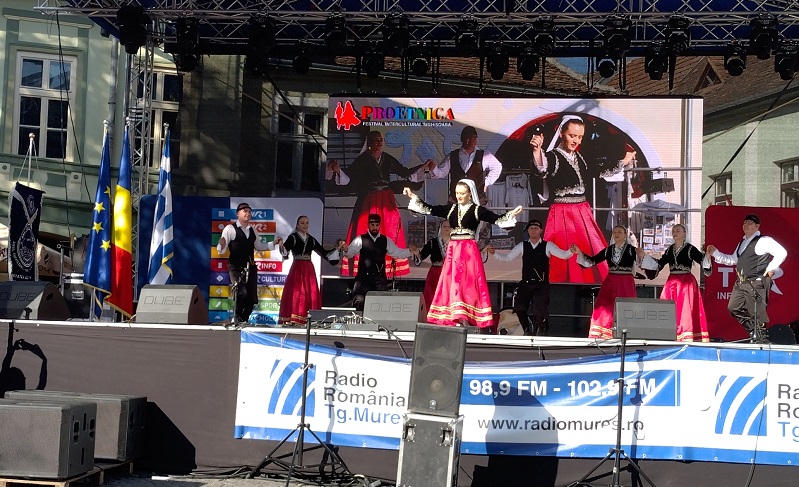
By the luckiest chance, Sighisoara was hosting an annual folk festival just as we arrived.
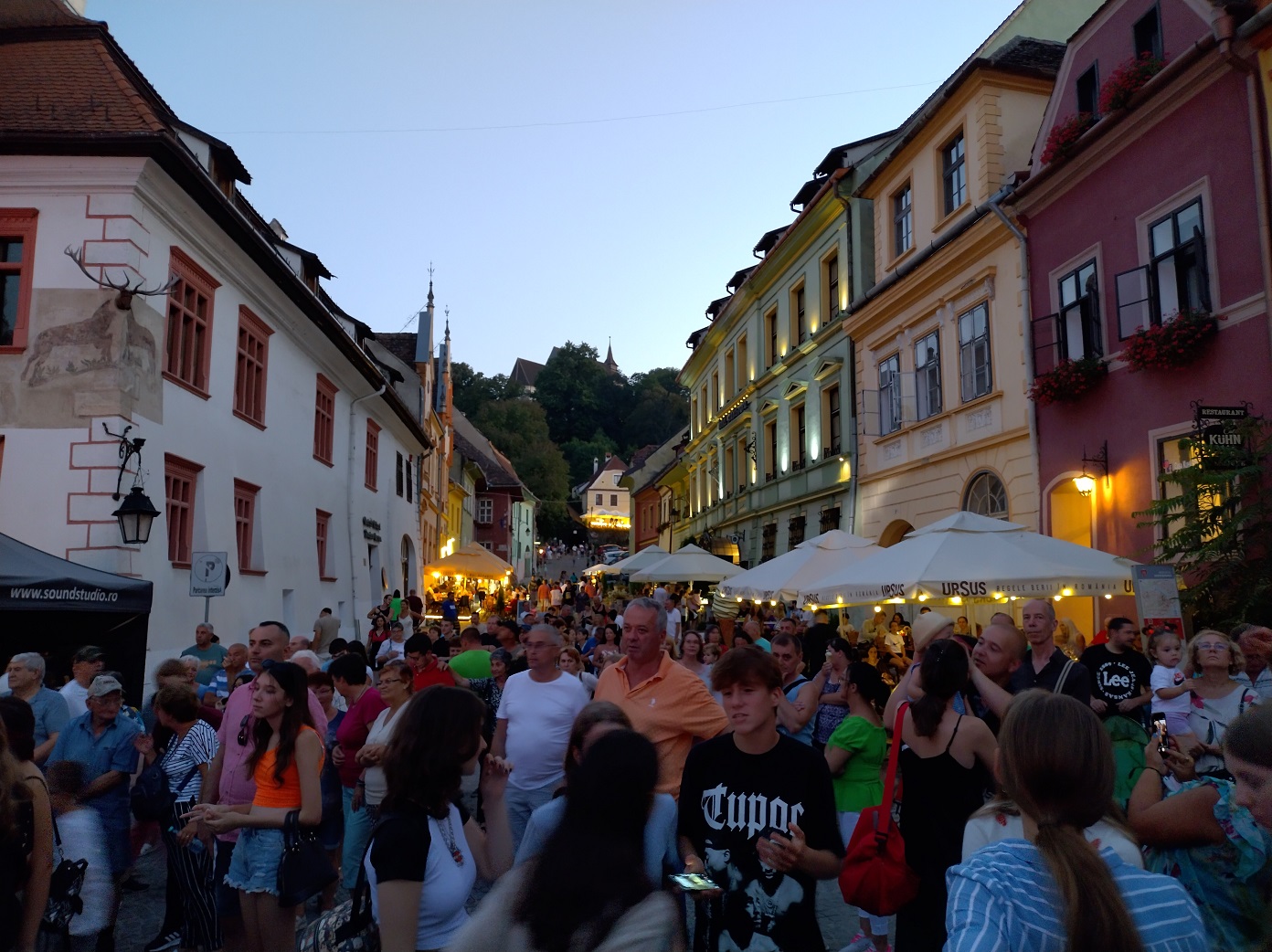
The town was crowded due to the folk festival. In the background can be seen the hill where there is the “Saxon” area, including a church, school, and a historical cemetery.
There are attempts to give the town a “Dracula” theme, because the town was the birthplace of Vlad III, Vlad Drăculea, or Vlad Țepeș (the Impaler), who the Irish author Bram Stoker identified as Count Dracula in his 1897 Gothic horror novel. Stoker did not visit Transylvania, and based his novel on library research in England. The name Dracula he made use of, on the belief that it meant “devil” in Romanian. The name actually meant “Son of the Dragon” in mediaeval Romanian. More than 30 films have been made based on the novel.
However, other than a closed “Dracula Museum”, and some vampire merchandise in souvenir shops, there was not much else supporting the thesis. More successful is the supposed “Count Dracula Castle” to the south, which also has no real relation to any vampires.
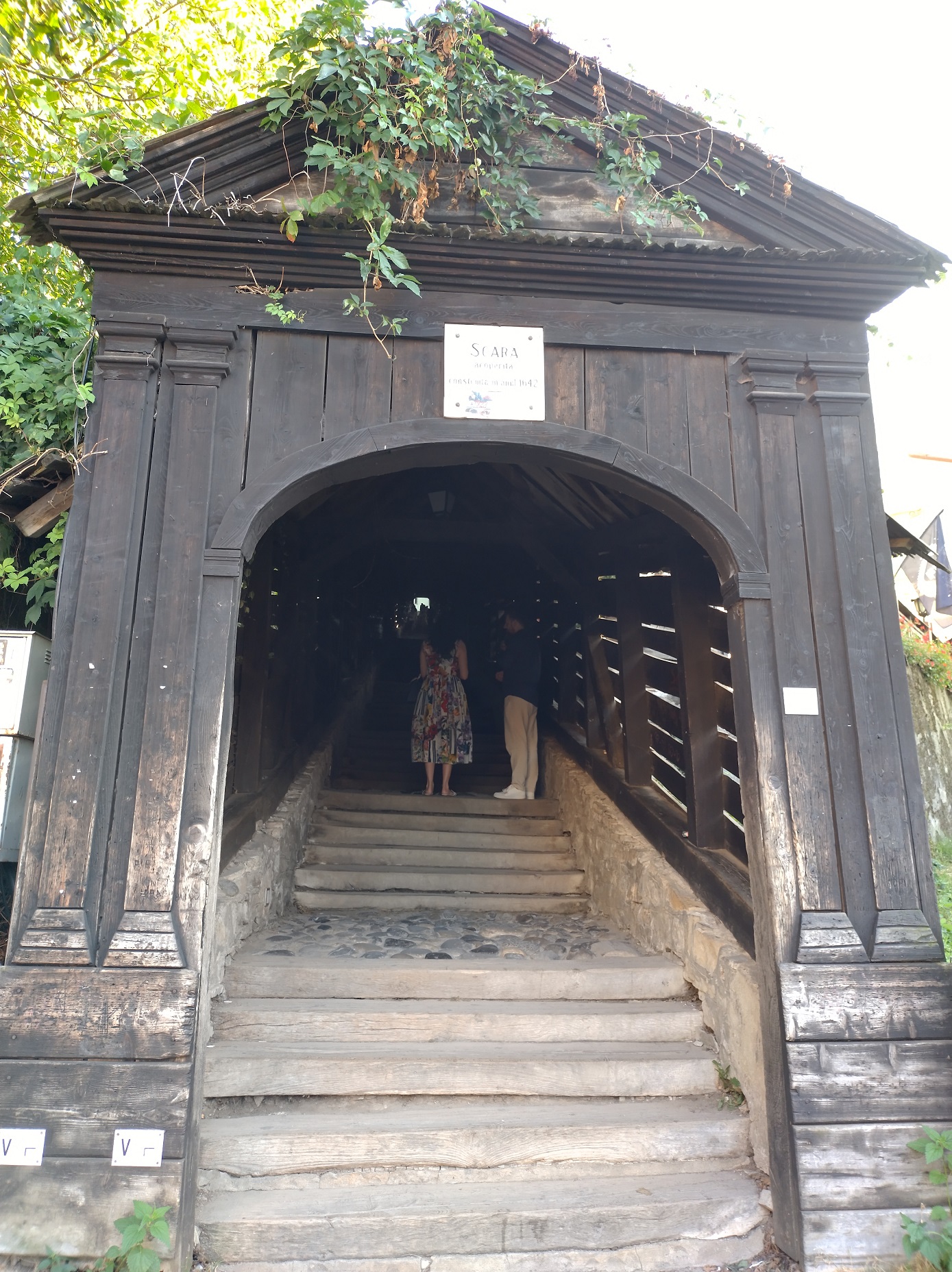
Scara Scolarilor, a rather unusual feature. This covered stairway was built in 1642, and leads up to the Saxon area above the town. There we find the Biserica din Deal (Church on the Hill), the Ropemaker´s Tower (Turnul Frânghierilor), and the Saxon Cemetery.
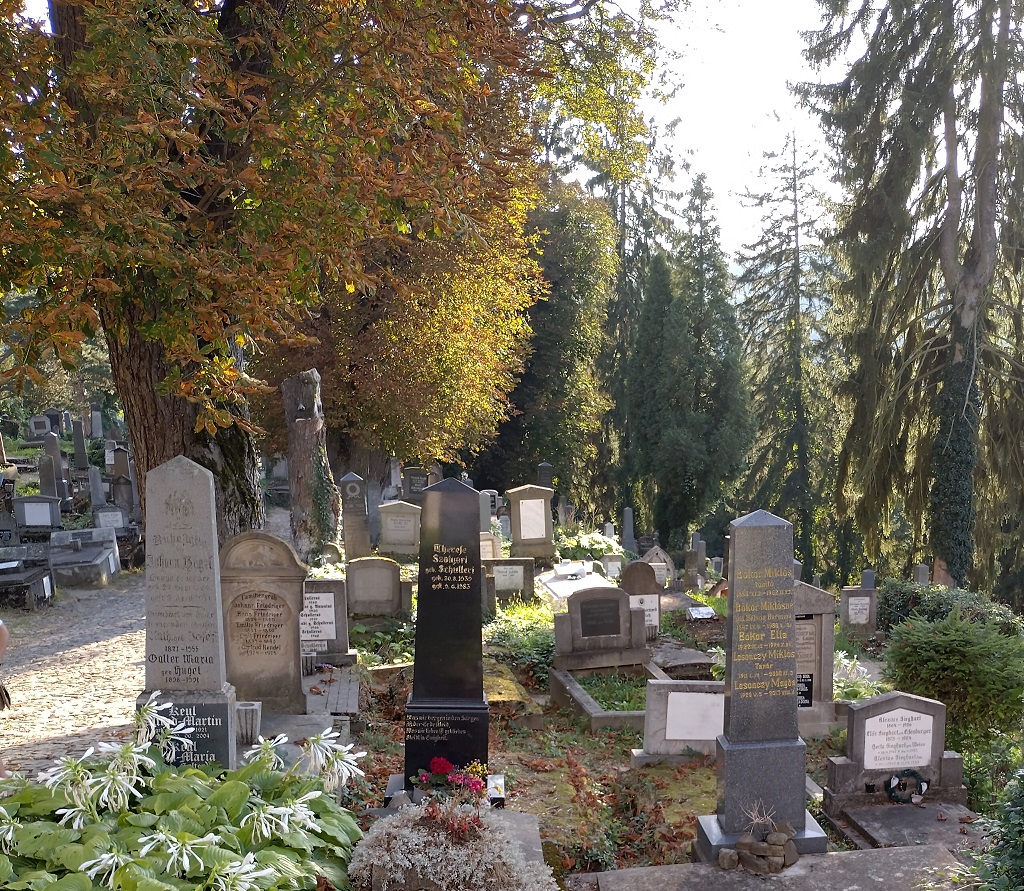
The extensive graveyard held many inscriptions in German, testimony to the Germanic history of Transylvania
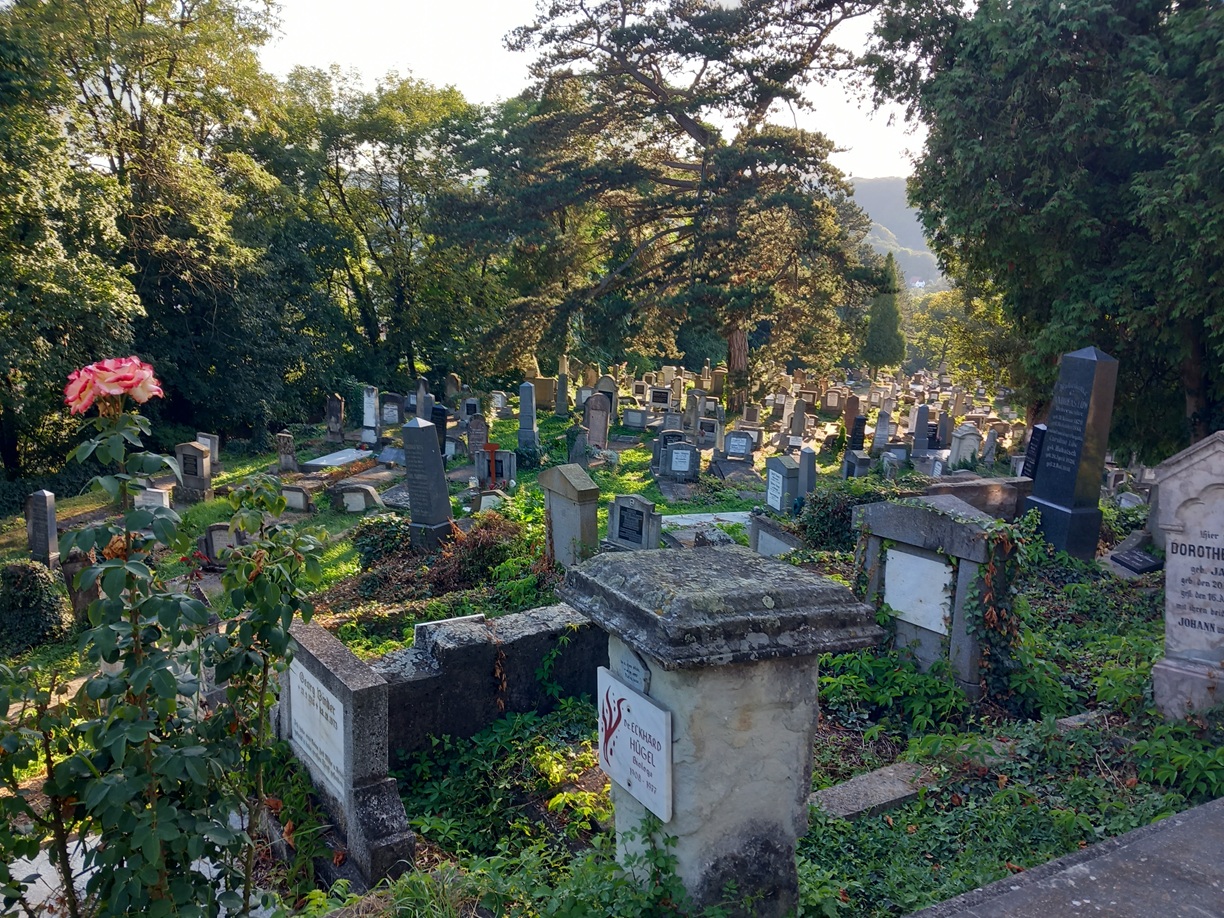
Cemetery Sibiu
Travel Diary
We slept till 7:45. After breakfast, a nice omelet was served, we decided to undecide to go to the folklore museum. We strolled up the steps and around the piatas, hogging the shade as it was already 33°C. Clear blue skies all the time in Sibiu. The museum option was foreclosed by an opening time of 12:00. So we wandered to the rear of the Orthodox Cathedrale and spent a few minutes admiring its many murals and furnishings. It gets my vote for most interesting and tasteful of the 3 cathedrals we visited. There were also a synagog and a 7th Day Adventist church to visit.. A real mix of religions here. Nothing Islamic was seen at all, except maybe the borrowed architectural feature of the onion spire on the Catholic church.
Cindy needed a mint lemonade fix, so we headed back to the hotel, only to find the restaurant was closed. We collected our bags and found another cafè for smoothies, mint lemonade and postcard writing, before walking to the station along a busy road.
The train was comfortable enough but very very slow, and a pleasantly mannered middle-aged man was sitting across from us, friendly but spoke no English. He tried to communicate about poverty, and maybe corruption in Romania. We saw crops for beer (beer-hops) on empty stakes, reminiscent of Vlad the Impaler, and one shop for natural spring water for treating skin problems. One elderly man was wearing a folk costume-decorated, white shirt, wide-brimmed black hat and breeches. We passed a large solar farm. So far no wind energy. Open, hill farmland with the occasional dam. Some cattle, otherwise, sunflowers and corn in the very dry conditions. Brown grass hilltops, neat townships with semi-modern houses, looking a little rundown from the train, often with solar panels. No solar powered lights at level crossings. Quite a few fields look fallow. Christian church spires rose from neat rows of houses. There was an American family sitting next to us enjoying a sack lunch. We didn’t engage in conversation until we met them later in Sighisoara.
The train station seemed to be a km or so from the center of this smallish seeming town. We had a 750m walk down a pleasant road to the river. Passing an Orthodox church we took a footbridge to the south side, where the fortress town of Sighisoara paraded high above us, pointing itself out with towers and buildings shouldering the edge of a precipice. Our pension was at the start of one of the footpaths leading up to the citadel and we could hear talkative passersby right outside our window even up to midnight. After having a rest we headed on up too, meeting the American family from the train. They were from Nevada City, California and they are on a two year journey around the world having already been to South America, since January, and were heading towards Egypt. The parents are both teachers of American History, English, Science and photography. And their little boys, 11 and 8 years old, both friendly and talkative, study online. They went to a special school which included a home schooling option. One of the kids was very keen on chemistry, and wanted to make a safer nitro-glycerine…
Up on the Citadel of Sighisoara we strolled around appreciating the tourist crowds gathered for a folk festival (Proethnic) of Romanian dancing and singing groups from the area. The stage was set up in the main square. We walked past the tourist trapping souvenir shops and restaurants, trying to milk the Dracula image, after all Vlad the Impaler came from here. We ascended to the upper cemeteries, church and German school through the 176 covered stairs. The upper cemetery had stones with German inscriptions attesting to its 19th century (and earlier) linguistic dominance. Transylvania was Hungarian until it became part of ’Greater Romania’ at the end of WWI when many Germans settled here. We dined in a small restaurant opposite from Melas’ house, the Melas who commanded the Austrians at Merengo in 1800. He grew up here! Cindy had pork steak with mashed celery root and I had a ’Buddha Bowl’ of green beans, rice and vegies, to bolster the flagging vitamin count. Seated next to us were a retired nurse and her doctor husband from Ohio who have hired a car and driver for a 9 day tour to see ’all of Romania.’ They intend to visit Oz in December 2024. Cindy was sorry she didn’t exchange contact points with the nurse. Missed opportunity. Such is traveling…
Vlad the Impaler
Vlad Țepeș (1428/31 – 1476/77) was Voivode (ruling prince) of Wallachia three times between 1448 and his death in 1476/77. The second son of Vlad Dracul, ruler of Wallachia from 1436 till 1447, he was held as hostage in the Ottoman Empire in 1442, to ensure his father´s loyalty. However, Vlad´s father and elder brother were killed by the invading Hungarians in 1447. Vlad led counter invasions of Wallachia, first on the side of the Ottomans, then on the Hungarians´. He attacked Transylvania, defeating the Saxons there, and impaling the captives, earning him his epithet, the Impaler.This nasty form of execution became a habit, and he impaled the Ottoman Sultan´s envoys. He massacred tens of thousands of Turks and Muslim Bulgarians in 1462, attempted to capture the Sultan, and fled to Transylvania, where the King of Hungary, Matthias Corvinus, had him imprisoned from 1463-1475. Released in 1475, he fought for Corvinus against the Ottomans in Bosnia, before he himself being killed in battle in 1477.
His sobriquet was inherited from his father, Vlad Dracul (Vlad the Dragon, in medieval Romanian), who was a member of the Order of the Dragon. Dracula is the Slavonic genitive form, meaning son of Dracul.