Romania-Bulgaria 2023
Day 6: Tuesday 29 August 2023
Bucharest, Romania – Ruse, Bulgaria
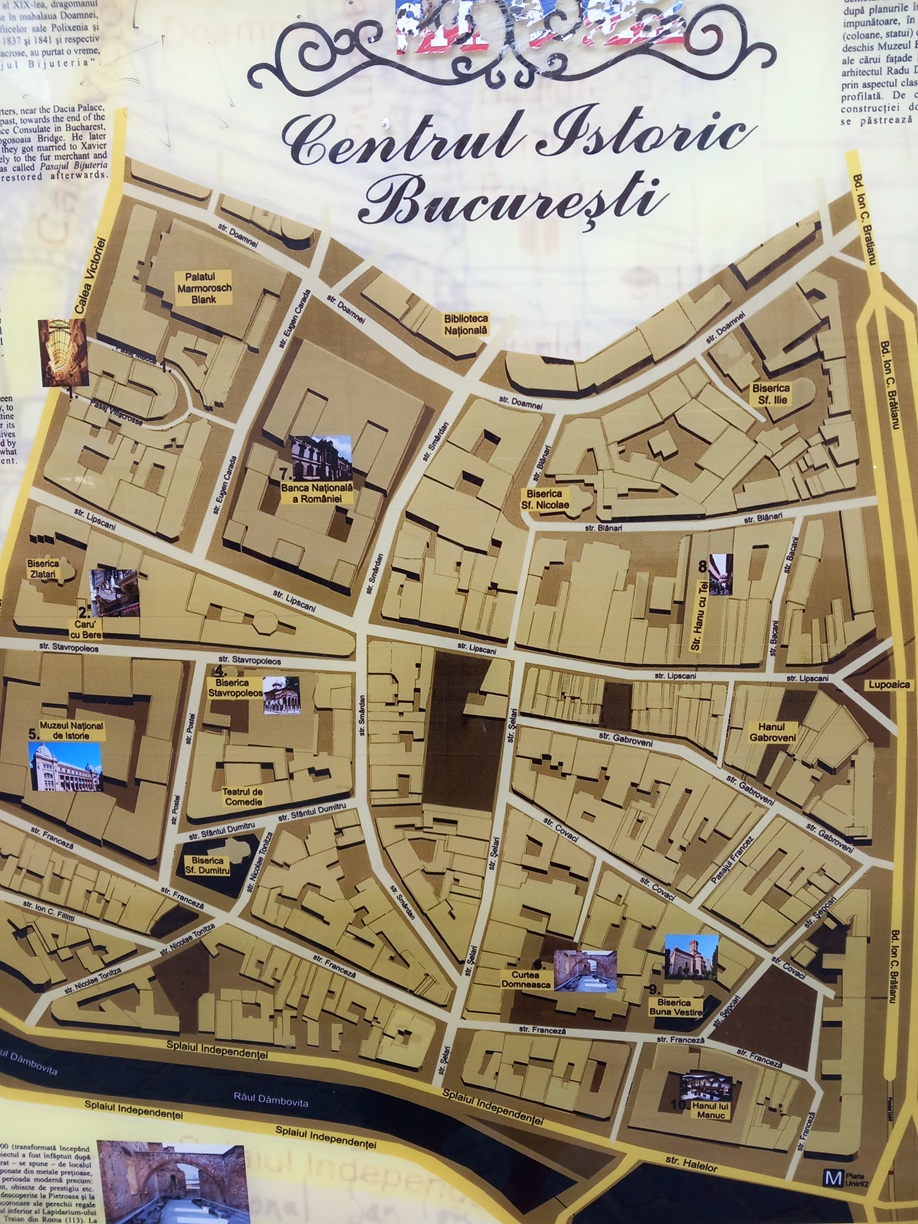
Map of what little remains of Old Bucharest
Reminiscent of Napoleon III´s restructuring of Paris in the 1850s, Bucharest underwent a tragic transformation, known as systematization, under the communists in the 1970s-80s.Ceaușescu´s goal was to turn Romania into a “multilaterally developed socialist society”, inspired by North Korea´s Juche ideology, which the communist president had witnessed in person in 1971.
The ideology of Juche arose as an independent development of the historical materialist ideas of Marxism–Leninism, on the theory that a country will prosper through self-reliance in the political, economic, and militaristic sense. An essential tenet of Juche is loyalty to the leader, incorporated in the Ten Principles for the Establishment of a Monolithic Ideological System The concept has characteristics not dissimilar to quasi-religion, nationalism, and fascism.
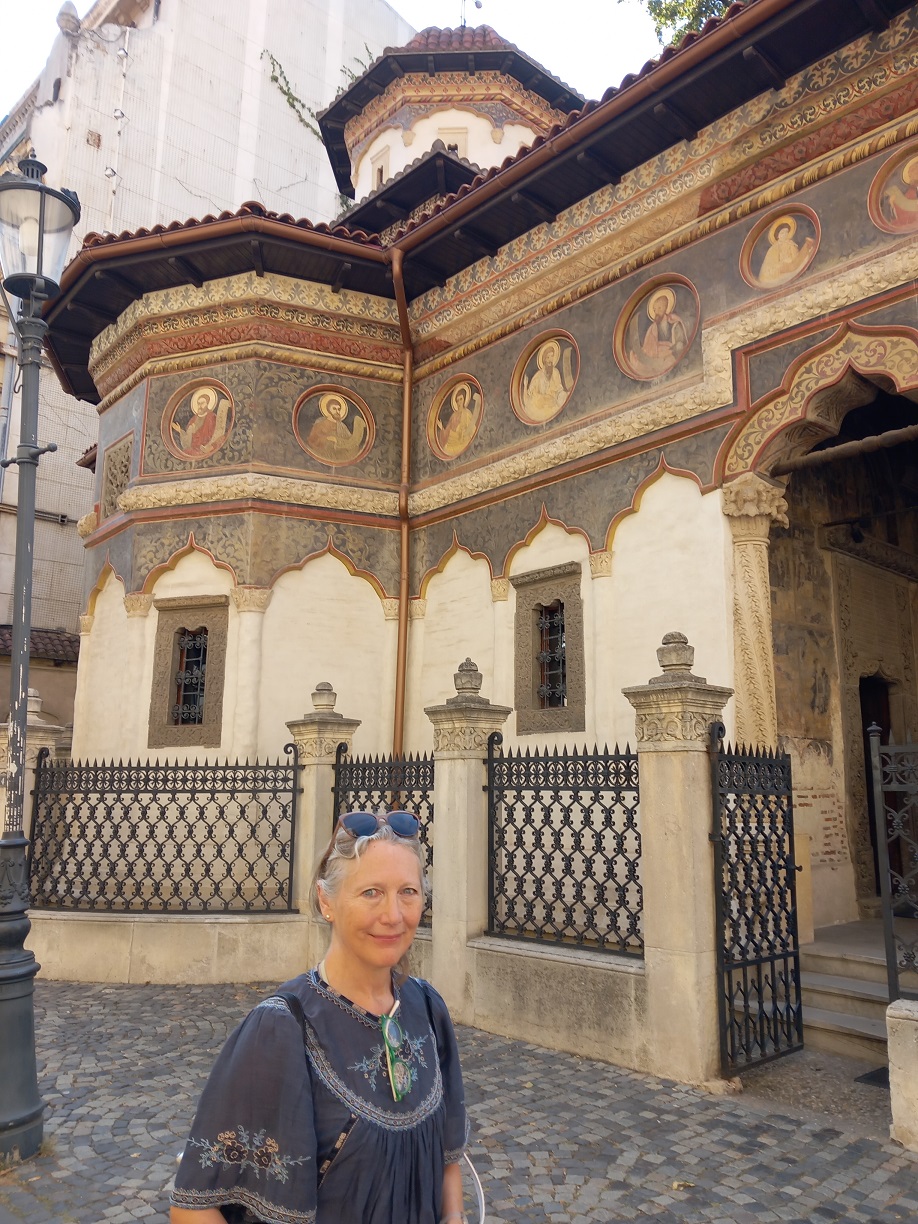
Stavropoleos Monastery (Mănăstirea Stavropoleos / Biserica Stavropoleos), 1719-1730.
This monastery for nuns from the 19th century is one of the rare examples of Bucharest Easter Orthodox architecture to survive the terrible eradication of historical culture during the communist years. The church and monastery is built in the evocative Brâncovenesc style, named after Constantin Brâncoveanu (1654-1714), Prince of Wallachia 1688-1714, also known as Wallachian Renaissance or the Romanian Renaissance.
The word Stavropoleos derives from Greek for “The city of the Cross”. The monastery is known for its collection of Byzantine music books, and its choir. Music was heard from speakers as we visited. The church has experienced collapses, including the dome falling, as the result of earthquakes. The paintings were restored at the turn of the 20th century. Only the church remains, the monastery having been victim to the communist systemisation programme.
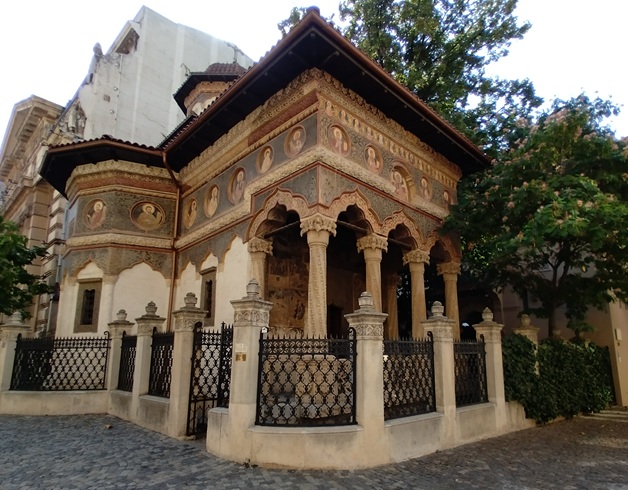
Stavropoleos Monastery, Home of the Stavropoleos Byzantine Choir
The church music sung during services is neo-Byzantine, based on the works of 19th century Romanian psalmodists, among whom Macarie the Hieromonk, Nectarie the Hermit, Anton Pann, Dimitrie Suceveanu, and Greek chants translated into Romanian.
Founded in 1994, the Stavropoleos Byzantine Choir chants at the Stavropoleos Church and teaches Byzantine music at the National University of Music Bucharest. The group has performed in Romania and abroad.
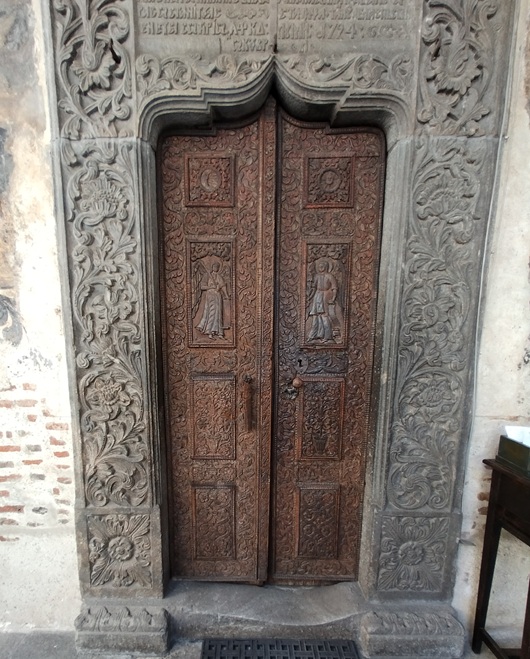
Old door, Bucharest
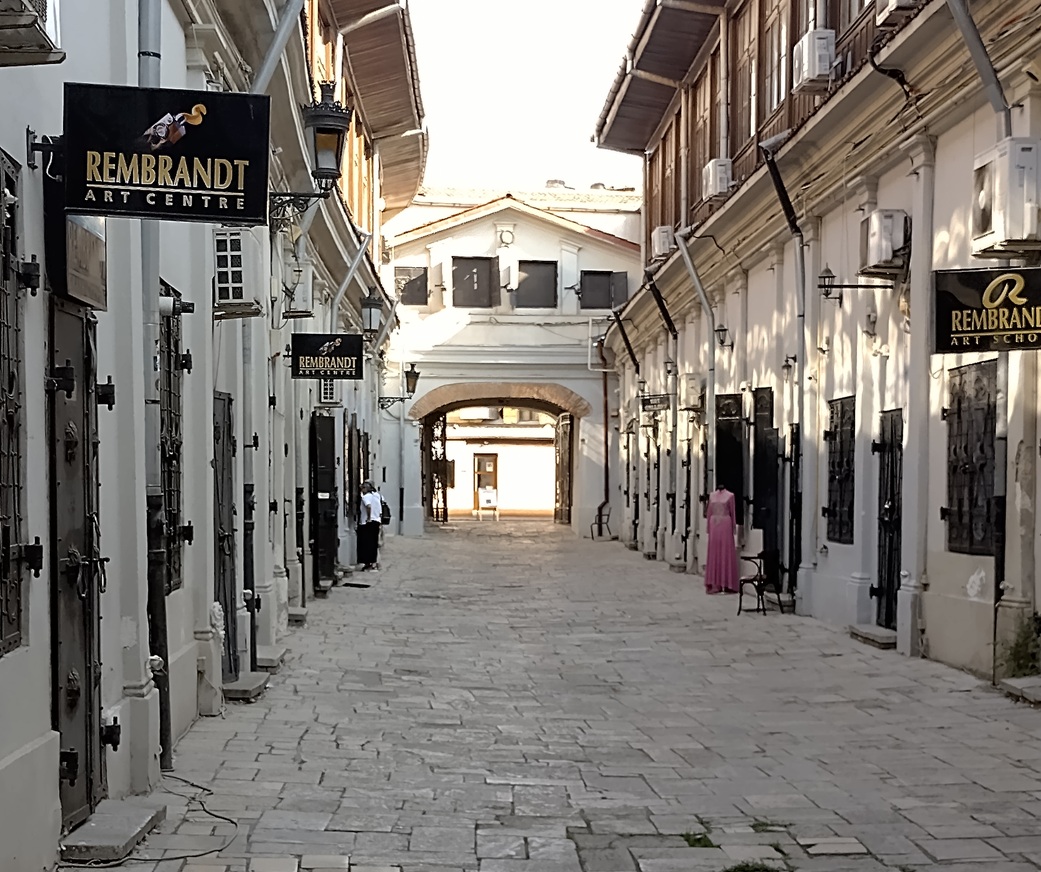
Shopping and artisan street in Bucharest
Between 1950 and 1975, Romania´s economic growth was one of the fastest-growing in the world. Ceaușescu came to power in 1965, and was initially quite successful in gaining the support of the people, by increasing wages, reforming the pension system, and decreasing consumer prices. By the late 1970s, growth was being achieved by 34.1 % of GDP in heavy industry, and production exceeded demand. Inefficiencies and accumulating inventories of unsellable production were covered up by falsification of statistics. There was an inflexibility in the economy, with 87% of industrial workers employed by large companies of more than 1,000 workers.
This situation of where a country is worse off because of its growth is called immiserizing growth, a theory proposed by Jagdish Bhagwati, in 1958. Over-production results in the fall in the terms of trade (exports are sold too cheaply), which in turn affects world prices.
Romania became indebted to Western creditors, who were willing to fund Romania´s acquisition of technology. By 1981, Romania became reliant on support from the IMF (International Monetary Fund), a “lender of last resort to national governments”. Ceaușescu imposed a severe austerity programme in order to repay the debt. Other countries in a similar situation took a more moderate approach, rescheduling debts, known as “haircuts”.
The draconian measures included increasing exports while decreasing imports (the net foreign balance was 9.5% by 1989), resulting in food shortages and material and energy shortages for industry. Economic stagnation resulted, leading to a full-blown crisis by the end of the 1980s. The industrial capacity fell as equipment became obsolete, energy demand increased, and the standard of living fell. The solution to the problem of insufficient energy for industry was to restrict severely energy available for domestic purposes.
AIDS spread rapidly as needles were re-used in hospitals due to shortages. The government imposed calorie restrictions on the population, as food production fell due to sector neglect and manpower shortages.
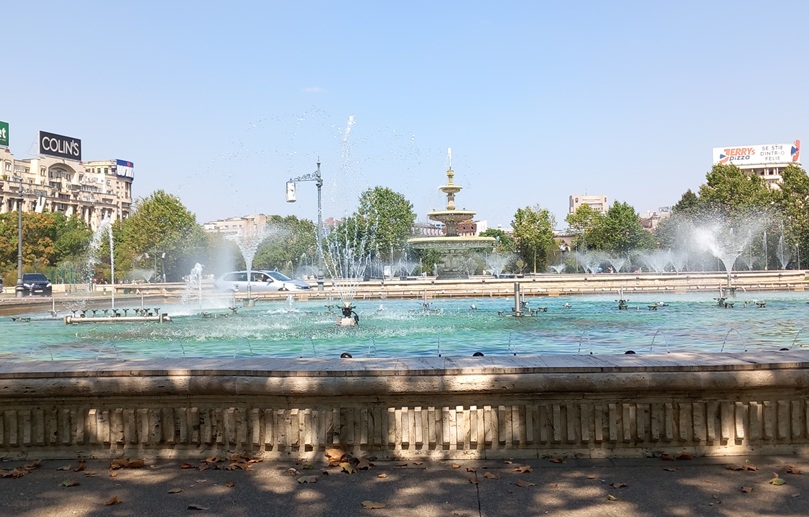
Fountain Bucharest

Palace of the Parliament (Palatul Parlamentului), or (post-1989) People´s House (Casa Poporului), Bucharest
Built on a hill called Dealul Spirii, after a doctor named Spiridon “Spirea” Kristofi, who built a fortified church in 1765, Spirea Veche. In 1984, the dictator president of Communist Romania, Nicolae Ceaușescu (1918-1989) demolished the church to build the House of the People. In this era, a large number of old heritage buildings were demolished in the cause of modernisation.
The hill was also the location of the 1776 Curtea Nouă (‘the New Court’), the residence for Alexander Ypsilantis, Prince of Wallachia. The final battle of the 1848 Wallachian Revolution was fought on the hill, between the Romanian rebels and troops of the Ottoman Empire. A mass grave was discovered, revealing people who died during the Black Death of the 1340s.
Ceaușescu´s Folly
With a floor space of 365,000 square metres, a height of 84m, and a volume of two and a half million cubic metres, the building is the third largest administrative building in the world. It is possibly the heaviest building in the world: in total, about 4 million tonnes, of which 700,000 tonnes of steel and bronze, a million cubic metres of marble, 3,500 tonnes of crystal glass, and 900,000 cubic metres of wood. [Guinness Book of Records]The modernist Neoclassical building was commenced in 1984, and had not been completed at the time of the 1989 revolution, in which its instigator was killed. 700 architects worked on the project, over 13 years, from 1984 till 1997. It houses both houses of government, three museums, including the Museum of Communist Totalitarianism, and a conference centre. About 70% of the building remains unused.
The building has an estimated value of 4 billion euro, making it the most expensive administration building every built anywhere. Heating and electricity bills hit the Romanian taxpayers for more than 5 million euros every year.

Menu, Bucharest
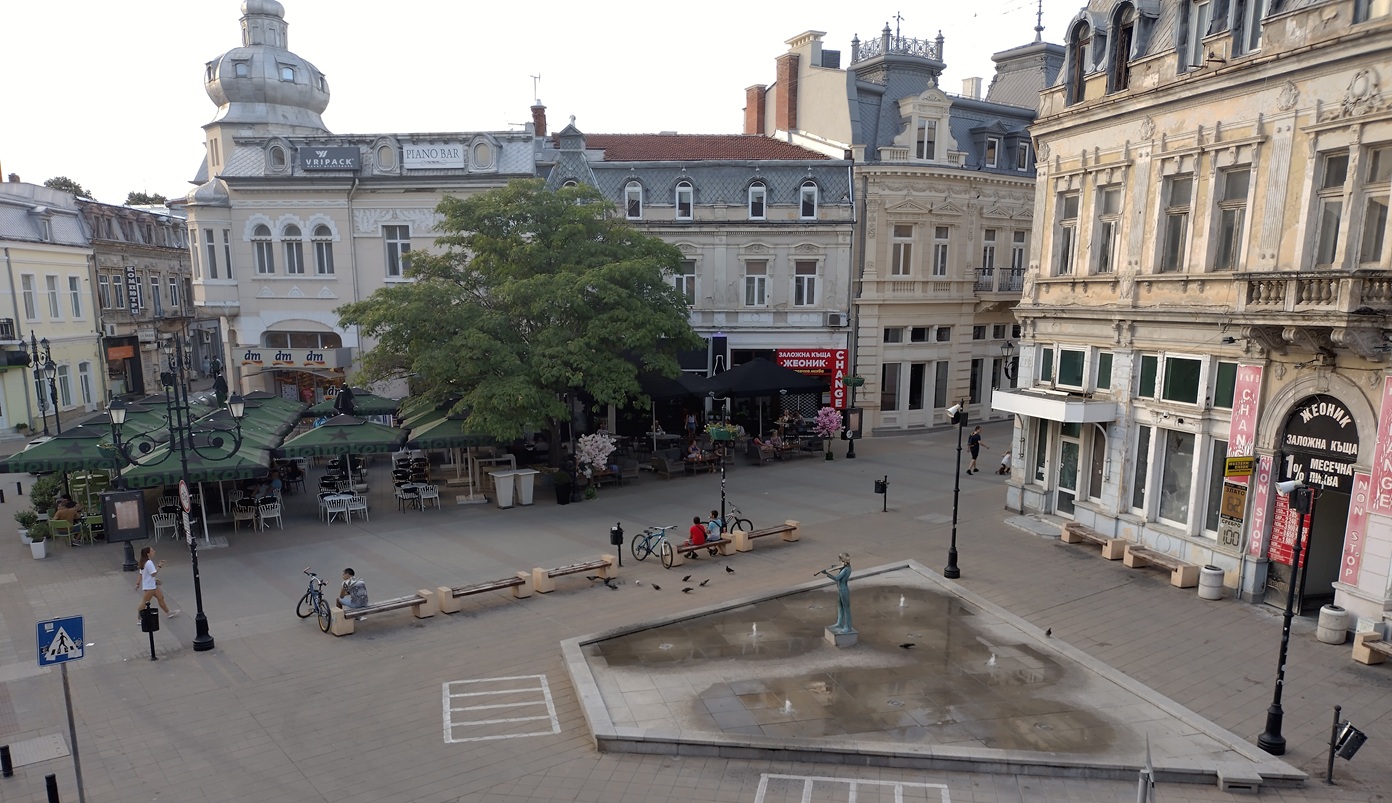
View from our hotel, Ruse, Bulgaria
Travel Diary
Another very hot day, 36°C. We walked the old town, deposited our bags for 50 Leu (€10) at a student travel cafè, then found 2 old Orthodox churches, which may have been among those moved when Bucharest was communised. An interesting mix of grandiose and derelict buildings, we found the Bulevardul Unirili which leads from the grand Parcul Unvii and its myriad fountains to the austentatious Piata Constiturei, or which is the enormous Palatul Parlamentului, Ceausescu’s enourmous pretentious statement of ego and contempt. There are well-to-do apartments (for the faithful no doubt) in multistory blocks along the Bulevardent, which has a shady avenue for pedestrians and a roaring central 4-lane street. The ediface of the parlament building is moated by terraces, and a low wall, ensuring no encroachment by the peasants. Far too large and uninviting to attempt to walk around, we retraced our steps to the park and relaxed in the shade while old guys with security shirts patroled boredly looking for troublemakers.
After some trepidation we were relieved to be picked up by the Pegasus mini-bus sevice to Ruse from the now closed Horoscope Hotel. The young driver is taciturn and efficient. We even left early (16:06 instead of 16:15) and were in Ruse by 17:30. The road, a 2 laned motorway, was lined on one side by hundreds of semi-trailers, parked before the border. Wonder how long they had to wait to cross? The coat-hanger steel girder bridge took us over the wide Danube past docks and myriad cranes and conveyor belts between the docks and railway lines. Our passports were taken by the border guard and stamped while we waited on the bus. From the bus depot in Ruse we took a taxi for 10BGN (€5) to our wonderful Hotel Adeo in the centre. Some kind of mix of Soviet/modern architecture, with evidence of some new investment.
Dinner was had at a traditional Bulgarian restaurant recommended by our very friendly and well spoken hotel receptionist. We had chopped eggplant and tomatoes with roasted peppers, cabbage leaf dolmas made of rice, herbs, minced meat. Cindy had the goose liver on broiled orange slices and currant sauce and a big hunk of fresh bread. I had the Landowner’s style lamb with rice, herbs and liver. To drink: a salted yogurt drink called ayrian and wine. Our waitress was a cute, willowy young woman who had studied American English but went to the UK to work and could not understand English English. hahaha
After dinner we strolled back up the pedestrian zone to a large park with a victory monument. A row of regal buildings projected umbrella-shielded boulevard restaurants. The whole place was buzzing with people: couples, girls groups and guy gangs strutting their stuff, young and not so young on electric trottinettes and bikes. We enjoyed the cooling air by the fountain.