Romania-Bulgaria 2023
Day 9: Friday 01 September 2023
Veliko Tarnovo, Bulgaria – Sofia, Bulgaria
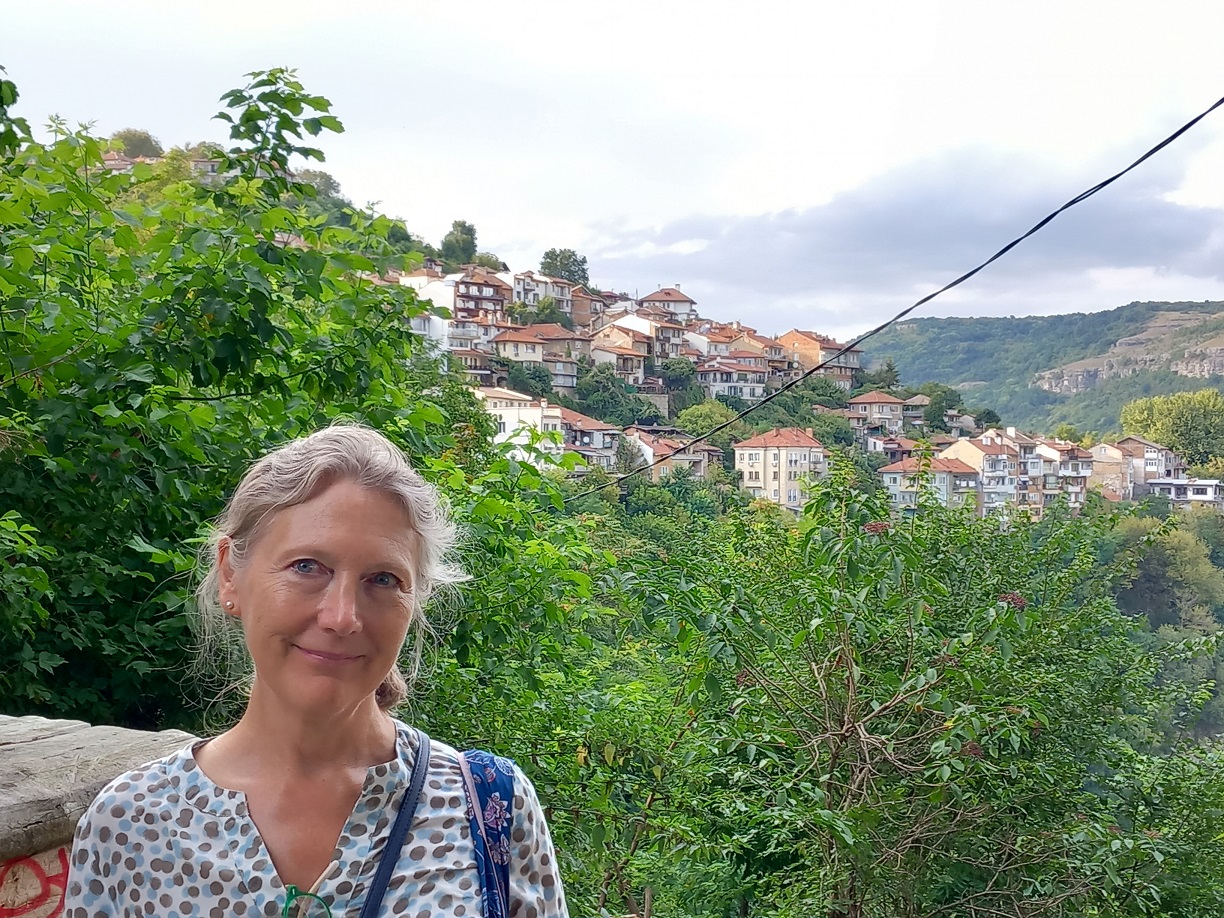
Cindy enjoying a view of the hillside town, Veliko Tarnovo. The River Yantra winds its way around the valley below, creating an arc of the older part of the town, providing natural viewpoints like this one. There are also many caves in the limestone hills, which date back to the Jurassic (201-143 Mya (million years ago)) and Cretaceous (145-66 Mya) periods.
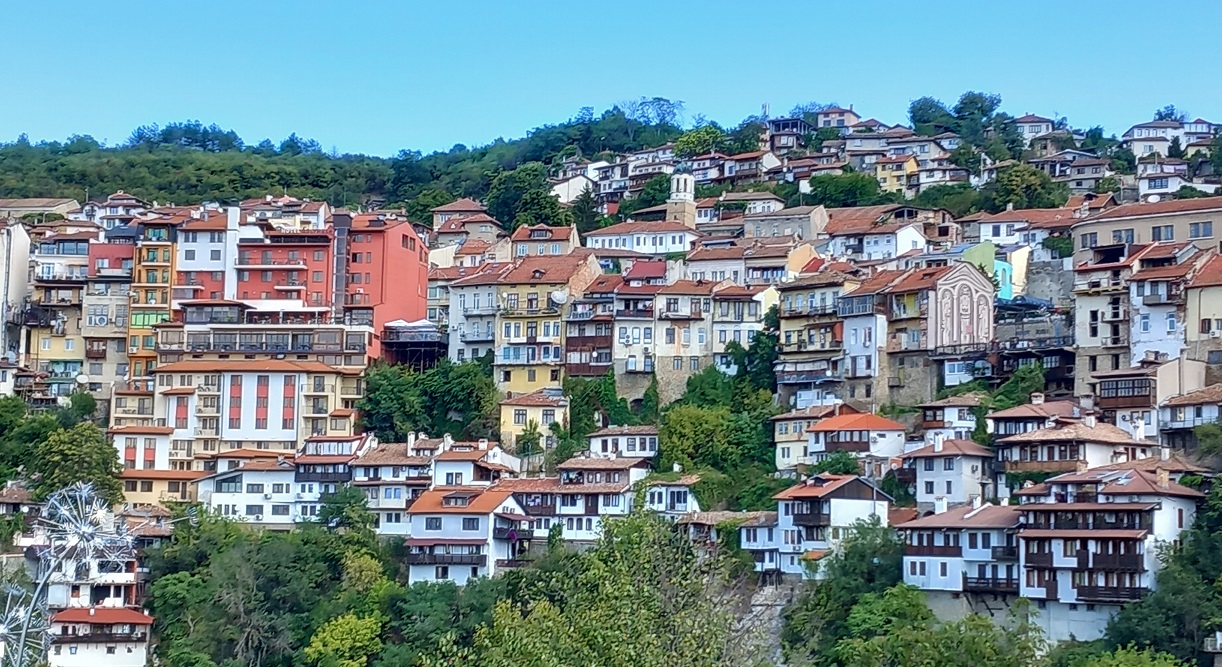
The hillside town of Veliko Tarnovo. The highest point is 241m above sea level. It is one of the oldest settlements in Bulgaria, and the first traces of human presence date back to the 3rd millennium BC, on Trapezitsa Hill.
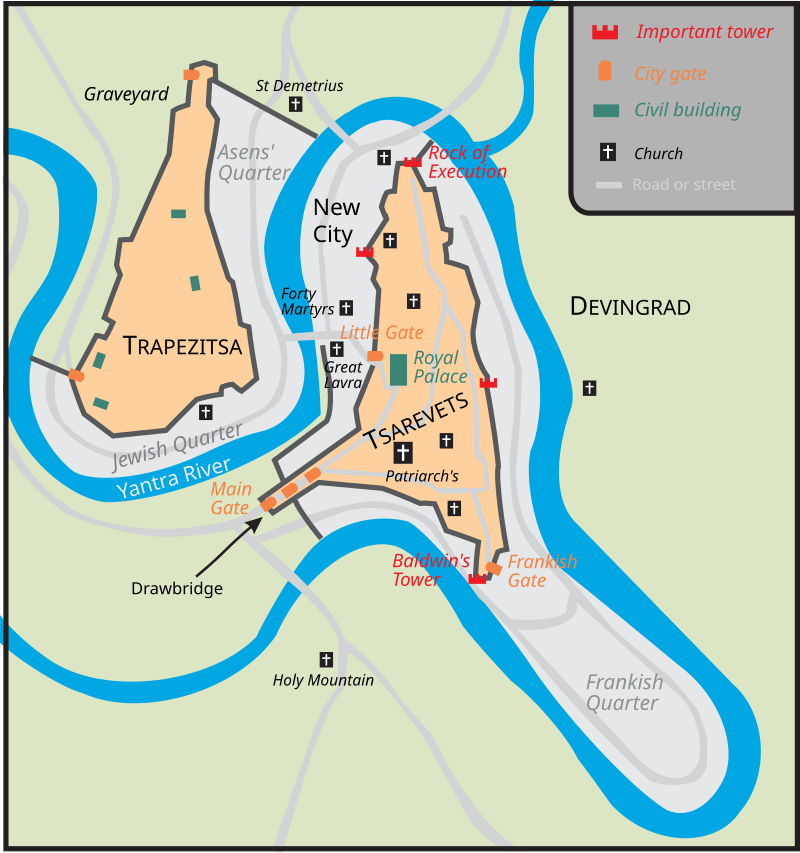
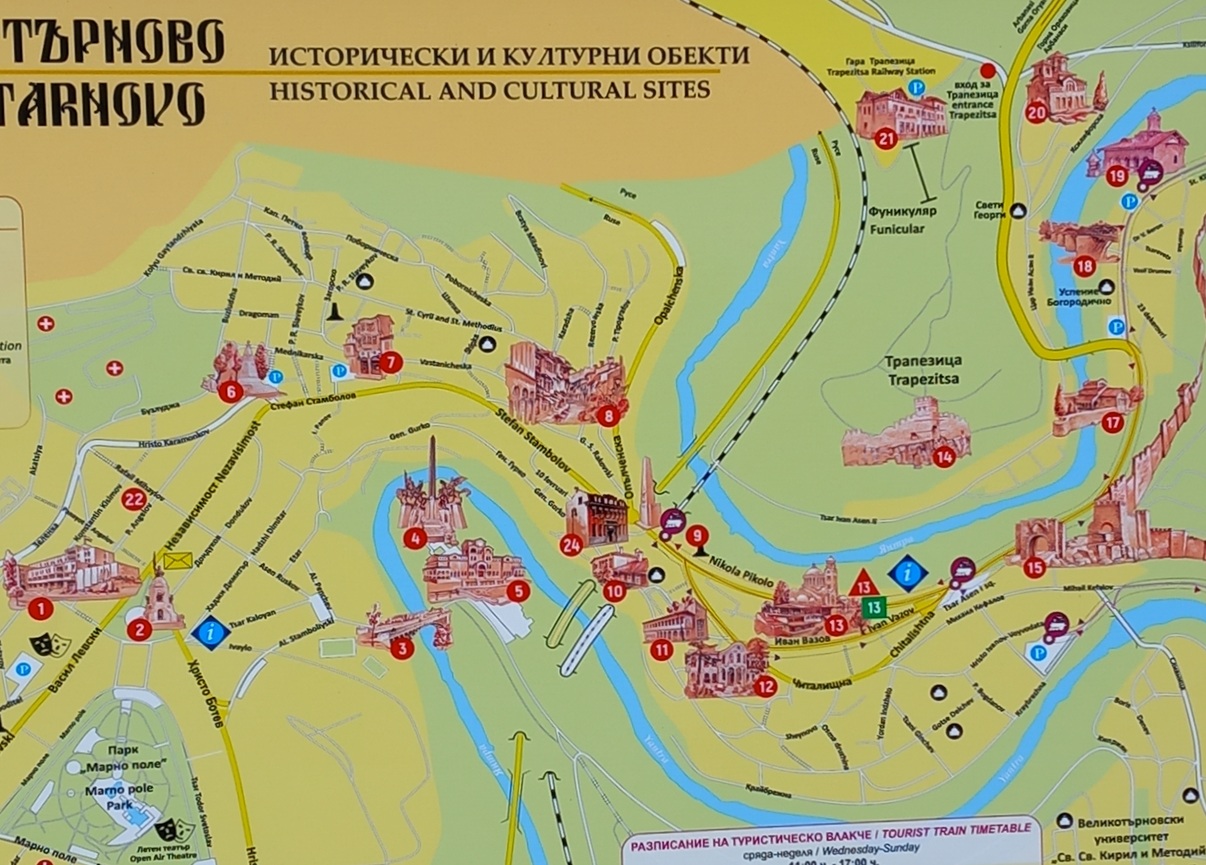
Tourist map of Teliko Tarnovo, showing the ancient hill of Trapezitsa (14), the peninsula with the monument to the Asen Dynasty (4) and Art Gallery (5), and to the right the medieval defensive wall (15). The Monument to Mother Bulgaria is on the left (2).
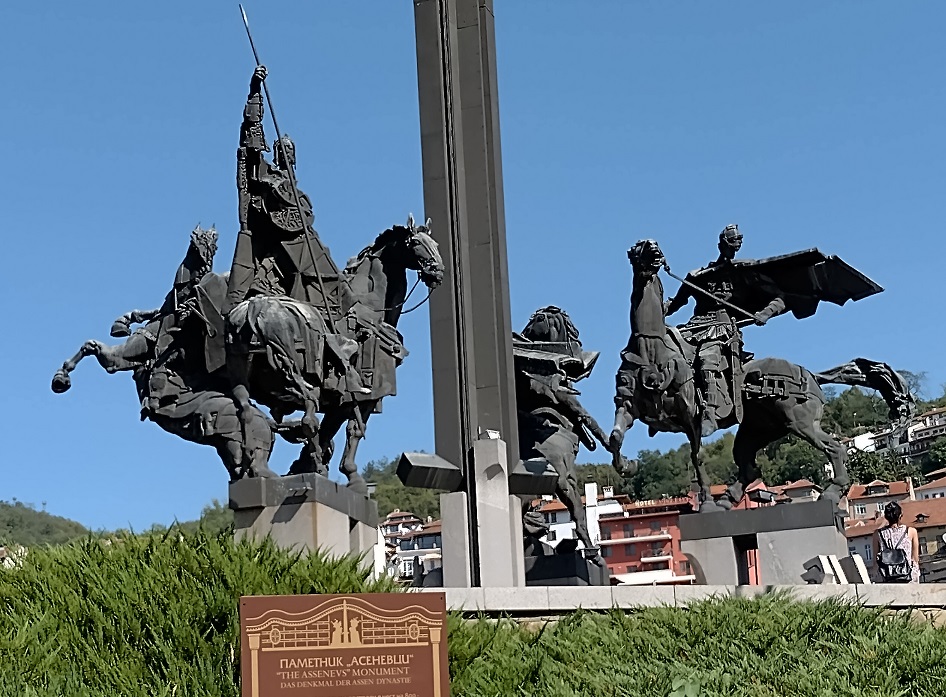
The Monument of Asenevci (the Asen Dynasty), 1985, by Krum Damianov.
The House of Asen founded the Second Bulgarian Empire, from 1185-1280, after rising to power during a rebellion against the Byzantine Empire.
The inscription reads:
The Assenevs Monument
The monument of the Assen dynasty was dedicated to the 800 years anniversary of the rebellion against Byzantine rule which ended with the liberation of Bulgaria. The composition represents the leaders of the revolt – the brothers Assen and Peter and their successors – the Tsars Kaloyan and Ivan Assen II – are the most glorious tsars of the Assen dynasty (1185-1241). During their rule Bulgaria reached high political, economic, and cultural prosperity. The author of the composition is Prof. Krum Damyanov.
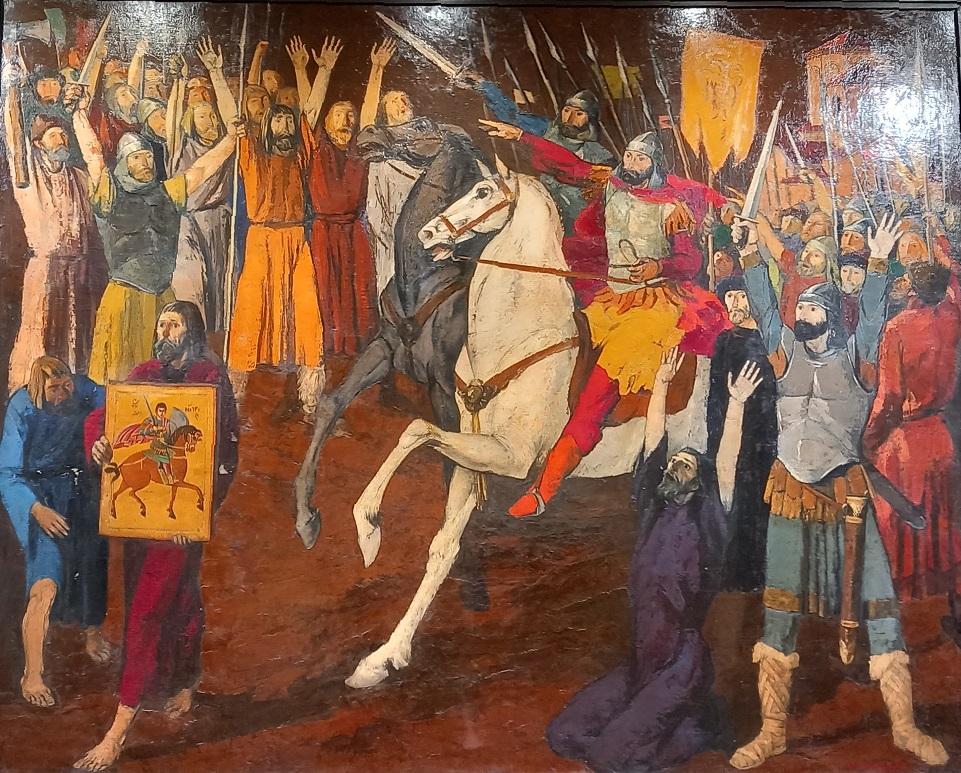
Alexander Terziev “The Revolt of the Asenevtsi”, Fine Art Museum, Boris Denev, Veliko Tarnovo.
Victory against the Turks during the Second Bulgarian Empire. The great warriors of the Bulgarian liberation wars were often sanctified, and Veliko Tarnovo was the centre of Bulgarian political and cultural life for many centuries, before the country fell under Ottoman control.
The Tarnovo Artistic School began during the 13th and 14th centuries CE. With some influence from Byzantine art, Tarnovo painting has its own characteristics, visible also in murals in churches, icons and illuminated manuscripts.
Tempera, a durable paint made by grinding powdered pigments into a binding agent, usually eggyolk, was used for the first time in Eastern Europe in the movement. This technique allowed wall murals to be painted more slowly than is possible using the Italian fresco method. This explains the great use of colouring and detailing we have seen so far.
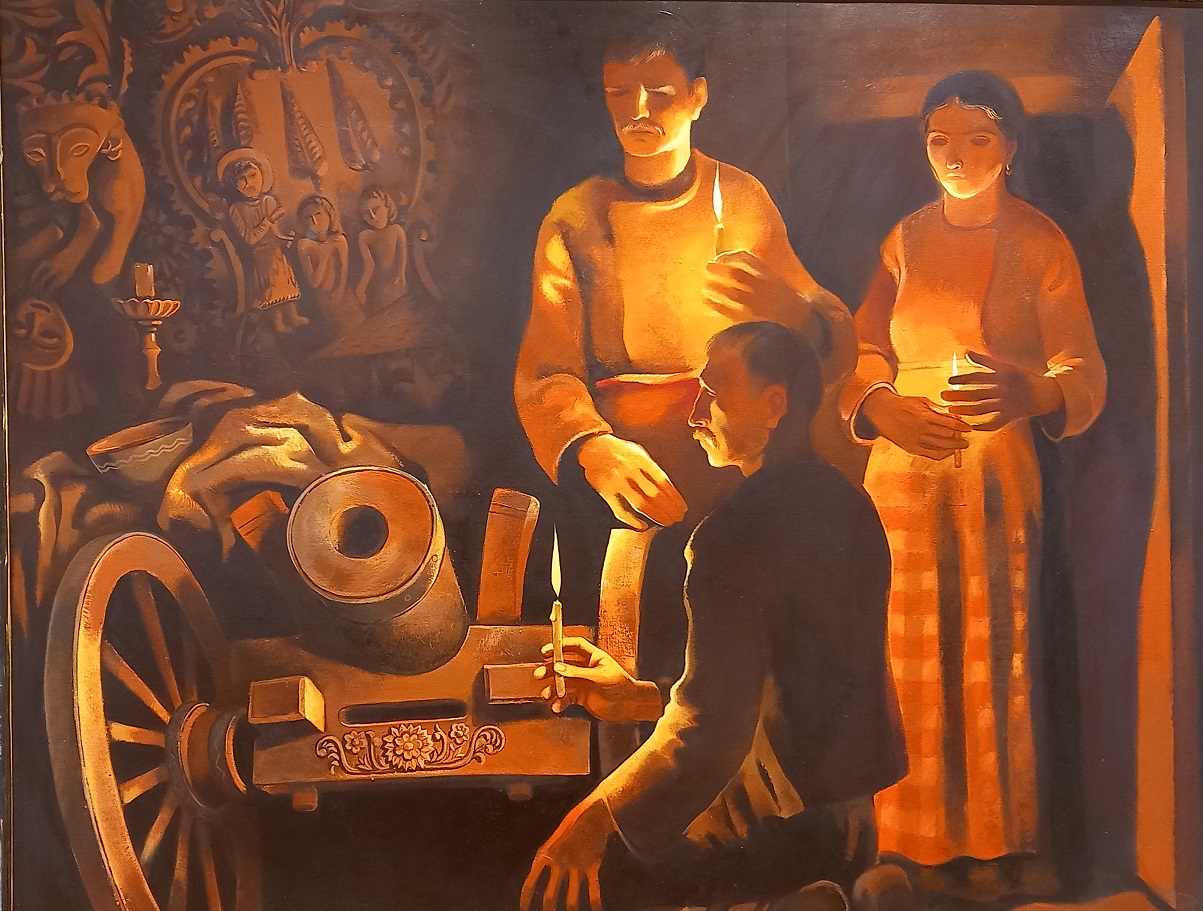
Fine Art Museum, Boris Denev, Veliko Tarnovo.
The painting depicts how peasants improvised in the construction of wooden cannons during the ill-fated uprising against the Ottoman Empire in 1876. Without modern weapons or external help, the fight was hopeless. In revenge the Ottomans exacted a terrible price, carrying out brutal massacres of combatants and non-combatants alike.
The April Uprising lasted just over one month. Although it failed in its initial objective to liberate Bulgaria from the Ottoman Empire, it was ultimately successful in that it led to the Constantinople Conference, then the Russo-Turkish War (1877-1878), which resulted in the Liberation of Bulgaria.
The Constantinople Conference was a meeting of the Great Powers (Austria-Hungary, Britain, France, Germany, Italy and Russia) from 23 December 1876 to 20 January 1877. After the brutal suppressions of the Herzegovinian Uprising in 1875 (Serbs against the Ottomans) and the April Uprising (Bulgaria) in April 1876, public outrage in the West led to demands on the Ottomans for political reforms in their Balkan territories. The refusal by the Ottomans effectively gave a green light to Russia to forcibly intervene in the Balkans, without fear of intervention by the Great Powers, as had been the case of Britain and France siding with Turkey in the Crimean War of 1853-56.
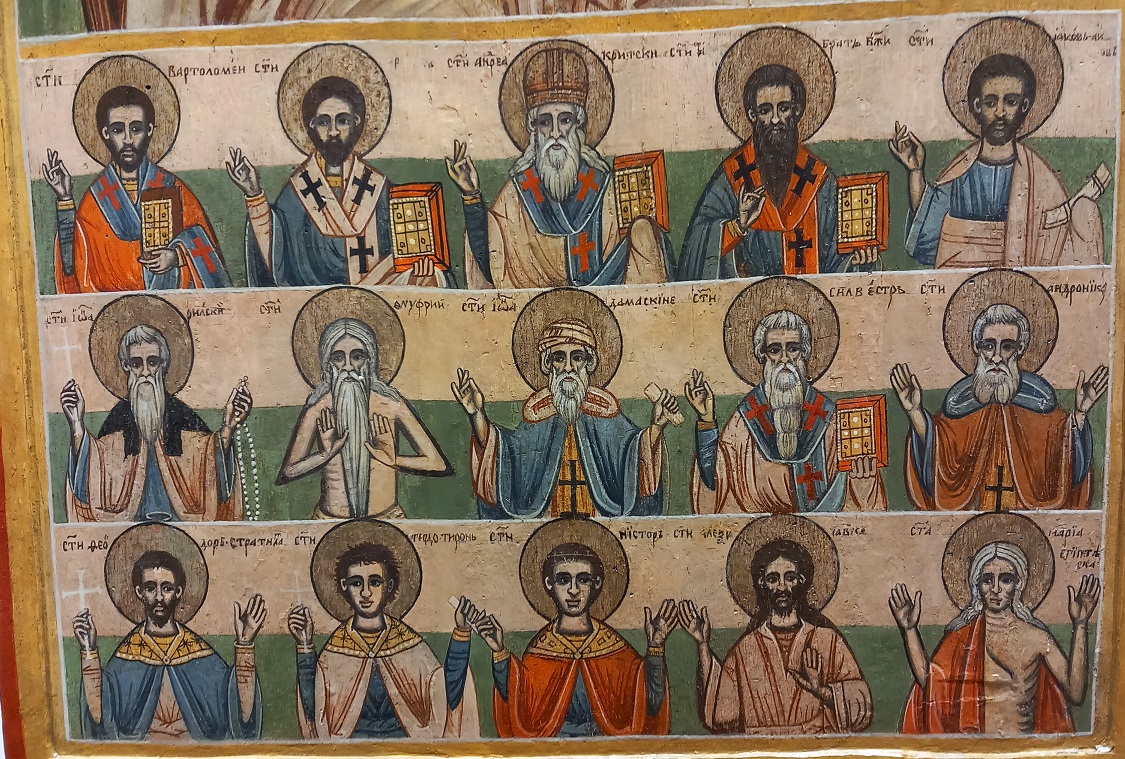
Fine Art Museum, Boris Denev, Veliko Tarnovo
Oh when the saints, come marching in……
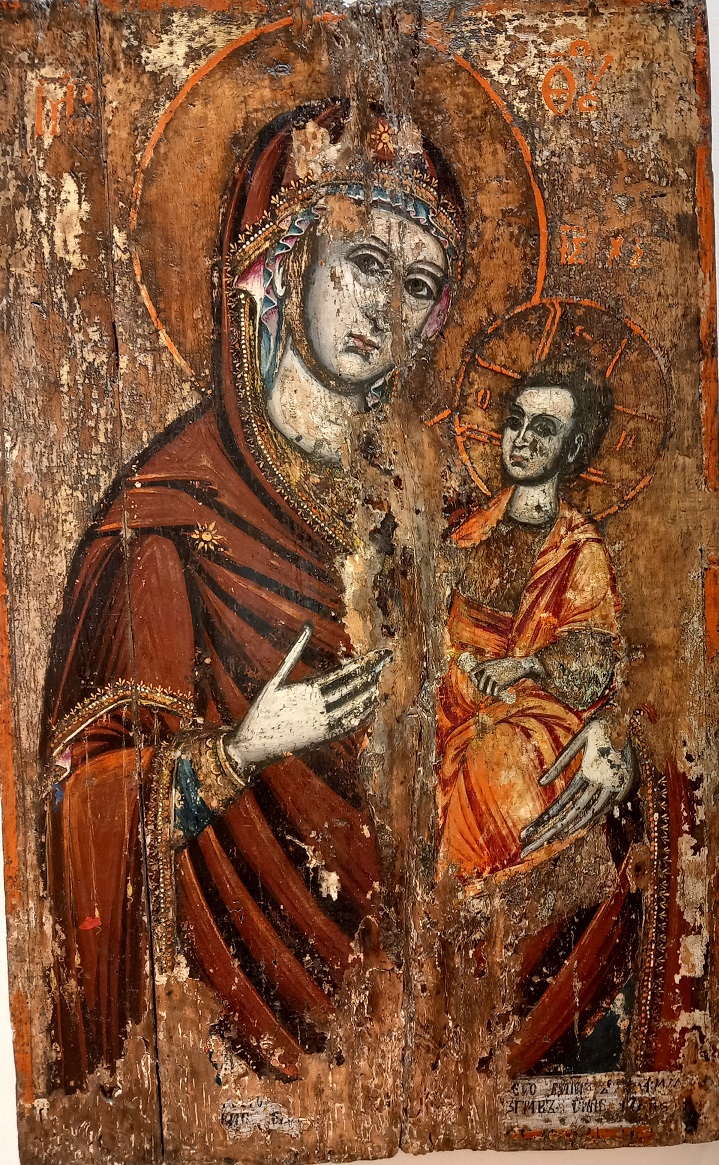
Fine Art Museum, Boris Denev, Veliko Tarnovo
A very old painting on wood of Mary and infant Jesus
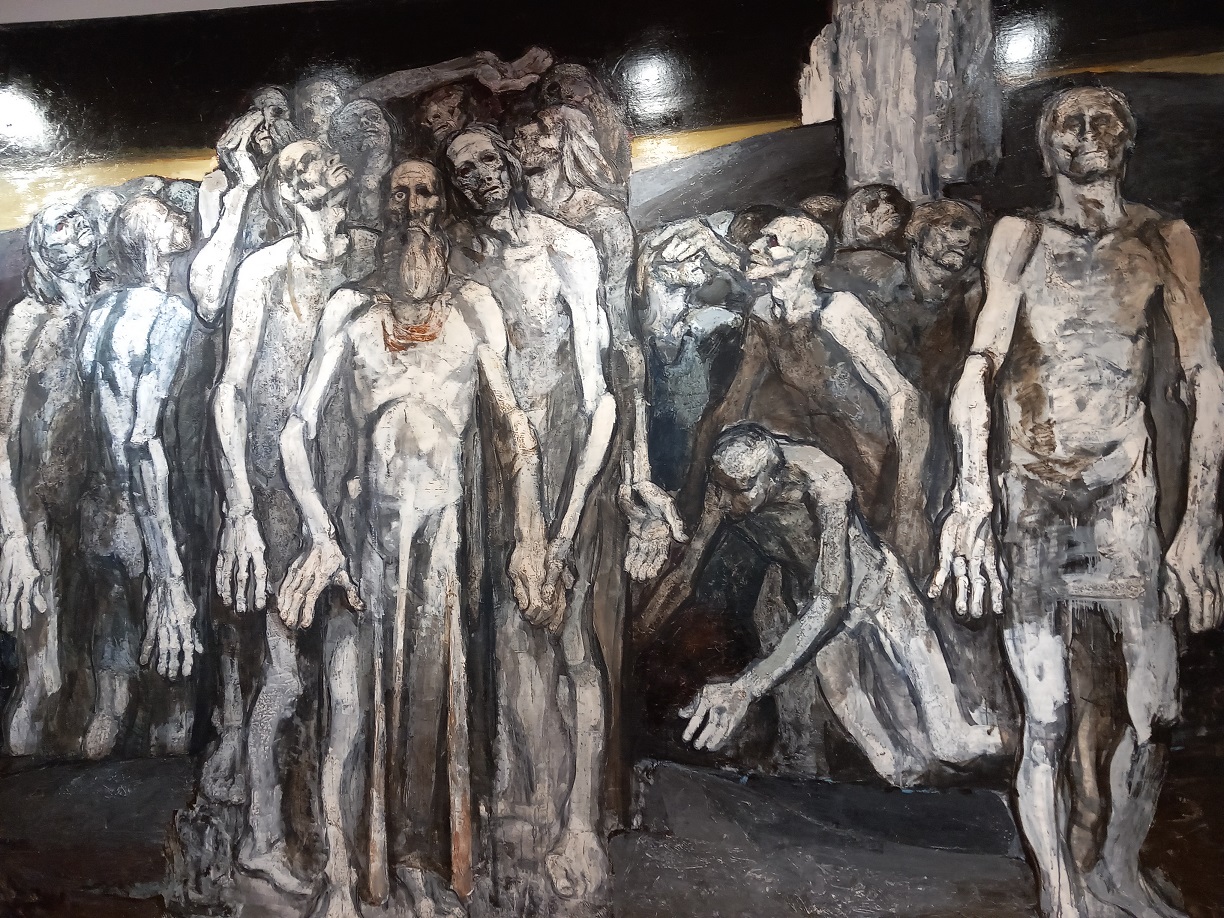
Samuil’s Wars, by Svetlin Rusev (1933-2018), Fine Art Museum, Boris Denev, Veliko Tarnovo
This horrific painting depicts the atrocity of the blinding of Bulgarian captives by the Byzantines in 1014, with one man in a hundred being left with one eye, to lead the others home.
The End of the First Bulgarian Empire
The First Bulgarian Empire, 681-1018, was in constant conflict with its neighbours, primarily the Byzantine Empire to the south-east, but also the Magyars (Hungary) to the north-west, the Pechenegs and Kievan Rus to the north-east. It covered territories far in excess of modern day Bulgaria.Bulgarian Tsar Boris II (c.931-977, reigned 969-971) was forced to abdicate by the Byzantines in Constantinople, making Bulgaria a province subject to Byzantium, and officially abolishing the Bulgarian Empire. His brother, Roman (930s-997), tsar 977-991, was held captive in Byzantine 991-997.
However, Samuel (born ?, died 1014, reigned as Emperor of Bulgaria 997-1014), became chief commander of the army in 976. Through 40 years of warfare, Samuel initially had success, winning a decisive victory over the Byzantines at the Battle of the Gates of Trajan in 986, and regaining much of the land lost. He pushed the boundaries of the Bulgarian Empire south into modern day Greece, and plundered the Peloponnese Peninsula. He broke an alliance between the Serbs and the Byzantines in 997, taking Serbian land.
On the death of Tsar Roman, Samuel was proclaimed Emperor of Bulgaria. A marriage of Samuel’s son to the daughter of the King Stephen I of Hungary brought peace for a while, but eventually the Hungarians sided with the Byzantines against Samuel. A bitter war of attrition till 1014 culminated in a decisive defeat of the Bulgarians by the Byzantines at Kleidion.
It is generally believed that 14,000 Bulgarian captives were blinded, leaving only one in a hundred with one eye to lead the others home. Legend has it that on seeing his blinded soldiers, the disheartened Samuel promptly died of a heart attack.
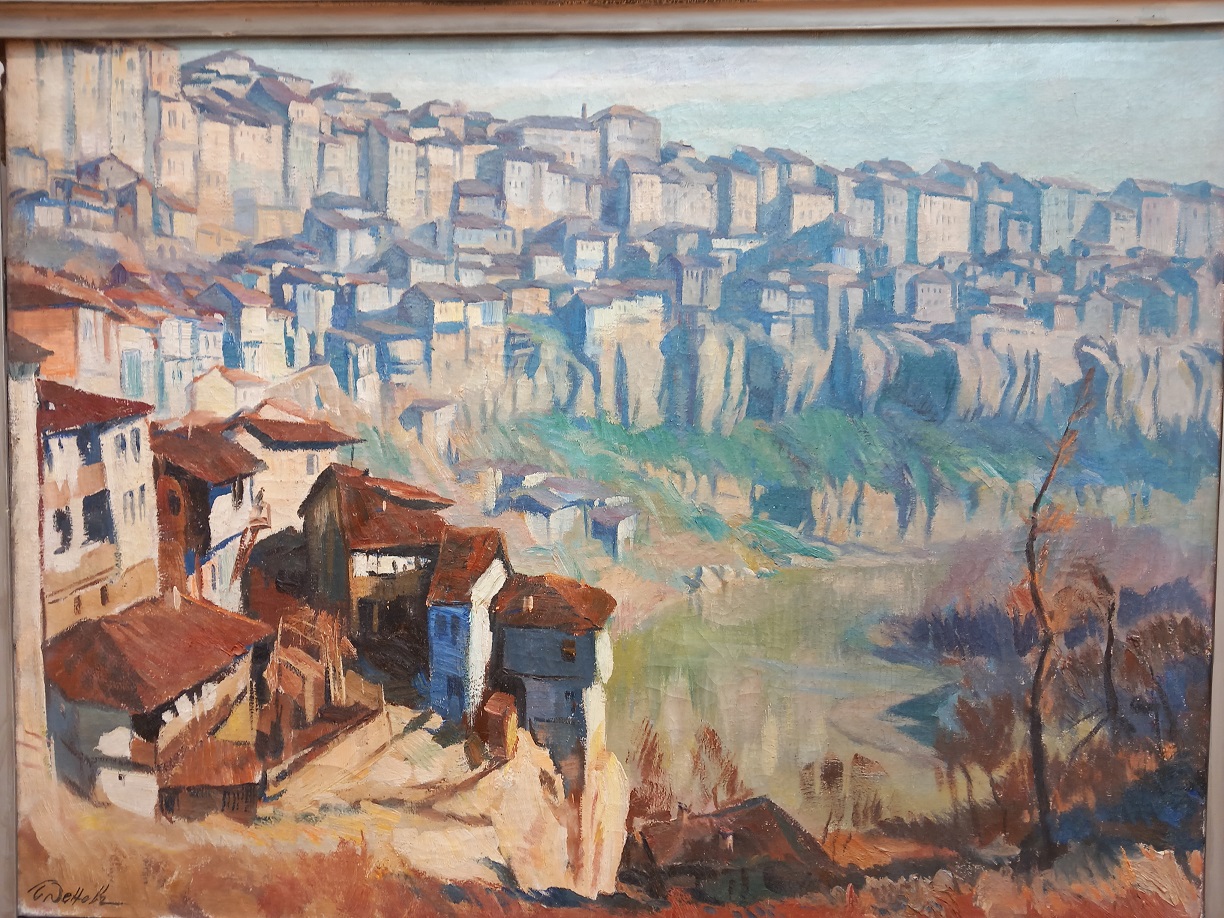
General View of Veliko Tarnovo, by Boris Denev (1883-1969), the namesake of the Fine Art Museum, Boris Denev, Veliko Tarnovo
This painting captures the spirit of the hillside town quite effectively.
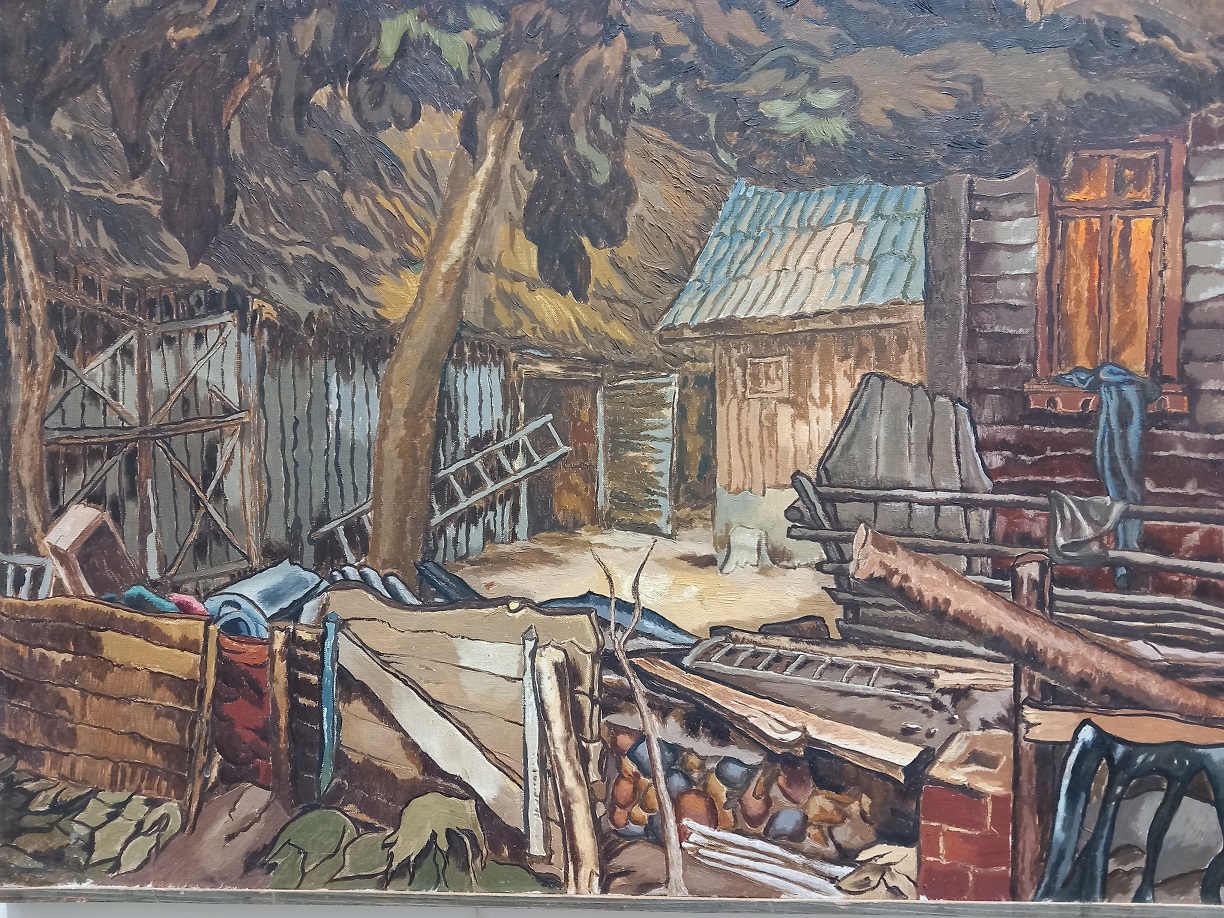
Yard in the field village, by Slavka Deneva (1929-1984), Fine Art Museum, Boris Denev, Veliko Tarnovo
One of my favourites.
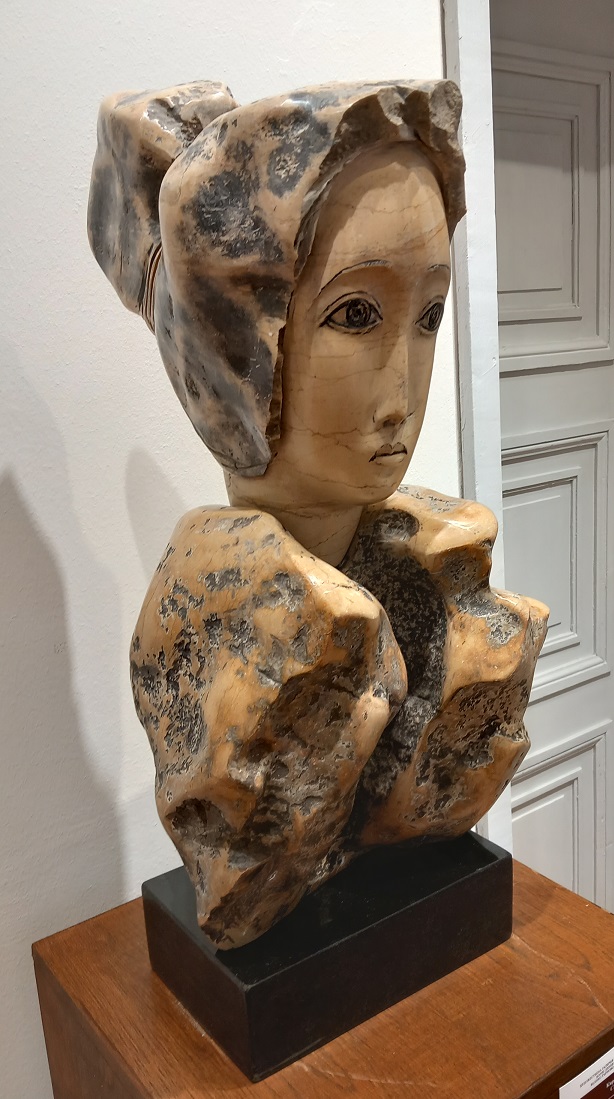
Condition, 2018 by Kiril Meskin (b. 1943), Fine Art Museum, Boris Denev, Veliko Tarnovo
I love the way the artist has used the forms of the original stone so effectively.
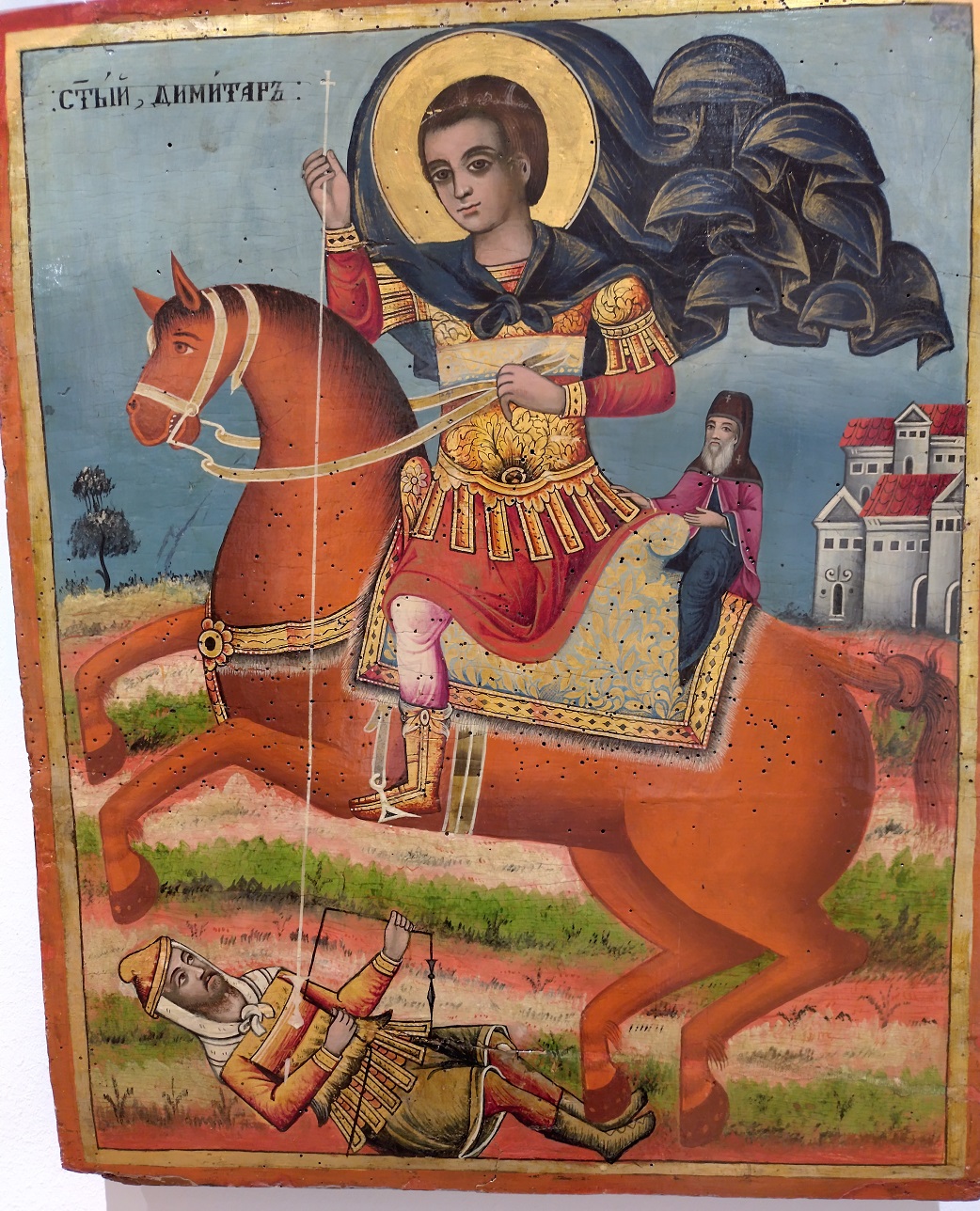
Fine Art Museum, Boris Denev, Veliko Tarnovo
Victory of the saintly Bulgarian tsar over the Turk, with the priest going along for the ride. There is something irresistibly beguiling about the cartoon quality of this style of painting.
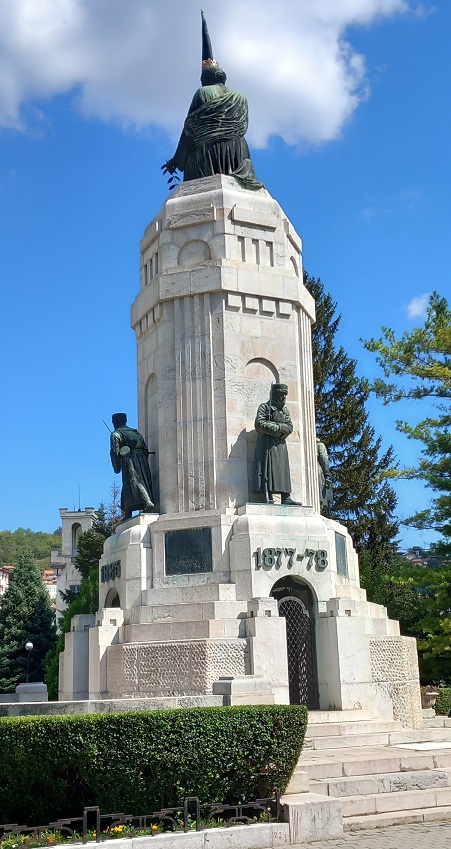
Monument Mother Bulgaria, a war memorial erected in 1930.
Bulgaria has been involved in at least 36 wars since its establishment around 680, which is about one per generation. Of these, 23 can be considered victories to some degree. 13 were fought against the Byzantine or Ottoman Empires. [Ref: Wikipedia
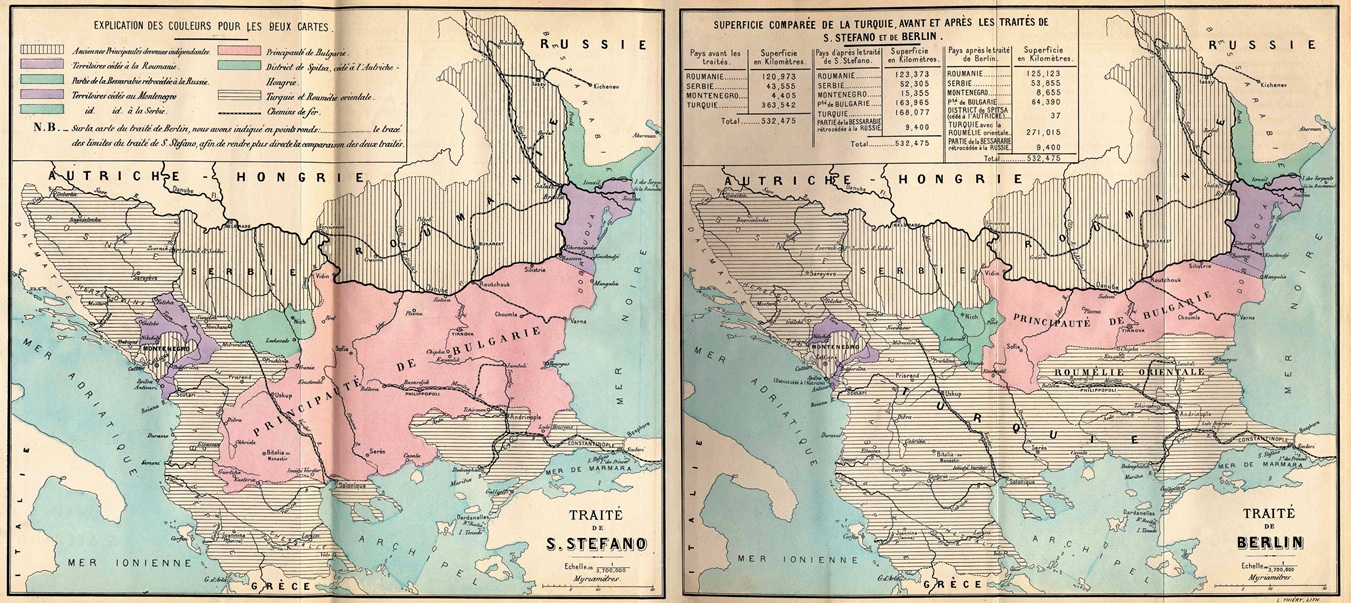
The Russo-Turkish War of 1877-1878: the Balkan States and the Russian Empire ganged up on the Ottoman Empire, and won decisively. The result was independence for Bulgaria, Romania, Serbia and Montenegro, formalised by the Treaty of Stefano (1878) and the Treaty of Berlin (1878).
The Treaty of Stefano provided for the formal establishment of the Principality of Bulgaria, ending nearly 500 years of Ottoman rule. It was signed on the 3rd of March, a date celebrated by Bulgarians as Liberation Day. The treaty envisages an enlarged Bulgaria. In particular, Bulgaria would extend through Thrace (northern Greece) into Macedonia, reaching the Adriatic coastal ports. This gave Russia access to the Mediterranean. Not surprisingly, this was not acceptable to the other Balkan states or western powers, resulting in the treaty being superseded by the:
The Treaty of Berlin
Signed by Austria-Hungary, France, Germany, Great Britain and Ireland, Italy, Russia, and the Ottoman Empire on 13th July, 1878, this treaty radically changed the frontiers of the Balkan States. Romania, Serbia, and Montenegro were recognised officially as independent states through this treaty.
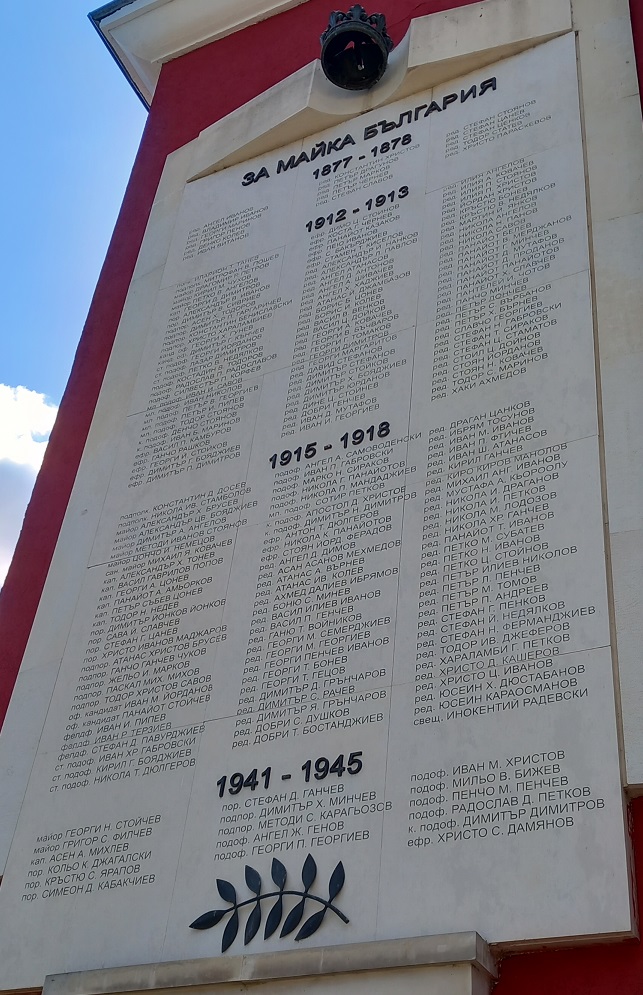
Memorial plaque to the fallen in the various, numerous wars Bulgaria has fought since independence. This was hung outside a war veterans association hall.
See notes below for details.
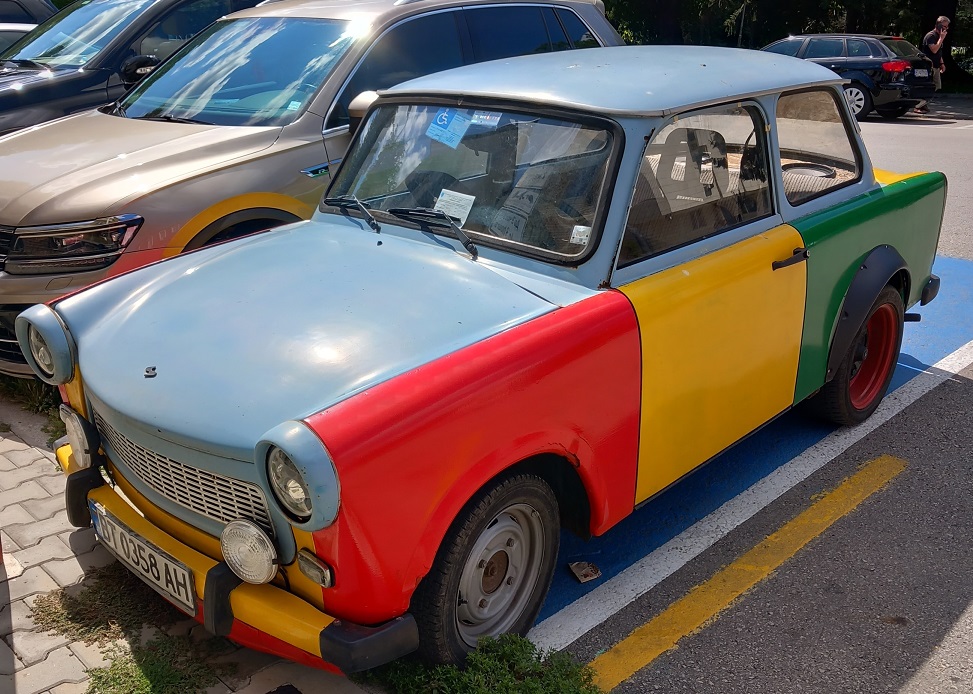
We were delighted to find this ‘Trabbie’, an old Trabant (which means ‘satellite’ in German), outside our hotel in the morning. These cars were practically the only ones available to East Germans during the communist era, 1961-1989. They enjoy a cult following today.
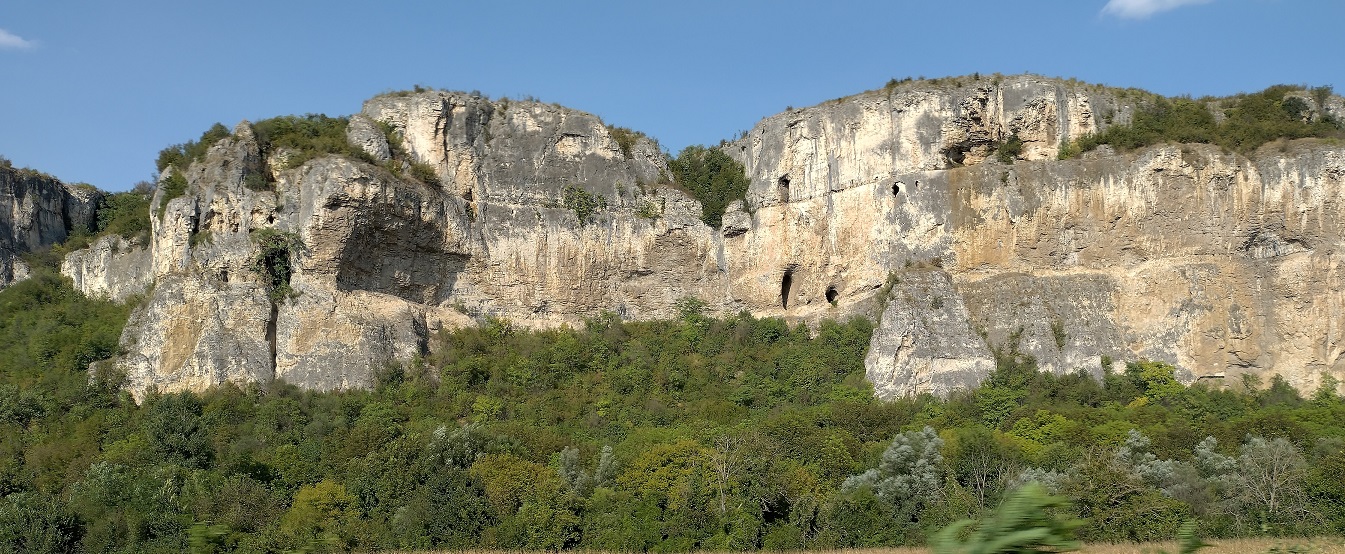
Limestone rock formation on the way to Sofia
We passed through open, flat farmland and forest to enter the mountains with rocky (limestone, I think, given the cement factory or two we passed) sculpted shapes reaching upwards like chubby accountants’ fingers. Such topography explains, similarly to Romania, the divided histories of the north and south of the mountain range that sits dead centre in the country. The southern region, Thrace, would be easy for the Ottomans to enter, but the Bulgars could stop them in the mountain passes.
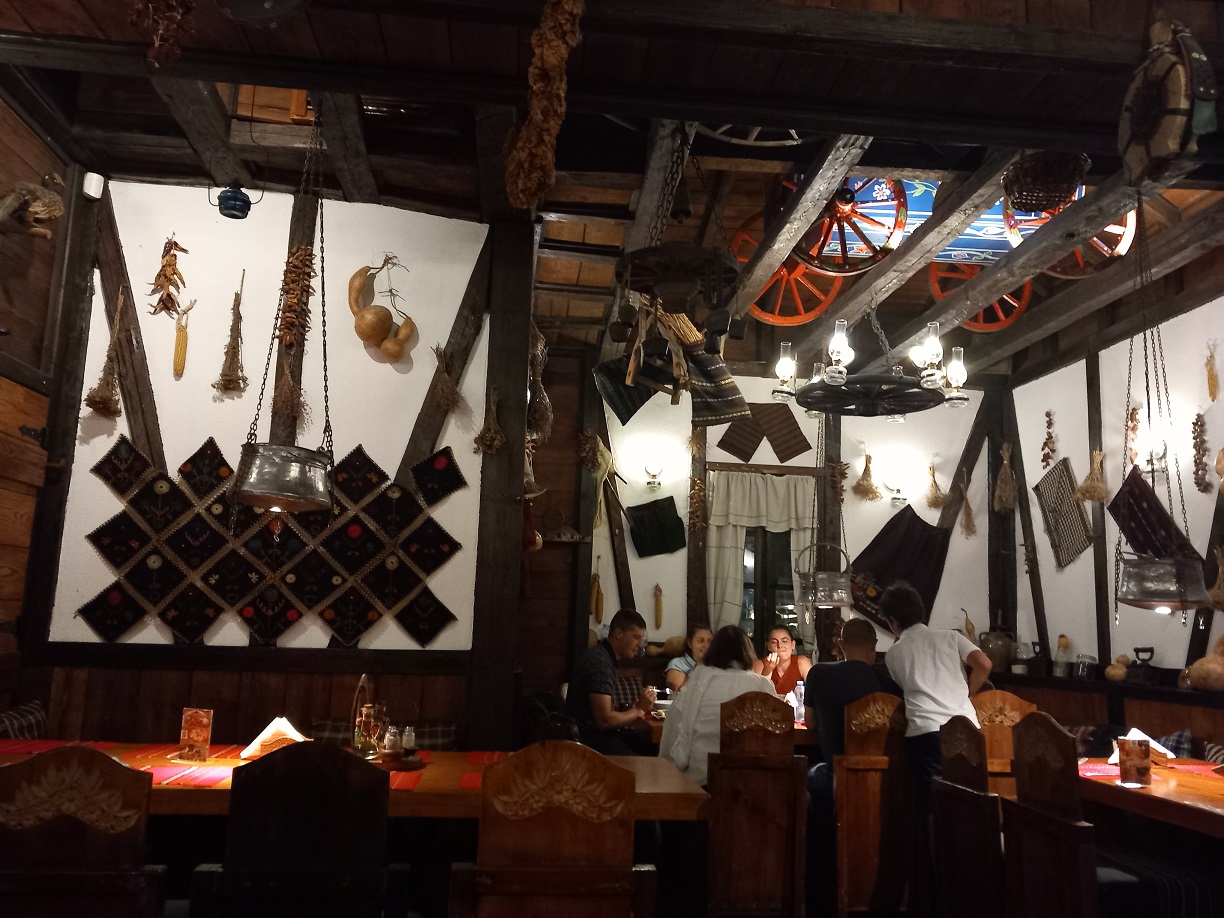
Restaurant in Sofia
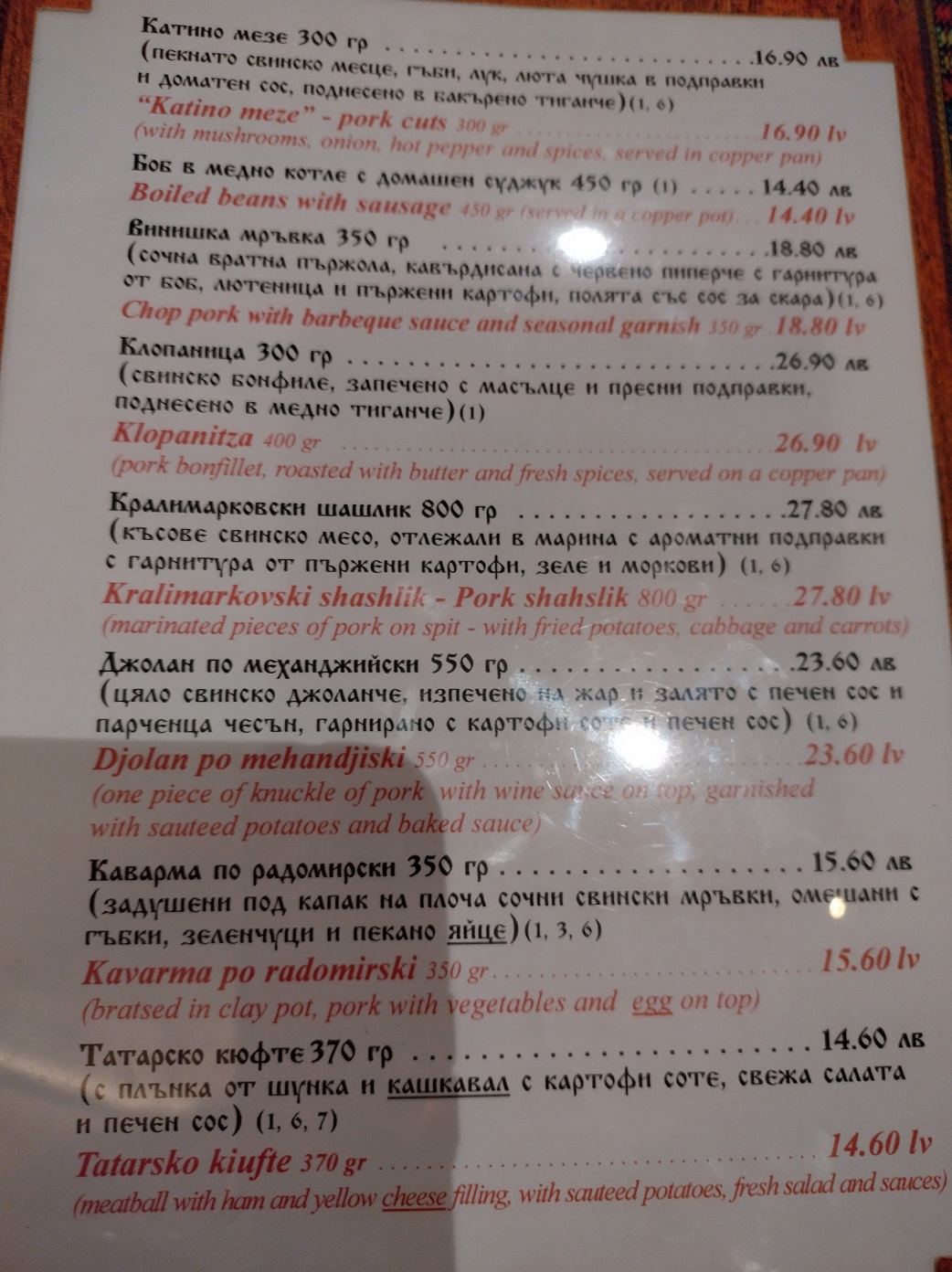
Menu in restaurant in Sofia
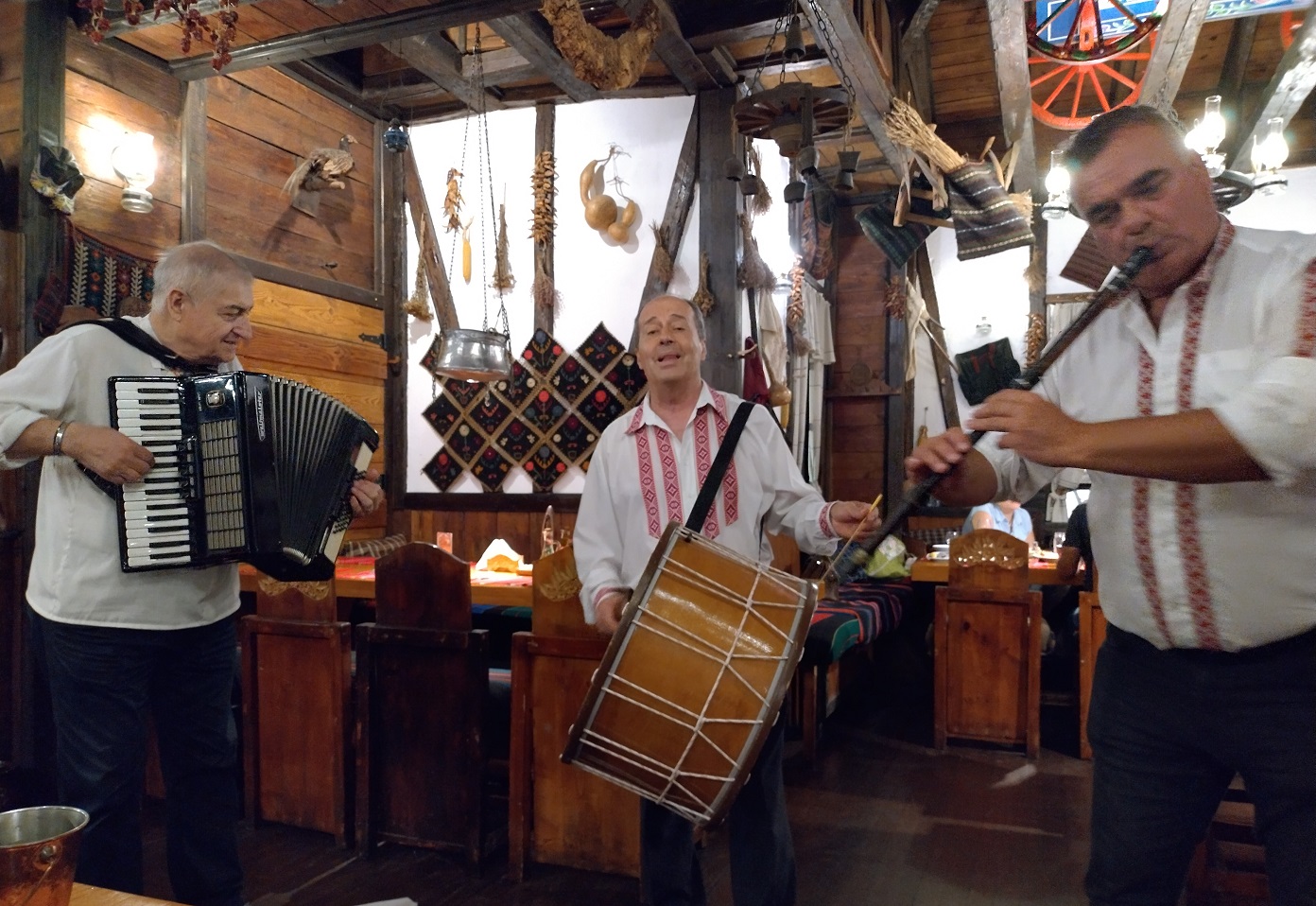
Music in restaurant in Sofia
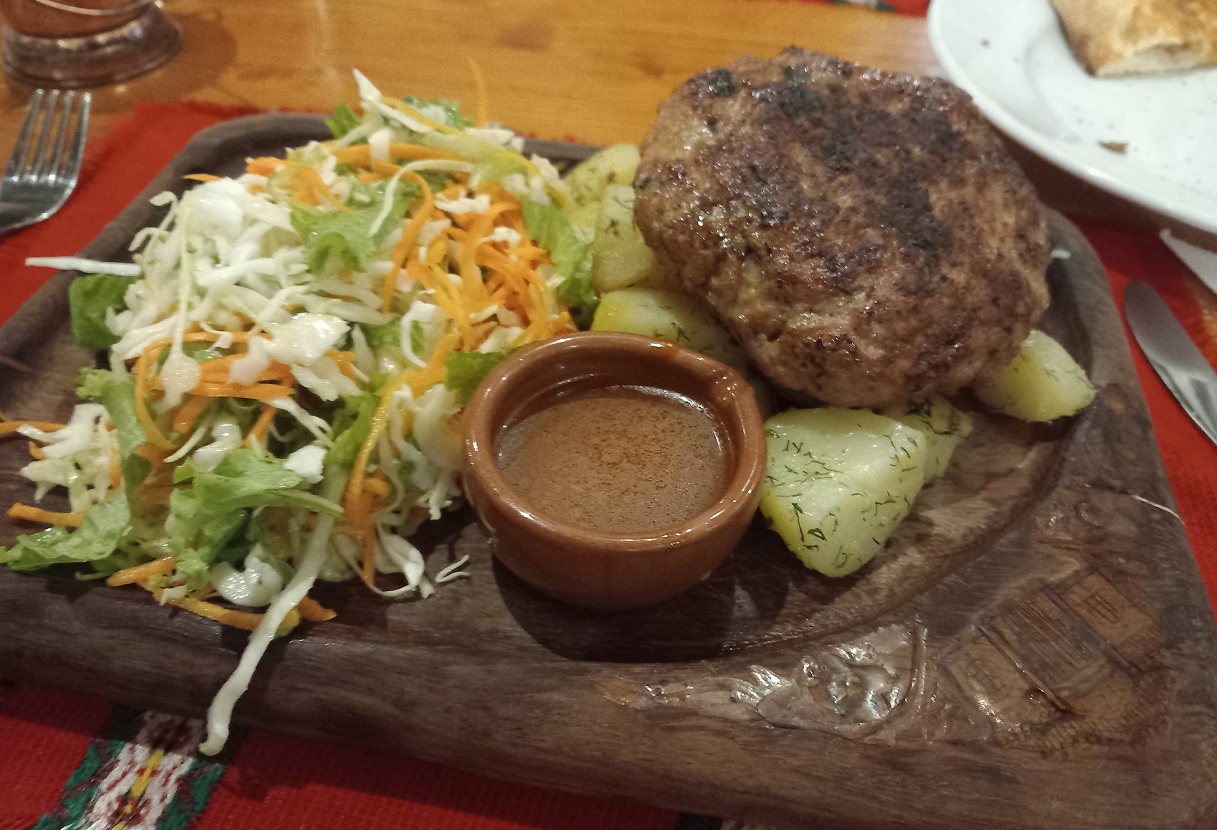
Bulgarian dish
Travel Diary
Veliko Tarnovo
Our breakfast was a choice of 4 menus, such as Continental, American…Not great but well-meant. We found the bridge across to the tongue-peninsula, badly in need of and in repair, with a view of the murky brown Yantra river gurgling around the sharp bend below us. The ’island’ has nothing but a large sandstone art gallery dedicated to a local painter, and a massive commerative statue with 4 tzars on horseback around a phallic sword reaching pointedly to the stars. This was the old capital during the 2nd Bulgarian Empire of the 13th century, and don’t they remind you of that at every turn.
The gallery had a permanent exhibit of 19th-20thC painters, many orthodox religious paintings of saints, etc. and their heroisims and pathos of the hardships of life and war under the Ottomans. Some cityscapes of Tarnovo are pleasant. We found the Mother Bulgaria statue commemorated in one painting, painted as a column before Mother Bulgaria took up roost. Wars of 1877-1878, 1885, 1912-13, 1915-18 commemorated around the base. A military club nearby gave us a list of the fallen in the various wars. Then it was a taxi to the station.
Train journey from Veliko Tarnovo to Sofia
The first train to Gorno was not quite the horror show of yesterday but it was close. We waited in the station hall under the scrutiny of youngish police officers in dark blue uniforms for the train to Sofia. The police looked us over but decided a swarthy young couple were more within their profiling and asked for their IDs. The train arrived punctually (i.e. only 20 mins late) and we found our compartment. It was occupied by a young couple who cleverly rolled up a leaflet page to wedge open the top-down sliding window. It was very hot and when the sun entered directly, dazzling. The carriage occupants swapped in and out. A little wizened lady brought in her mentally handicapped son holding a stuffed animal, who was very well-mannered and well dressed. Another elderly lady arrived and I was the chief bag to overhead rack hauler. (Much appreciated by all.) The old lady and the middle-aged lady to my right talked incessantly for hours, their way of ignoring the discomfort of the trip.
Sofia
We arrived in Sofia after many hot hours. The central station seemed to be in different stages of rennovation. The tracks and main hall were new, white stone and quite elegant, and then one passes to the mid 20th century Soviet era dowdy part before exiting. The old part of the central train station is in huge contrast to the new gleaming, state-of-the-art metro we find later. We walked the short distance to our Hotel Adria which seemed like an oasis in a dilapidated, crumbling sidewalks area. The staff were waiting for us and were very sweet.
After settling in we headed out to explore and I figured out how to use the trams and metro right away. Cindy just wanted to walk to the center but was glad we didn’t do that in the end. We walked to the metro entrance and found a beautiful underground street. We exited in the centre where all the huge and beautiful government buildings were well lit and impressive. Eventually we returned to our neighborhood to have a late dinner in an authentic Bulgarian restaurant with Bulgarian musicians serenading the customers. We heard ’O Sole Mio’. They had drums, an accordian and a wooden flute, played at an angle of 30°. Cindy was happy with her meal of a big salad with all the fixings of tomatoes, Bulgarian cheeses, etc. I was not that hungry so my meal wasn’t as appealing although it was delicious. Potatoes, salad and a little meat loaf.
Bulgaria’s Wars of Independence
Bulgarian-Serbian War, 1885. Hardly had the echoes of the cannons died down, and cemeteries filled with new guests across the region, following the two wars of the late 1870s, which gave Bulgaria independence, than a new conflict erupted between Serbia, supported by Austria-Hungary, and Bulgaria. Bulgaria won this two-week war under the command of Prince Alexander of Battenberg (NB: this is the family name that was changed to ‘Mountbatten’ in England). He was the first prince (knyaz) of the autonomous Principality of Bulgaria from 1879 until his abdication in 1886). The result was recognition of the Unification of Bulgaria with the southern region known as Eastern Rumelia.The Macedonian Struggle, 1893-1912 Fought as a series of guerilla campaigns, mainly between Greek and Serb militias against Bulgarians, in Ottoman Macedonia. This low intensity insurgency continued until the full-blown eruption of the:
First Balkan War, 8 Oct 1912 – 30 May 1913 This 8-month conflict was a victory for the Balkan League (Bulgaria, Serbia, Greece and Montenegro) over the Ottoman empire, leaving half a million killed, wounded or dead from disease. The result was that the Ottomans lost 83% of their European territories. Albania was created, freeing them from Serbia. Bickering over the spoils led to the:
Second Balkan War, 29 June 1913 – 10 August 1913 Within a month of the first carnage ending, Bulgaria decided it hadn’t gained enough territory, and launched a war of aggression against its previous allies, its neighbours, Serbia and Greece. These were able to defend themselves successfully. Romania took the opportunity to settle some scores, and intervened against Bulgaria as well, as did the Ottoman Empire, which seized some of its lost territories. Bulgaria’s nationalistic gamble had totally backfired, with the result being Bulgaria lost even more territory.
First World War, 1914 – 1918 This time Bulgaria sided with the Central Powers (German Empire and Austro-Hungarian Empire) and the Ottoman Empire against the Western Allies and Russia (the Entente), and the Balkan states, the kingdoms of Greece, Serbia, and Romania. After initial successes, the war ground down to attritional trench warfare, broken in 1918 by an ally assault on the Macedonian Front. Bulgaria had to return all territories gained, and pay crippling reparations.
Second World War, 1939 – 1945
Not one to learn by previous mistakes, once again Bulgaria sided with the losing side. It joined the Axis Powers from 1 March 1941 till 8 September 1944, when, like Italy, it switched to alignment with the Allies. With Nazi Germany’s support for Bulgaria’s irredentism, on the basis of the defunct Treaty of San Stefano of 1878, Bulgaria invaded parts of Greece and what had in the meantime become Yugoslavia. Unlike Romania, however, Bulgaria refused to join Germany’s war against the Soviet Union, and never declared war on it. Nevertheless, the Red Army entered Bulgaria on 8 September, 1944, prompting a coup in Bulgaria, deposing the pro-fascist leaders, and Bulgaria declared war on Germany.
Tsar Boris III had died on 28 August, 1943, soon after a visit to Berlin. It is suspected that he had been poisoned, as had the Greek prime minister, Ionnis Metaxas, two years earlier. Boris had been trying to extricate Bulgaria from the war. His death left his 6-year-old son as heir, resulting in a regency council and prime ministers playing musical chairs in a disintegrating power vacuum.
Unfortunately, Fascist Bulgaria was a participant in the Holocaust, although in an ambiguous way. Whereas they allowed the Jews in the occupied territories of Greece and Yugoslavia to be murdered wholesale, at home in their core territory, they ‘only’ applied discrimination, forced labour, property seizure, etc., but did not bow to German insistence that the Jews be exported to the extermination camps.