Asia and Australia 2025
Day 20: Wednesday 25 June 2025
Kyoto

Gion District, Kyoto. these traditional buildings abut the river. Gion is one of five districts of Kyoto which are traditional entertainment areas. They date back to the Sengoku period, or “Warring States” period. So named because of the frequency of civil wars throughout the 15th and 16th centuries, before the calmer Edo period.

These life-size posters exemplify the character of the Gion district of Kyoto. The Gion district developed to serve the needs of visitors to the nearby Yasaka Shrine, and is now one of the most exclusive geisha districts in Japan.
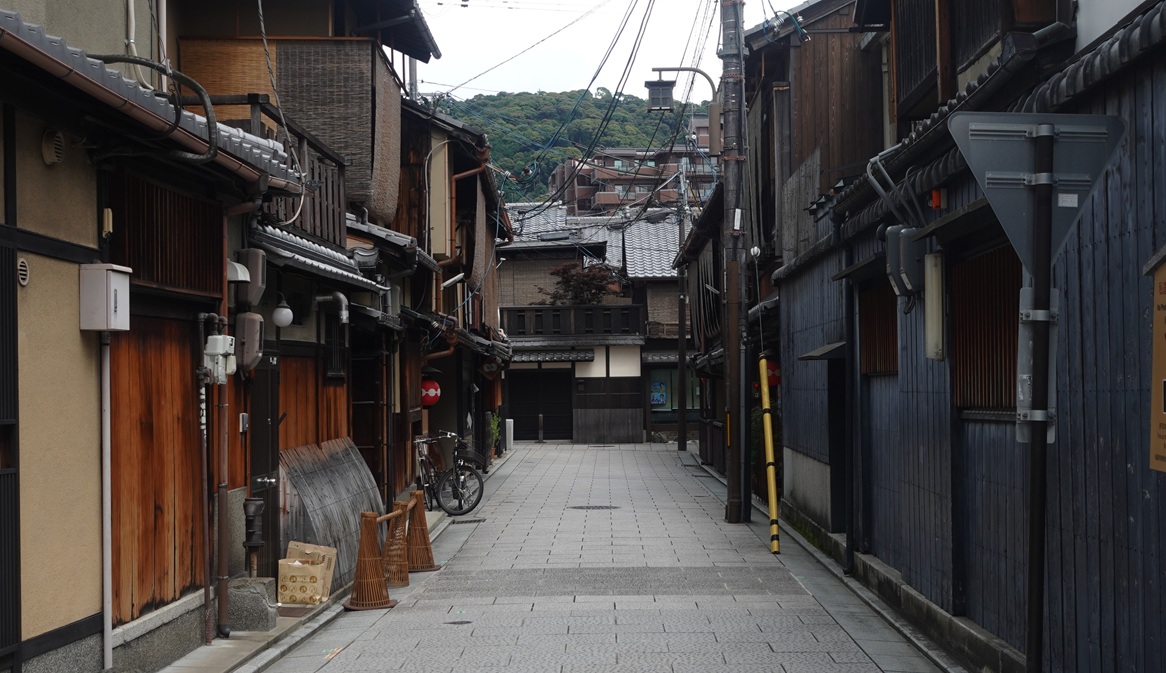
Gion District, Kyoto, famous for geishas and entertainment.
Sudare
Sudare are the traditional Japanese screens or blinds, made of decorative wood, bamboo, or other natural material, strung together with a single colored yarn.
Yoshizu are non-hanging vertical slat screens, made of common reed.

Cindy and Sean in the Gion district, Kyoto. Efforts have been made to preserve the traditional forms of architecture and entertainment.

Kyoto is well-known for its geisha tradition. Here, girls have dressed up for a photo shoot by the Shirakawa River, with a backdrop of some ochaya teahouses. In the past, these teahouses were the locus for geishas to entertain guests with parties, singing and dancing. A maiko is an apprentice geisha. Tourists can dress up in henshin studios, but, by law, their dress must be inaccurate, so that they cannot be mistaken for real geisha or maiko.

Uryūseki, or Cucumber Rock (A Symbol of Encouragement). This large rock is said to predate Chion-in, and is in front of the Kuromon. Gozu Tennō, a deity, said that in one night gourds started to grow from this rock.
Often, entrances to parks and palace grounds were marked by columns with vertical scripts. This one is particularly appealing.

Chionin Temple, Gion District, Kyoto. This vast temple complex is the main centre of the Jōdo-shū (Pure Land Sect) founded by Hōnen (1133–1212). The temple was built in 1234. One feature is a 550m hallway connecting two parts of the complex, known as the Nightingale hallway. Its flooring makes a sound similar to a nightingale, which was intended to remind visitors to listen to Buddha’s teachings, but also served as an early warning system for intruders.

Statues of Sakamoto Ryoma (1836-1867) & Nakaoka Shintaro (1838-1867).
Sakamoto is emblematic of the turbulence which accompanied the transition from traditional Japan to the industrialised, modern Japan, known as the Meiji Restoraton. Sakamoto played a crucial role in the subsequent negotiations that led to the voluntary resignation of the Shogun Tokugawa Yoshinobu in 1867, thus bringing about the Meiji Restoration. Sakamoto was assassinated by his political enemies, along with his friend, Nakaoka.
Nakaoka Shintaro was also a samurai, who fought alongside Sakamoto in the movement to overthrow the Tokugawa shogunate.

Nearby is the Yasaka Shrine, dedicated to Susanoo, the chief kami of the Gion Faith. Construction begain in 656. Susanoo’s consort was Kushinadahime, a central deity of the Gion cult, who Susanoo rescued from the monster Yamata no Orochi.
Yamata no Orochi is an eight-headed and eight-tailed serpent. The legend of its slaying by Susanoo reminds us of St. George and his slaying of the dragon. A twist to the tail of the legend is that the Kusanagi-no-Tsurugi, a sword, one of the Three Sacred Treasures, was found within the serpent’s tail.

Tanuki (raccoon dog) — a creature from Japanese folklore often depicted in statues outside shops, restaurants, or in streets. Tanuki wears a straw hat and has a large belly, and represent “good luck” or “prosperity” — they are believed to bring business, fortune, and cheer to shops or homes.
The characters on its belly (利光) can be read “Rikō” (or “Toshimitsu” / “Tokumitsu,” depending on reading), perhaps indicating a shop name or proprietor’s name.

The Kyoto Imperial Palace, located in the heart of Kyoto Gyoen National Garden, served as the principal residence of Japan’s emperors for more than a millennium, from the late eighth century until the capital moved to Tokyo in 1869. Its history reflects the political, cultural, and architectural evolution of Japan from the classical period through the dawn of modernity.

The origins of the palace are closely tied to the founding of Heian-kyō (modern Kyoto) in 794 CE by Emperor Kanmu, who sought to establish a new, stable capital free from the influence of powerful Buddhist institutions in Nara. The palace was conceived as the centre of the new city’s grid plan, modeled after the Chinese Tang capital of Chang’an, symbolising imperial authority and cosmological order. The first imperial residence, known as the Daidairi, included the main audience hall (Daigokuden), government offices, and living quarters for the emperor and court.

Kyoto Royal Palace Gardens
Fires, earthquakes, and other disasters repeatedly destroyed sections of the complex, prompting reconstructions and relocations of the emperor’s residence within Kyoto. By the 12th century, as the power of the imperial court waned and the military government of the samurai class rose, the court’s resources diminished, and the palace fell into disrepair. During this time, emperors and retired sovereigns often lived in temporary residences (sato-dairi) belonging to aristocratic families, several of which later evolved into the present-day Kyoto Imperial Palace complex.

Mural at the Kyoto Royal Palace
The palace assumed much of its current form during the Edo period (1603–1868), when it was rebuilt under the patronage of the Tokugawa shogunate. The most significant reconstruction occurred in 1855, following yet another devastating fire. This restoration defined the architectural style we see today: elegant yet restrained wooden structures surrounded by white earthen walls and graceful gates, exemplifying shoin-zukuri and Heian-period design aesthetics. The layout reflects traditional court hierarchy, with ceremonial halls to the south and private residences to the north.
Travel Diary
A maiko is an apprentice geiko in Kyoto (in Tokyo it is geisha) Their jobs consist of performing songs, dances, and playing the shamisen (3-stringed guitar type instrument) or other traditional Japanese instruments for visitors during banquets and parties, known as ozashiki.
yukkuri hanashite kudasai
eigo wo hanasemasuka
… wa doko desuka?
watashi wa (Peggy) desu
… wo kudasai