Rome-Naples June 2026
Day 12: Monday 15 June 2026
Pozzuoli – Ischia
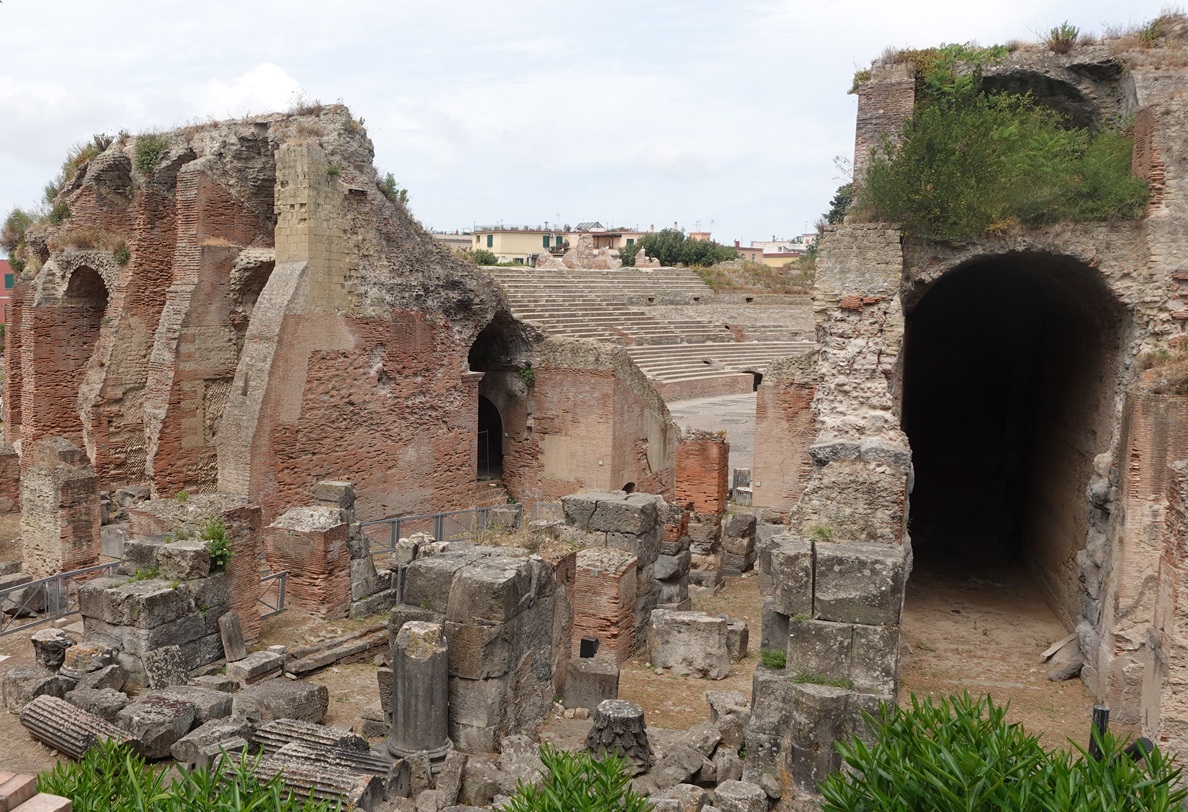
Anfiteatro Flavio at Pozzuoli.
Built in the second half of the first century CE, it was needed to enhance the by then insufficient capacity of the republican era anfiteatro in Pozzuoli, making it the only Roman city outside Rome to boast two amphitheatres. It is the third largest amphitheatre by capacity, after the Colosseo of Rome, and the Anfiteatro Campano di Capua. The older amphitheatre is in fact cut in two by the railway line.
Whereas the first amphitheatre was used primarily for gladiatorial competitions, the second was adapted for venationes, with exotic animals.
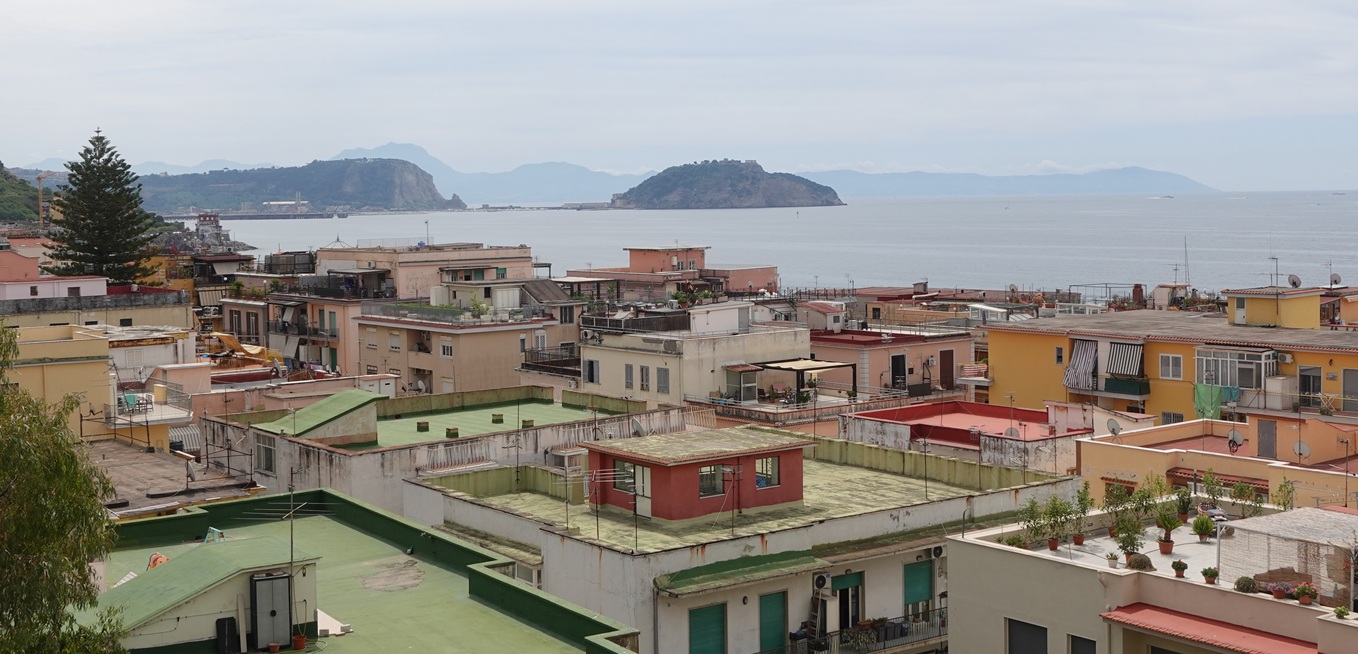
View of the Bay of Naples, overlook the rooftops of Pozzuoli.
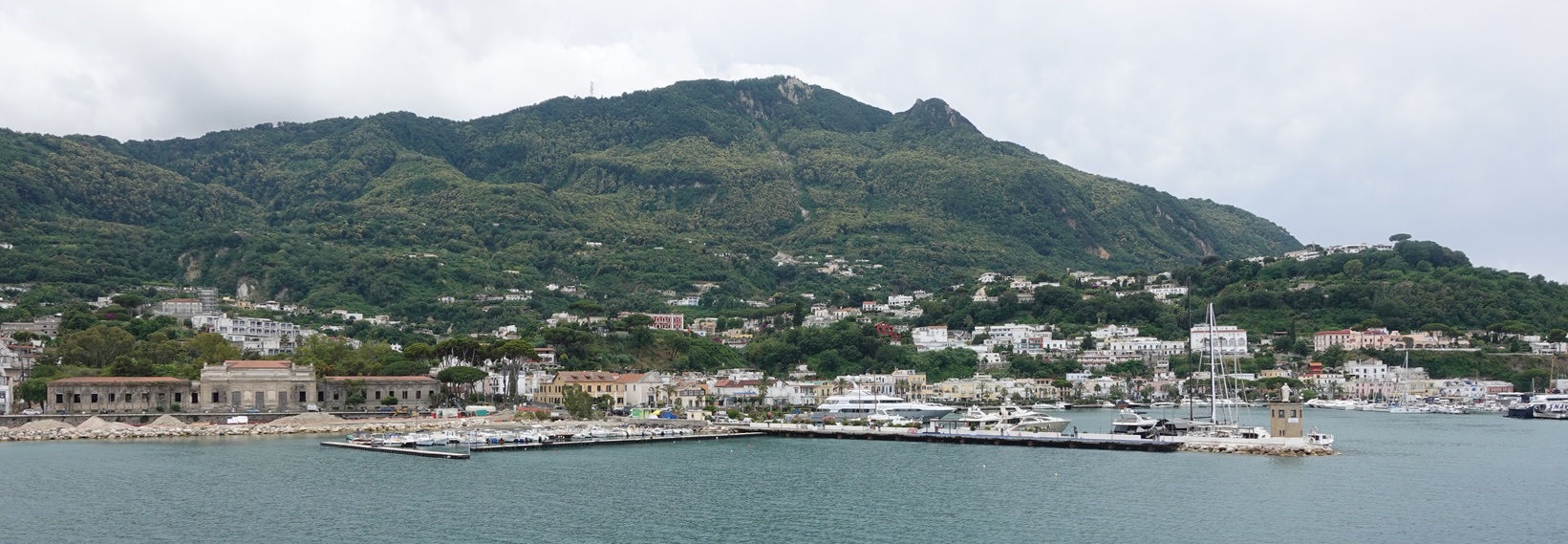
Arrival at Casamicciola Terme, on Ischia Island.
Ischia is a volcanic island 30km west of Naples, at the northern end of the Gulf of Naples. It is the largest of the Phlegrean Islands, and has been inhabited since the Bronze Age, becoming a Greek emporium in the 8th or 9th century BCE (Πιθηκοῦσαι, Pithekoūsai). It has 34 km of coastline, and its highest peak is Mount Epomeo, at 788m. 62,000 people live there permanently, with a large summer seasonal influx of tourists.
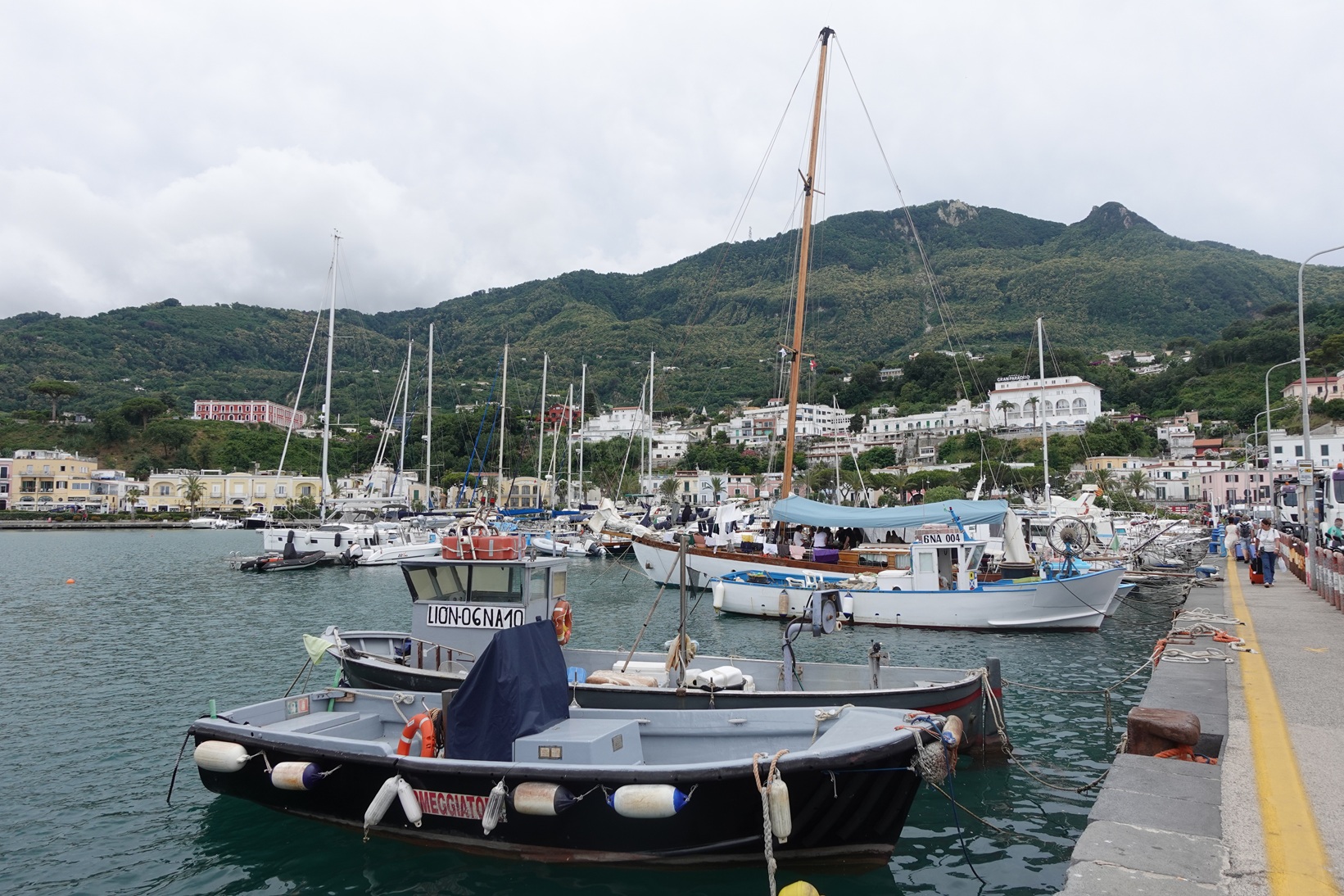
The harbour at Porto Ischia is clearly a multi-use base, for leisure craft, fishing boats and tourist ferries. There are small coast guard and carabinieri craft as well.
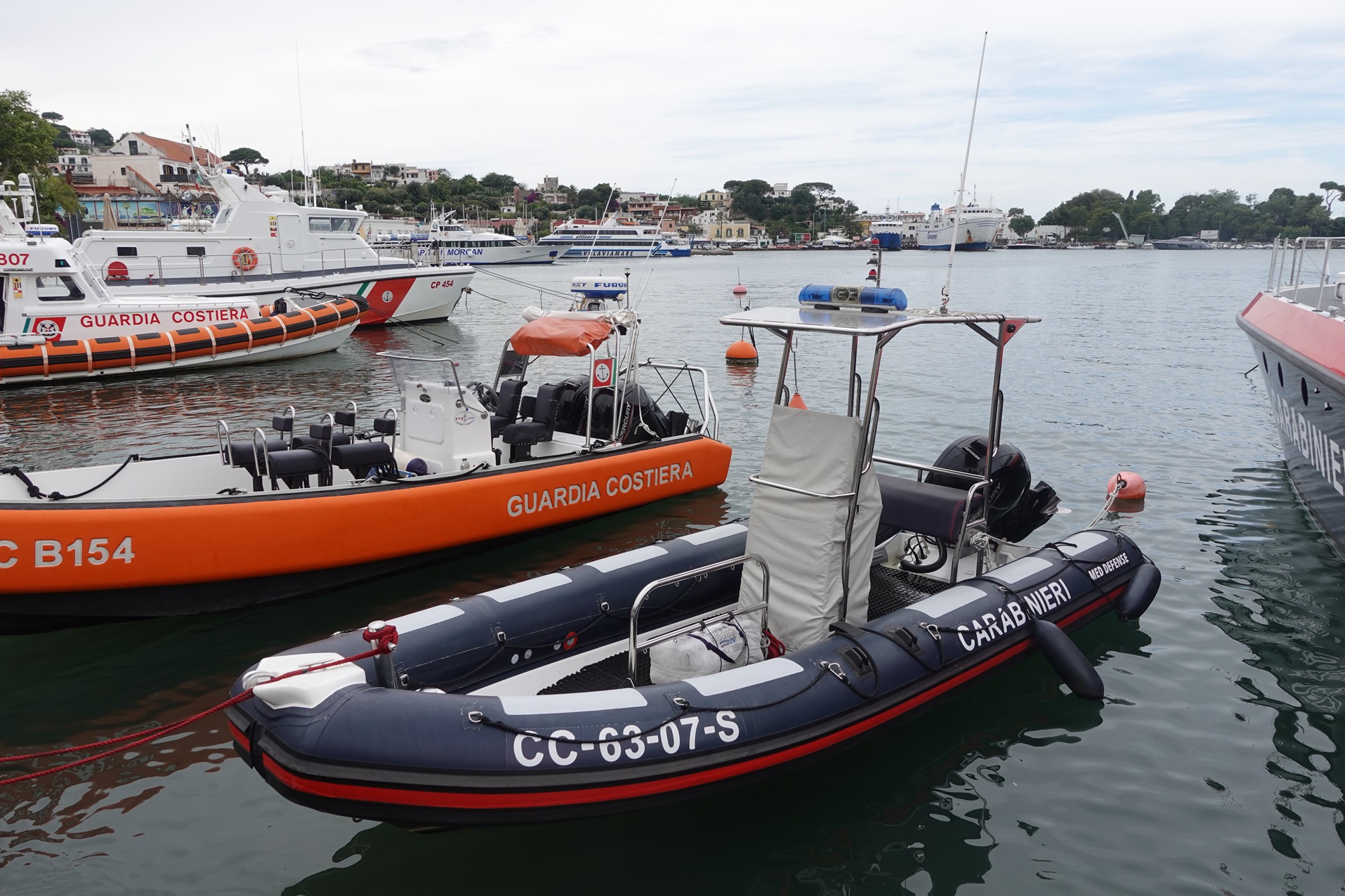
Boats of the police and lifeguards.
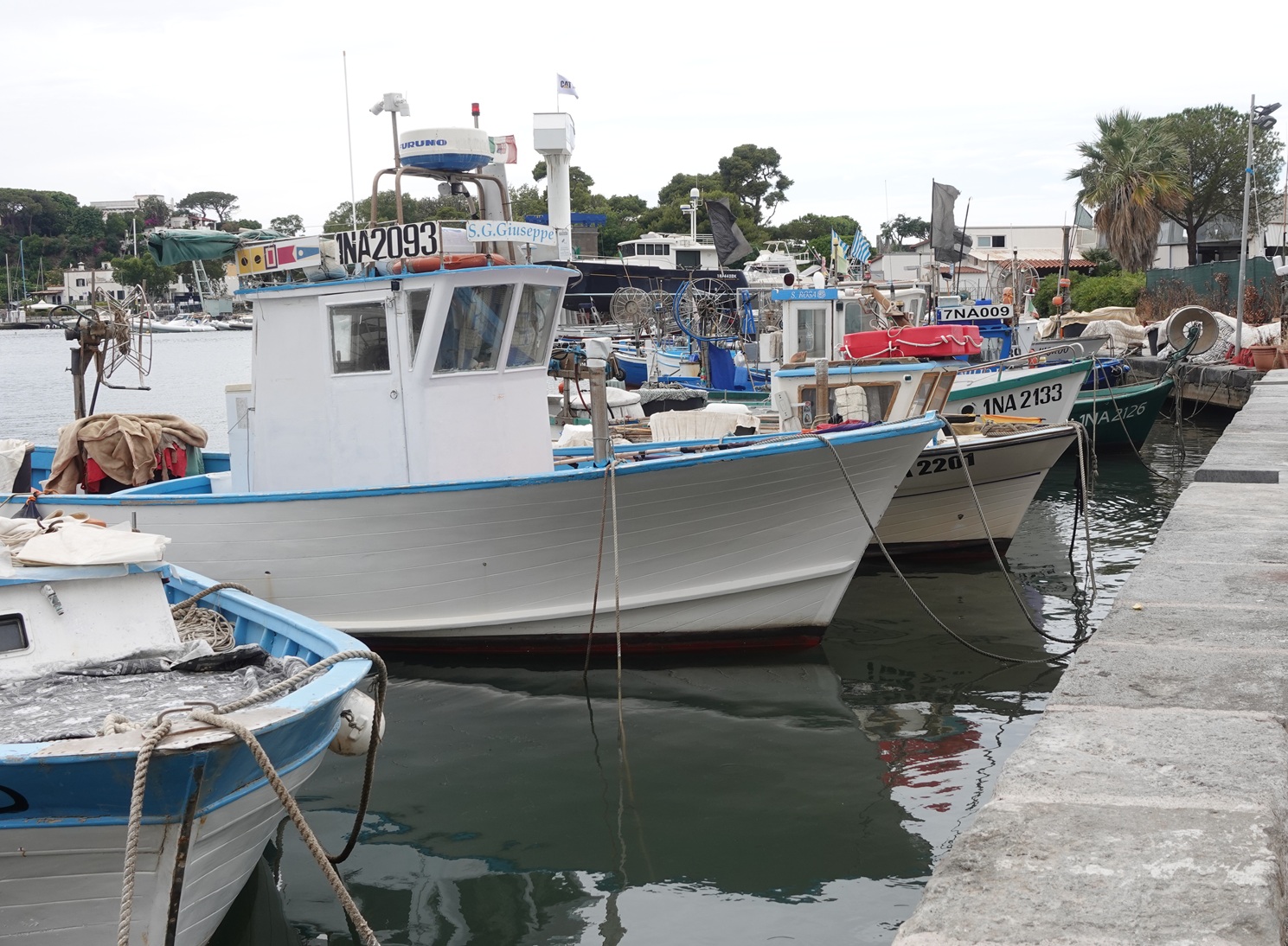
Boats docked at Porto Ischia
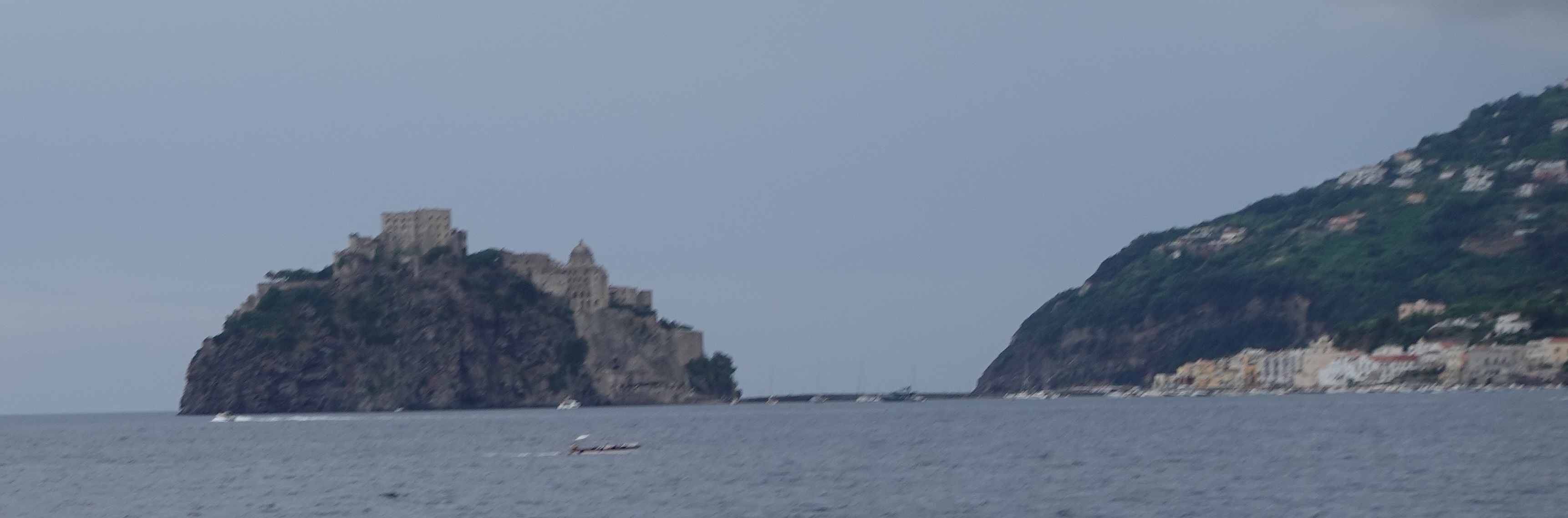
Leaving Ischia we get a distant view of Aragonese Castle, perched on a tidal volcanic rocky islet. A causeway connects the islet to the island of Ischia. The first castle was built in 474 BCE by Hiero I of Syracuse (tyrant from 478-467 BCE), and taken by the Romans in 326 BCE, and then recaptured by the Parthenopeans. In 1441 Alfonso V of Aragon replaced the wooden bridge with a stone bridge, and fortified the castle further to defend against pirate raids. By 1700, the islet had a population of 2000 famlies, a convent and abbey of Greek Orthodox monks (Basilian), and no fewer than 13 churches.
In 1809, the British laid siege to the islet and its garrisoning French, and nearly destroyed the castle by shelling. In 1912 the castle passed into private hands.
Parthenope was a city near to modern day Naples, founded at the end of the 8th century BCE. The city was named after the siren of Greek mythology, said to have washed ashore at Magaride*, after failing to bewitch Ulysses with her song.

A panorama of the Island of Procida.
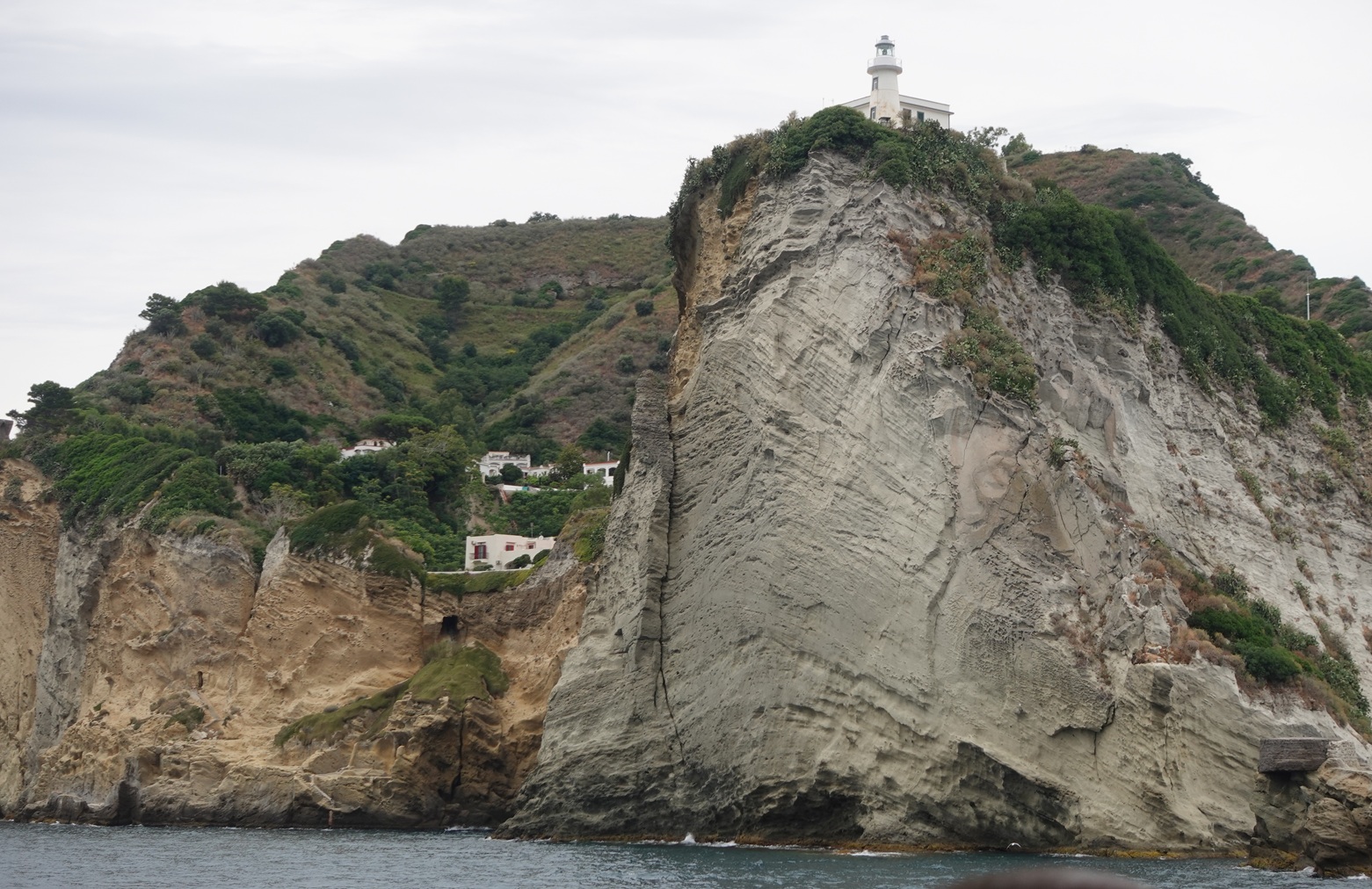
The lighthouse Faro Capo Miseno, on a cliff of tufo, the rock left by volcanic eruptions.
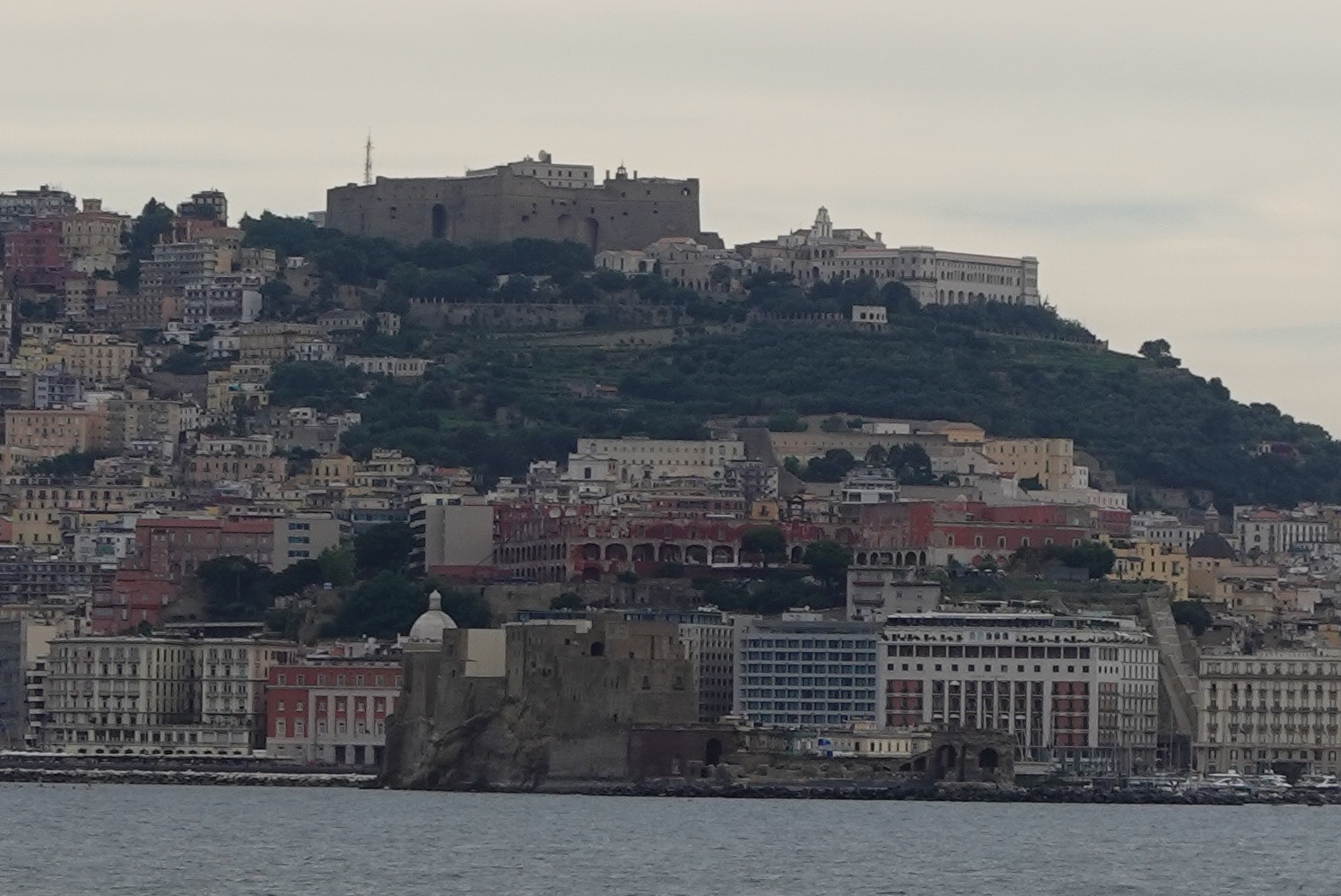
View of St. Elmo, overlooking the city of Naples, with Castel dell’Ovo at sea level.
*The location of the city of Parthenope lies at the foot of this mountain. Magaride was an island, now a peninsula, on which is Castel dell’Ovo, visible center bottom in the photo. The myth by Homer, the Odyssey, tells that Ulysses had himself secured to the mast of his ship, while his rowing crew stopped their ears with wax, so that he could hear the sirens’ song. Sailors who heard the song were so bewitched that they sailed onto the rocks to their doom. The siren Parthenope washed ashore here after having thrown herself into the sea, after failing to enchant Ulysses and his crew.
Not to be outdone, the Romans vamped up the myth by recounting that a centaur called Vesuvius (see where this is going…?) was madly in love with Parthenope. This infuriated Jupiter (the Roman upgrade of Zeus), who turned the centaur into a stratovolcano, and for an encore Parthenope into, believe it not, the city of Naples. Now, Vesuvius was not happy, as you can imagine, and to this day lets everyone know of his rage by frequent violent eruptions. (temper, temper….).
Not to be outdone, the Roman poet Virgil (of the Aeneid fame, a saga of the founding of Rome) had, by the Middle Ages, acquired a post-mortem reputation as a great sorcerer and oracle. In the legend that grew on this theory, Virgil placed a magical egg into the foundations of Castel dell’Ovo, to reinforce the fortifications. The egg remains there with his bones, and should the egg ever be broken, the castle would immediately turn into an omelette, and Naples would suffer disastrous events.
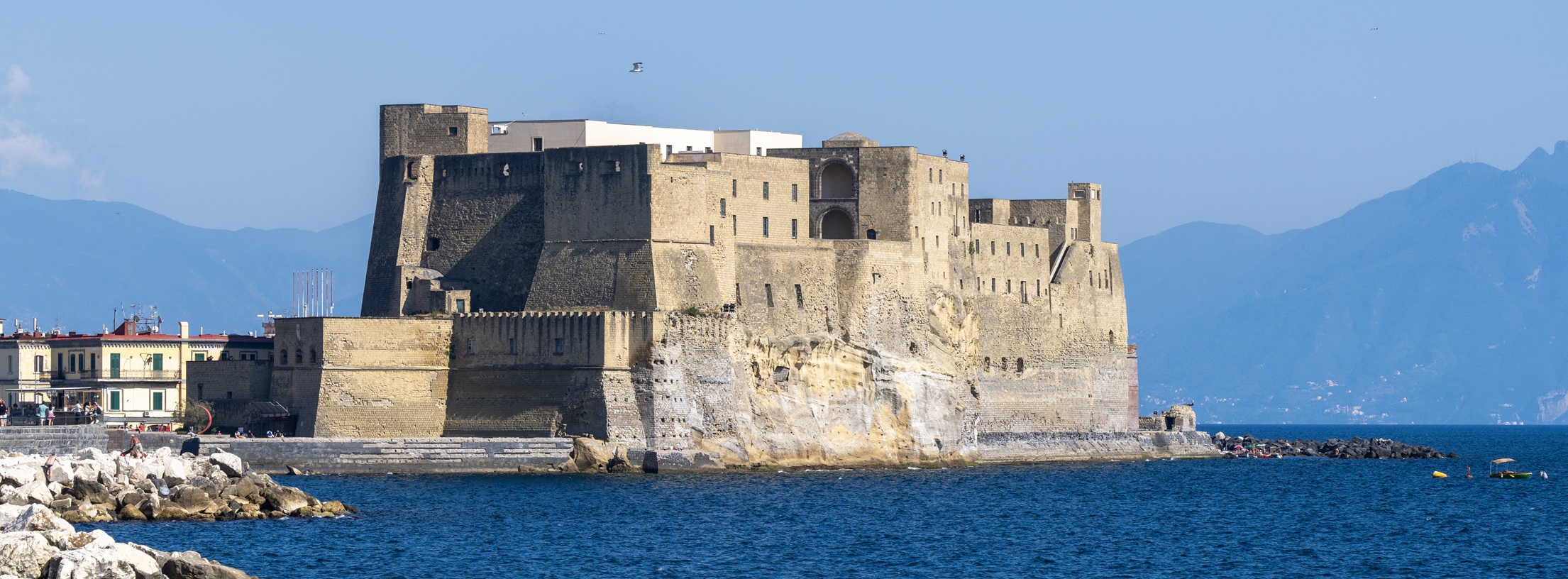
Castel dell’Ovo (Naples)
Image courtesy of Wikipedia
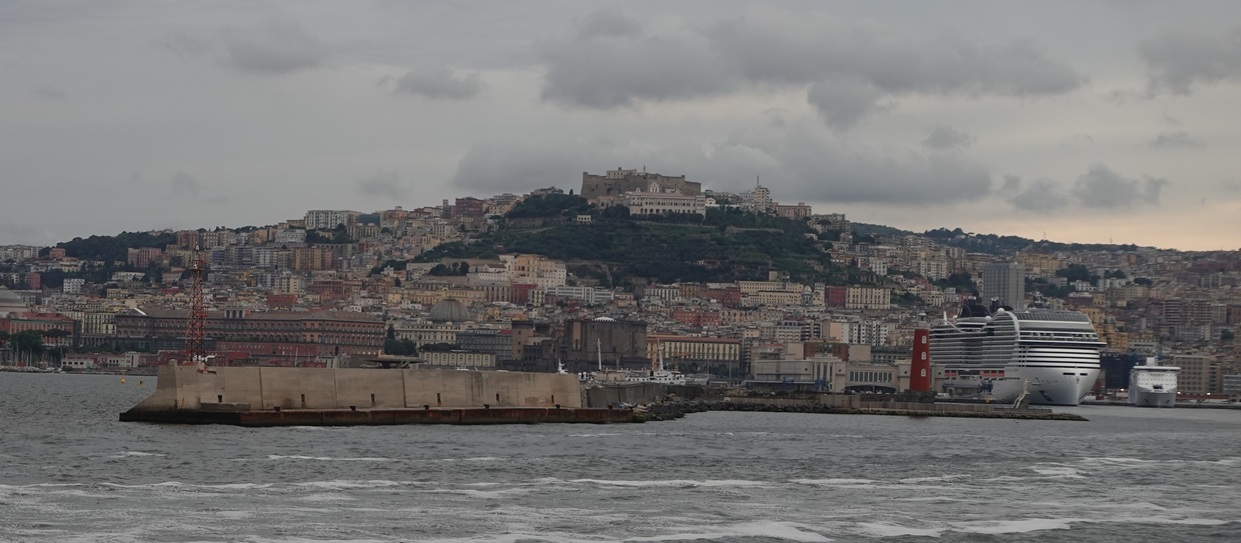
Arriving back at Naples, with a view of the harbour and Castel Saint`Elmo on Montesanto dominating the skyline. We docked by the cruise ship in the photo. These monsters are the size of office blocks.
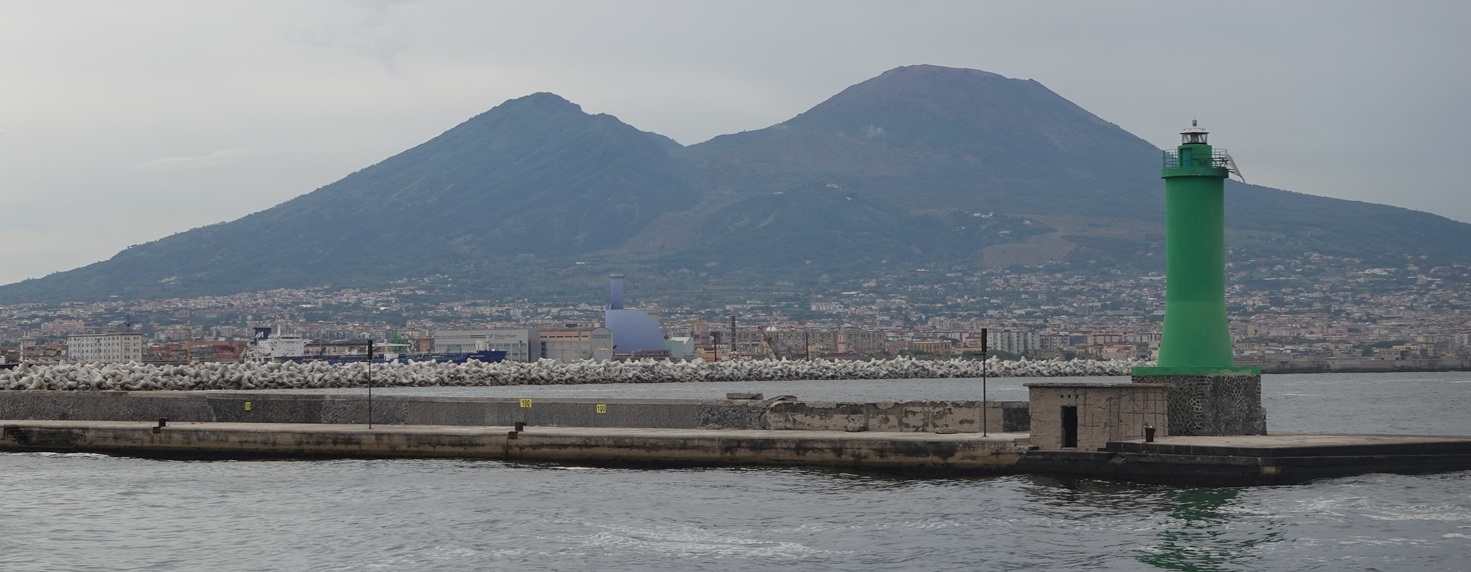
Rounding the Molo San Vincenzo, with its lighthouse, we have a view of Mt. Vesuvius across the Gulf.
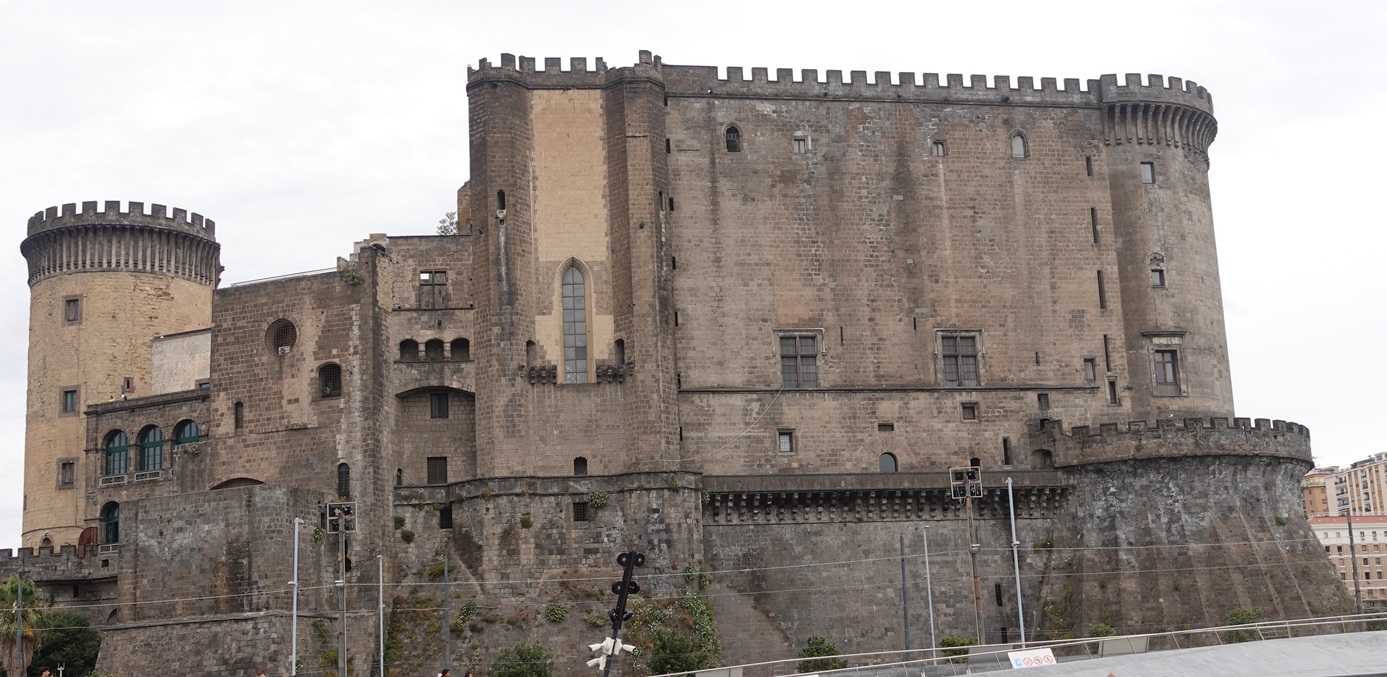
New arrivals to Naples are confronted by the enormous walls of Castel Nuovo – Maschio Angioino. Built 1475-1480 of yellow tufo, marble, and piperno stone (medieval and Renaissance sections), and red brick (facades with Baroque additions).
A previous castle at this site existed since 1279, and was subjected to regime changes and attacks by various throne claimants, reflecting the complicated history of this region.
From Wikipedia:
From 1343 onward, it served as the residence of Joanna I, who, in 1347, while fleeing to France, abandoned it to the assaults of the army of Louis I the Great, King of Hungary. He had come to avenge the death of his brother Andrew, Joanna’s husband, who had been killed in a palace conspiracy that the queen herself was suspected of having instigated. The castle was sacked, and upon her return, the queen was forced to undertake a radical renovation. During Louis’s second expedition against Naples, the castle, where the queen had taken refuge, withstood the assaults. In the following years, the fortress suffered further attacks: during the capture of Naples by Charles III of Durazzo and subsequently by Louis II of Anjou, who seized it from Charles III’s son, Ladislaus I. The latter, having regained the throne in 1399, lived there until his death in 1414.
Joanna II succeeded her brother Ladislaus and ascended the throne as the last Angevin ruler. The queen, portrayed as a dissolute, lustful, and bloodthirsty woman, is said to have hosted lovers of every kind and social background in her bedchamber—men even rounded up by her emissaries from among the handsome young commoners. To protect her reputation, Giovanna is said to have had no qualms about disposing of them as soon as her desires were satisfied. It is precisely in this regard that it has been told for centuries that the queen had a secret trapdoor inside the castle: her lovers, having fulfilled their purpose, were thrown into this pit and devoured by sea monsters. According to one legend, it was even a crocodile—having traveled from Africa across the Mediterranean to the castle’s dungeons—that was responsible for the horrific deaths of Giovanna’s lovers.
.
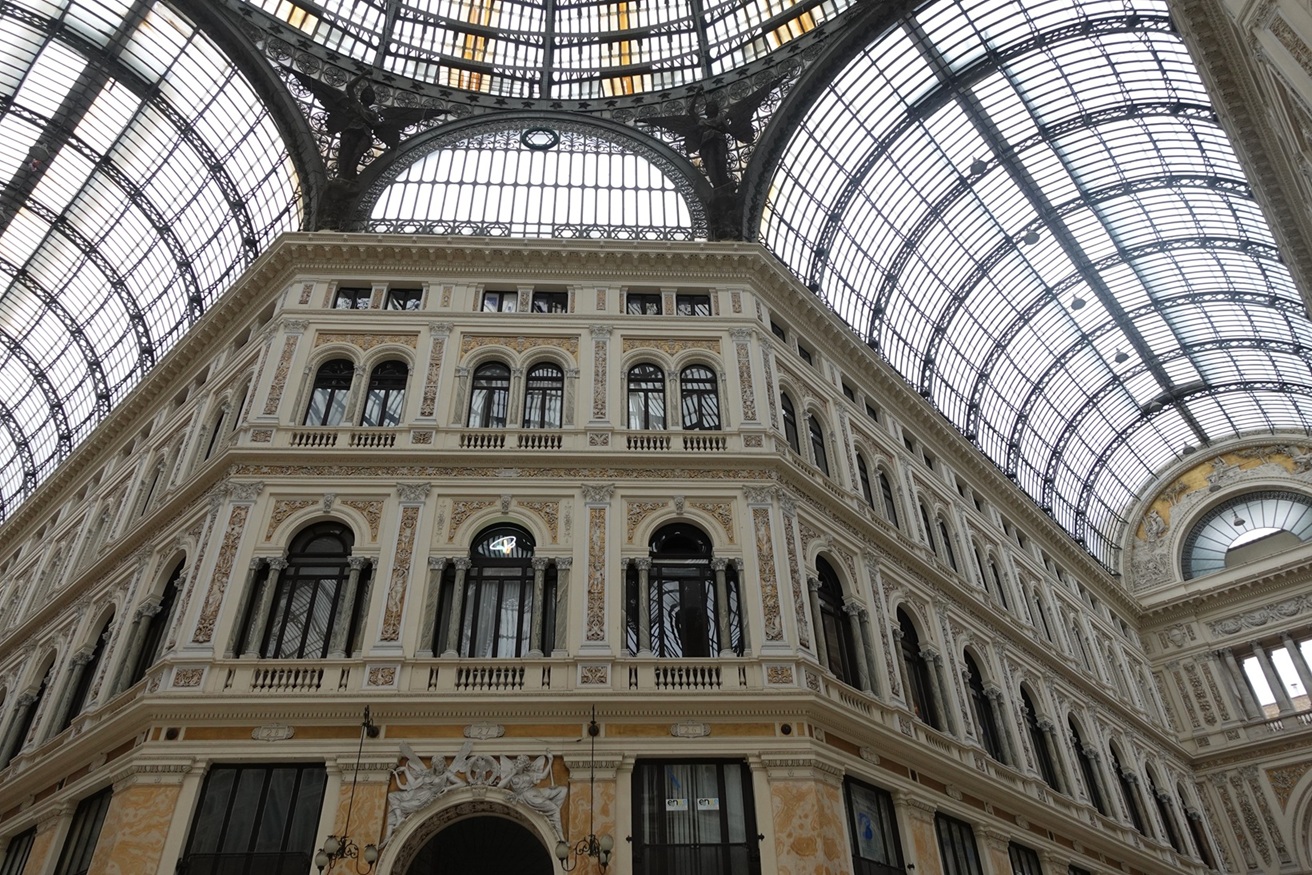
Galleria Umberto I.
Built from 1887-1890 in proto-liberty style, and named in honour of the king, to thank him for his generous presence during the cholera epidemic of 1884, which highlighted the needed for modernisation of the city`s infrastructure.
Kings of Italy:
- Vittorio Emanuele II, 1820-1878, reigned 1861-1878
- Umberto I, 1844-1900, reigned 1878-1900 (assassinated at Monza)
- Vittorio Emanuele III, 1869-1947, reigned 1900 – 09.05.1946 (abdicated)
- Umberto II, 1904-1983, reigned 09.05.1946 – 13.06.1946 (forced from the throne and into exile following the referendum declaring the Italian Republic.
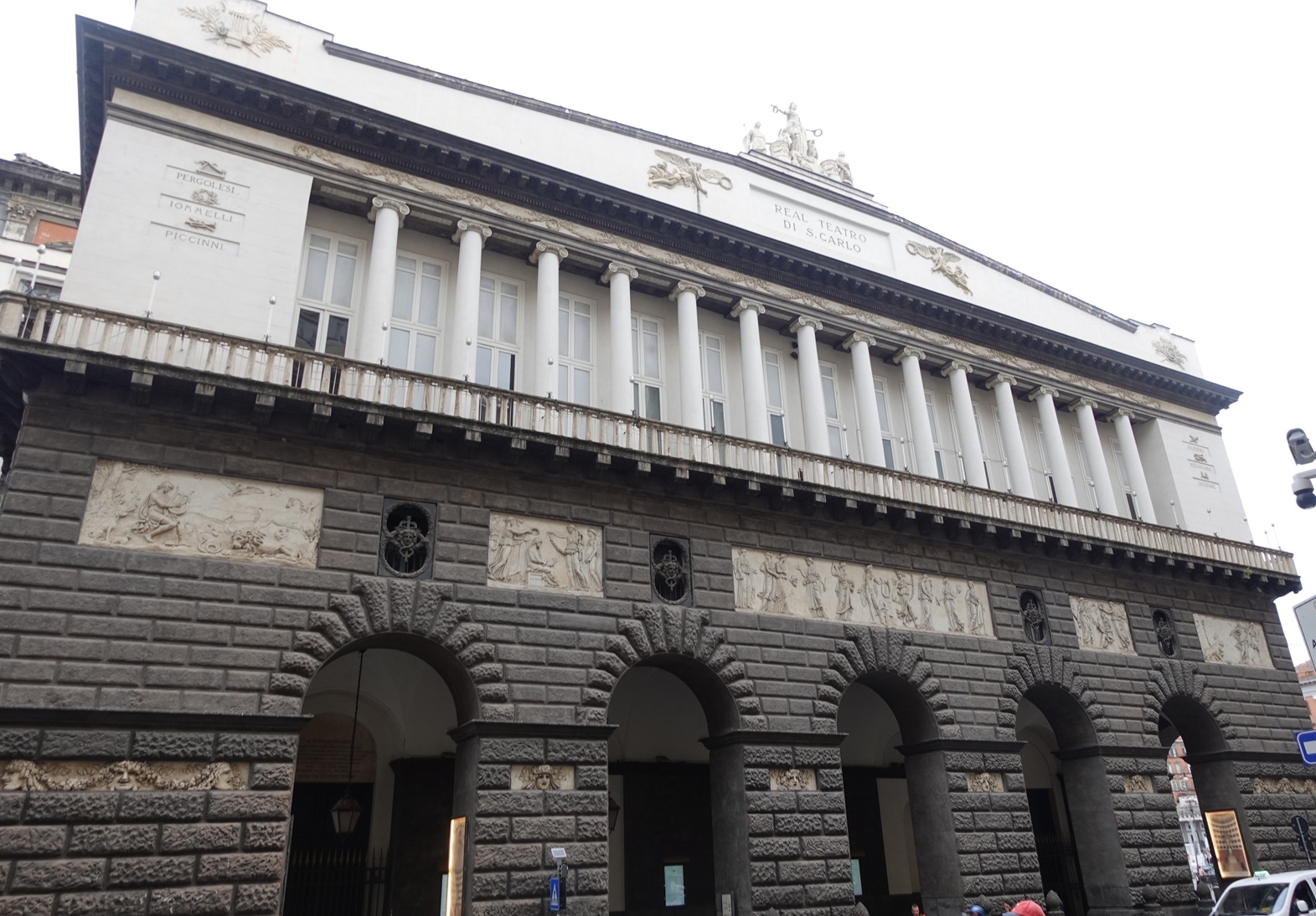
Teatro di San Carlo. Founded in 1737, it is one of the oldest theatres still in use in the world. It has a very large performance stage, and five levels of balconies in a horseshoe arrangement. It is built adjoining the Palazzo Reale, so that the royal family could enter the theatre without needing to pass through the street.
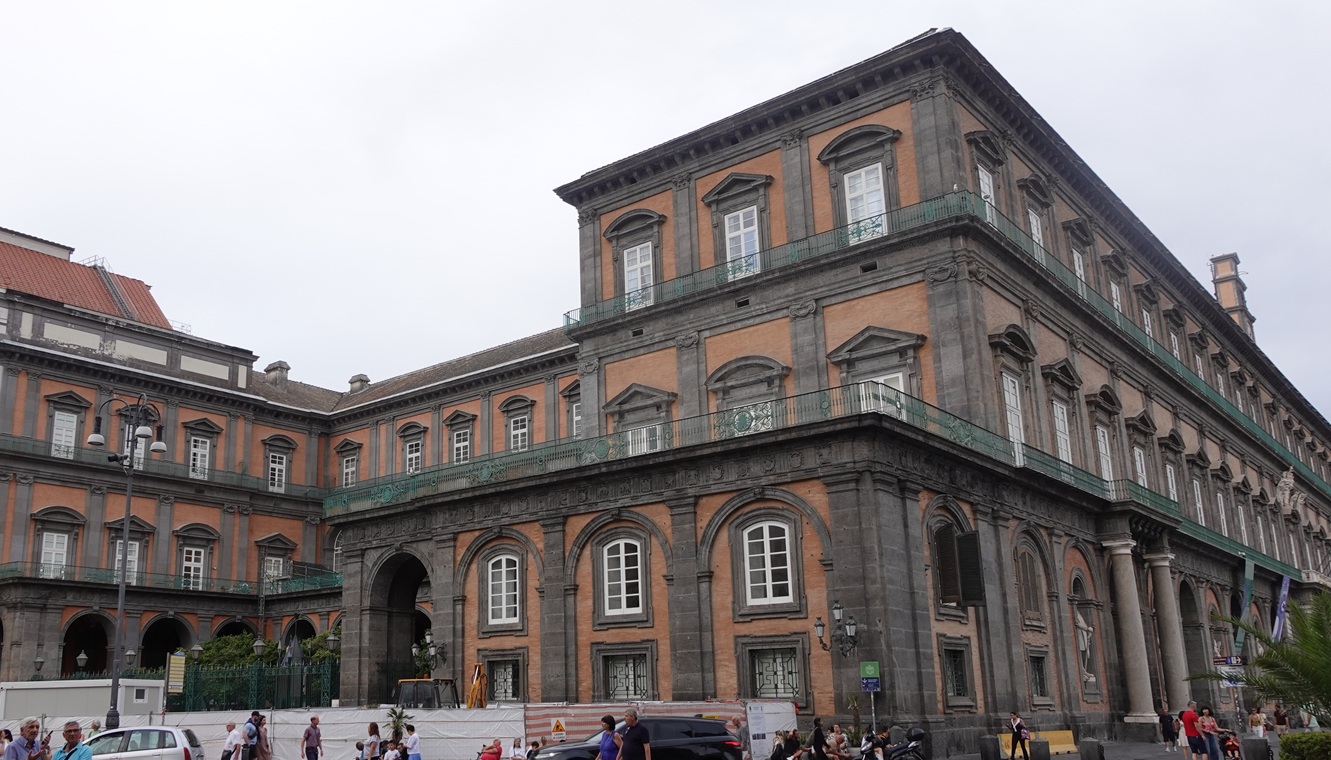
Palazzo Reale, Napoli. Its construction began in 1600, and took on its current form in 1858. It was the residence of Spanish viceroys, then Austrian viceroys, till 1734, the Bourbon dynasty from 1734 till 1860, with the Napoleonic decade from 1806-1815. The palace was passed to the state in 1919, and since then has been a museum.
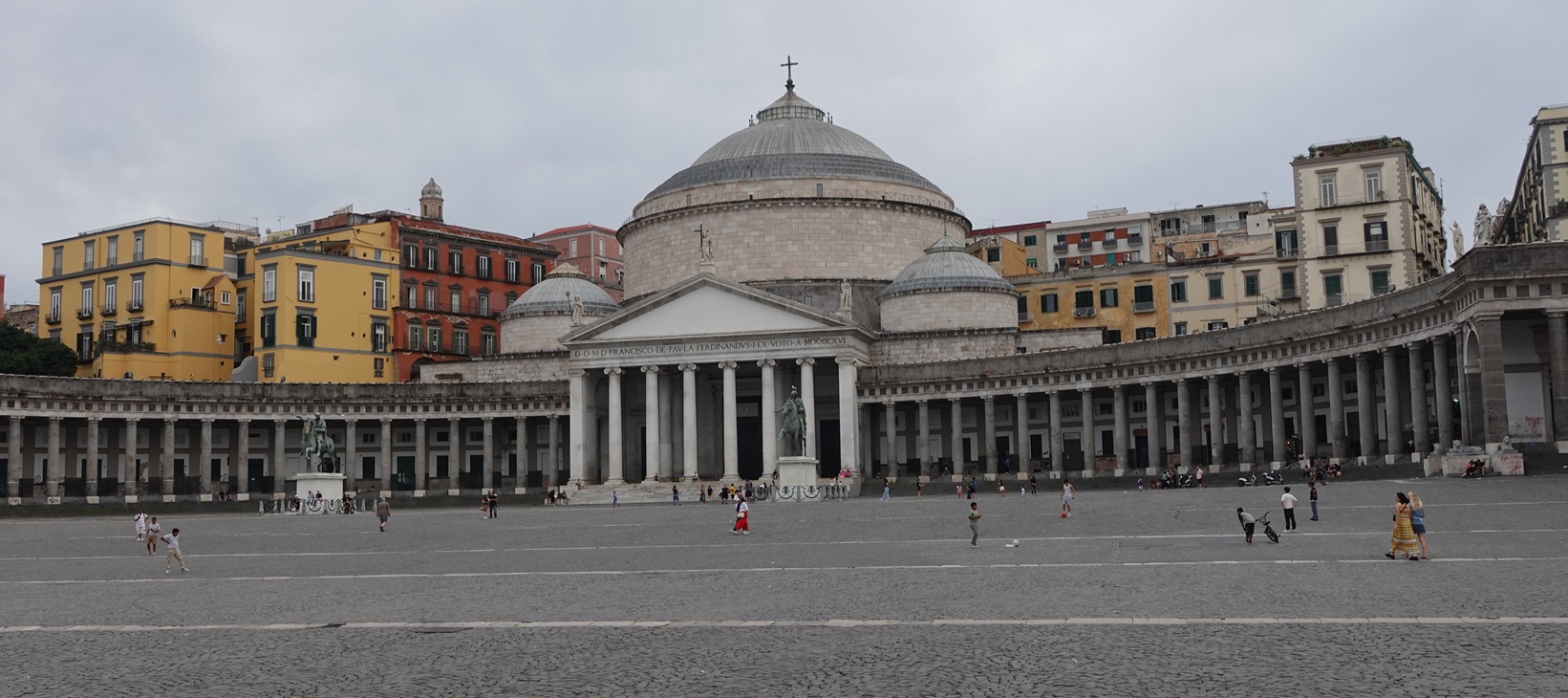
The San Francesco di Paolo Basilica in Piazza del Plebiscito.
The Piazza del Plebiscito is one of the largest in Italy, with 25,000 square metres. It is paved with basalt and porphyry.
The Royal Pontifical Basilica of Saint Francis of Paola is one of the most important examples of Neoclassical architecture in Italy. It was built between 1816 and 1846. During the Napoleonic decade, the French general Joachim Murat began the planning of a large piazza, but it was not till the restoration of the Bourbon dynasty that Ferdinand I of the Two Sicilies that the current basilica was built.
Joachim Murat (1767 – 18 October 1815) was one of Napoleon’s marshals. He became King of Naples as Joachim-Napoleon (Italian: Gioacchino Napoleone) from 1808 to 1815. He married Napoleon’s sister, Caroline, in 1800. He fought alongside Napoleon in many of the campaigns, including Ulm, Austerlitz, Jena and Eylau. It was at Eylau that he led a famous massed cavalry charger against the Russians.
He left after the Battle of Leipzig (16-19 Octobre 1813), during the retreat of the Grande Armee from its disastrous campaign in Russia, to return to Naples in an attempt to save his throne. In 1815, Murat launched the Neapolitan War against the Austrians, but was defeated at Tolentino (2-3 May, 1815). He fled to Corsica, and after attempting to retake his throne he was captured by King Ferdinand IV of Naples. He was tried for treason and shot by a firing squad in Pizzo on 18 October 1815.
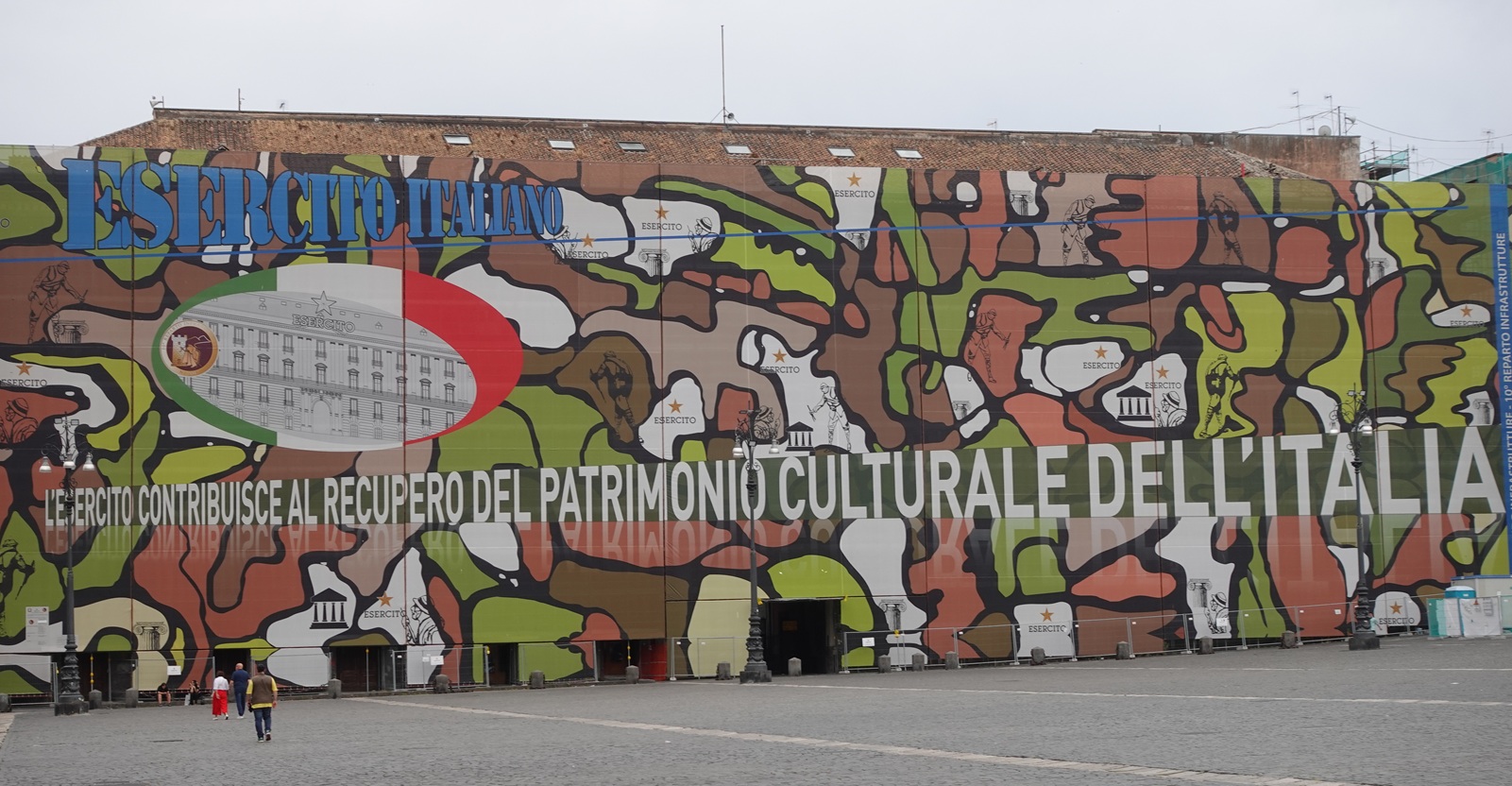
The current world situation and the move in Europe to expand its military capacities, is evident in this giant proclamation on the wall of a building adjoining the Piazza del Plebiscito.
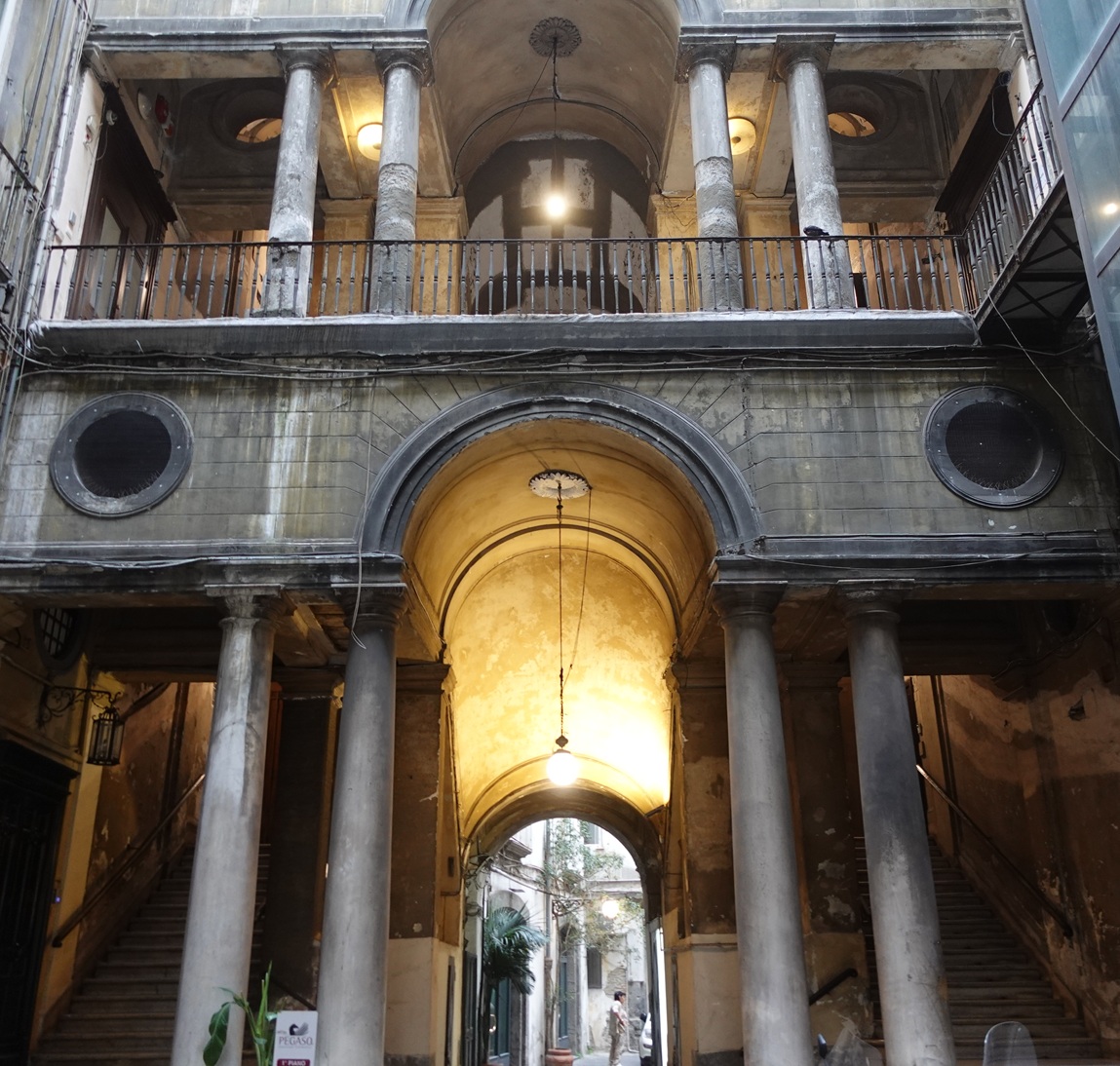
An inner courtyard in the Spanish district to the west of the Historic Centre.