Istanbul 2018
Day 1: Saturday 23 June 2018
Zurich – Istanbul – Mehmet Akif Ersoy Park – Hippodrome

Flying to Istanbul by Turkish Airlines. The view over the Balkans, and in particular the coastline to the Adriatic Sea, was quite spectacular.

We alight from the tram to gain our first glimpse of the The Blue Mosque, officially the Sultan Ahmed Mosque (Turkish: Sultan Ahmet Camii), a view through the Mehmet Akif Ersoy Park.
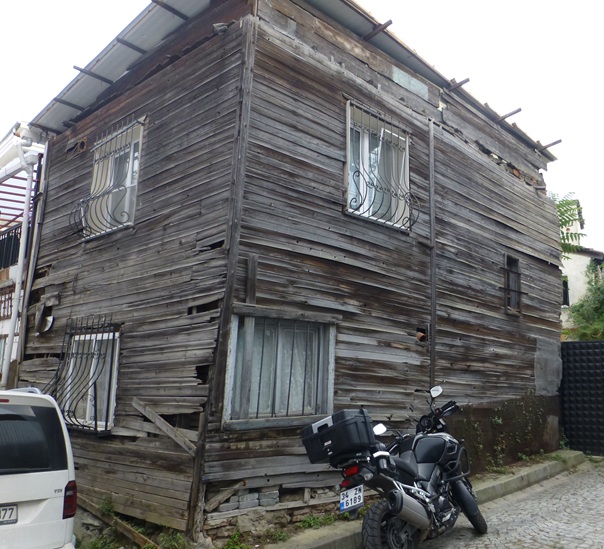
The traditional wooden houses of Istanbul have largely been lost to ‘development’, but our street had a few.

On the hill above the hotel area, we find these quaint wooden buildings.

The Hippodrome area has been maintained. Here we can see the ancient bronze Serpentine Column (Turkish: Yılanlı Sütun), which dates back to 479 BCE. It originally had three heads, and has alternative names of Plataean Tripod or Delphi Tripod. It is an ancient Greek sacrificial tripod from Delphi. Constantine took it as a souvenir in 324 CE, and commemorates the Greeks who won the Battle of Plataea in 479 BCE against the invading Persians.
The originally 8 metre high column was intact till the end of the 17th century. One of the heads is on display in the Istanbul Archaeological Museum.

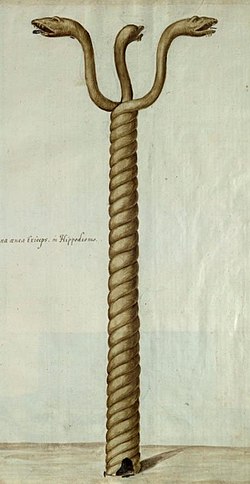
The original column. Image courtesy of Wikipedia

The Hippodrome, with the Egyptian Obelisk of Theodosius, from 1500 BCE, which had stood outside Luxor until Constantine nicked it for his new capital of the Eastern Roman Empire.
The Hippodrome of Constantinople
The Circus Maximus is today Sultanahmet Square (Turkish: Sultanahmet Meydanı). It has existed since Roman times, when in 203 CE Emperor Septimus Severus rebuilt parts of the city, then called Byzantium, expanding the walls, and adding the hippodrome as an arena for chariot races and other spectacles.Under Emperor Constantine the Great, the city became Nova Roma in 324 CE, then later Constantinople. He also undertook changes to the city, and remade the Hippodrome. It was probably about 450m long and 130m wide. The monolithic obelisk and the serpentine column are located along the spina, or middle barrier of the course.

The base of the ancient Obelisk of Theodosius has intrigantly carved reliefs.
The obelisk was erected in the 18th dynasty of Egypt by Pharaoh Thutmose III (1479–1425 BC).
The 18th Dynasty was the first dynasty of the New Kingdom of Egypt. It spanned 1550-1292 BCE, and it was during this era that ancient Egypt reached its peak power. It is also referred to as the Thutmoside Dynasty, since four of the pharoahs were called Thutmoside. Tutankhamun (reigned 1332-1323 BCE), Hatshepsut (c. 1479 BC–1458 BCE), the longest-reigning woman pharaoh, and Queen Nefertiti (c. 1370 – c. 1330 BCE), all belong to this dynasty.

Thutmose III (1481-1425 BC), the fifth pharaoh of the 18th Dynasty of Egypt. This statue is held in the Luxor Museum, Cairo. Image courtesy of Wikipedia

This wonderfully complete bust of Nefertiti, the great royal wife of Pharoah Akhenaten, is currently held by the Neues Museum, Berlin. Image courtesy of Wikipedia

Hieroglyph on the Obelisk of Theodosius from Egypt.
The obelisk was erected as part of the great temple of Karnak. Roman emperor Constantius II (337-361 CE) transported (aka stole) two obelisks. One he transported in 357 CE to the spina of the Circus Maximus in Rome, and is called the Lateran Obelisk. The twin was left in Alexandria until 390 CE, when Theodosius I (379-395 CE) took it to Constantinople.
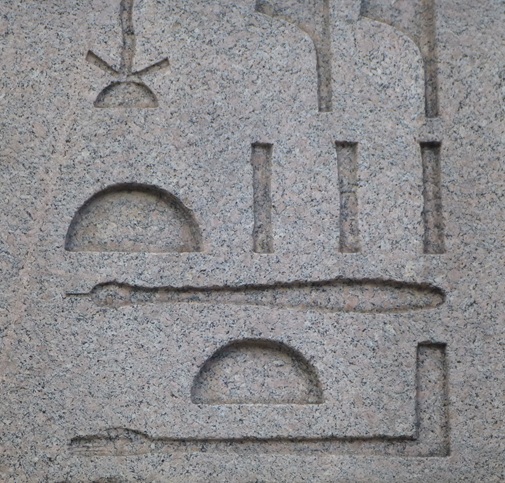
Hieroglyphs on the Obelisk of Theodosius.
Jean-François Champollion (1790 – 1832) was the first to decipher hieroglyphs, with the help of the Rosetta Stone, obtained during Napoleon’s ill-fated expedition to Egypt in 1798-1801.

Hagia Sophia
This Church was built in AD 537. The name means “wisdom”. The minarets were added in the 15th–16th centuries, when it became a mosque, following the 1453 conquest of Constantinople by the Ottomans. It is considered the epitome of Byzantine architecture.

The Blue Mosque (Turkish: Sultan Ahmet Camii)
Located across the park from Hagia Sophia, this stunningly beautiful mosque rivals it for attention. It is a fine example of Ottoman architecture, built between 1609 and 1617 during the rule of Ahmed I.
It features four semi-domes around a central dome, and the inside is decorated with thousands of Iznik tiles. Iznik tile pottery is named after the town of Iznik in Anatolia, Türkiye where it was made for Ottoman buildings especially those of Istanbul such as the Topkapi Palace and the Blue Mosque. There are 6 minarets.

The Blue Mosque (Turkish: Sultan Ahmet Camii)
The central dome is 43m in height and the 6 minarets 64m each.
Travel Diary
The tram takes us to Sultanahmet, next to the Seraglio Point, where we gain our first glimpse of the Hagia Sofia and the Blue Mosque. We walk down the hill towards the sea, to our Hotel, Erten Konak, supposedly 4-star. The room is disappointing, and not at all like the photos on Booking.com. Luckily, we had booked only two nights, being suspicious and wanting to keep our options open. It is going on evening, so we return to the Hippodrome and the Serpentine Column, dating back to 479 BCE. It was shipped from Delphi, Greece. And then the Egyptian Obelisk, from 1500 BCE, which had stood outside Luxor until Constantine nicked it for his new capital of the Eastern Roman Empire.
We saw a little bit of the courtyard leading into the Blue Mosque, and located the Basilica Cistern. Too late to visit either. We brave the wind to eat in an outside restaurant near the Roxelana Baths, or Hürrem Sultan Hamami, where we could enjoy a Whirling Dervish performance on a small stage in the restaurant. Our first call to prayer sounds out from a Blue Mosque minaret, which was answered by other minarets around the city.