Pavia, 2025
Day 1: Tuesday 04 March 2025
Pavia

Statue of Minerva
A not inaudacious statue on Viale Libertà, Pavia. Minerva is the Roman goddess equivalent of the Greek Athena. She is the goddess of wisdom, justice, law, victory. As the shield and spear suggest, she is also the goddess of ‘strategic’ warfare, as opposed to the ‘violent’ warfare of Mars. She is one of the three Roman deities which compose the Capitoline Triad, which includes Jupiter and Juno. This group was worshipped in a temple on Rome’s Capitoline Hill (capitolium). Her symbols include the owl (wisdom and knowledge), the snake and the olive tree. Marcus Terentius Varro (116–27 BCE), the Roman polymath, considered her to be ideal and the plan for the universe personified.
It’s a long story, but this tough gal was born from the head of her father, Jupiter, as a grown adult, in full battle armour.
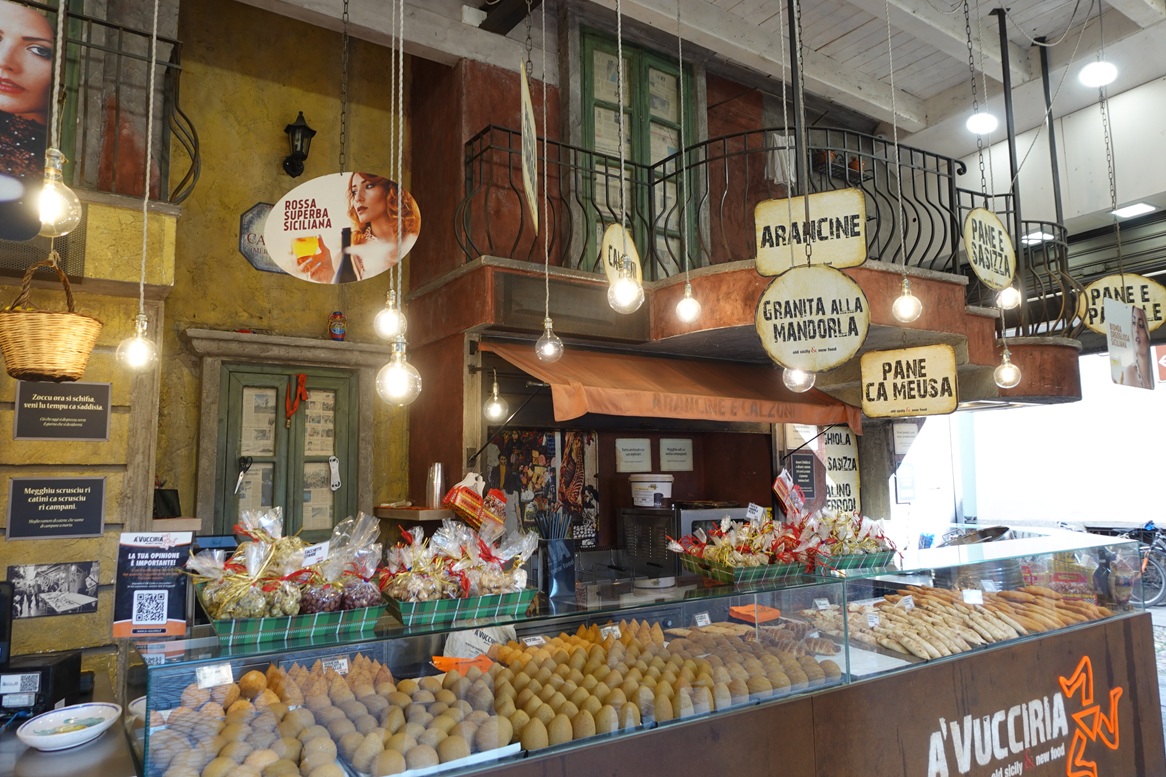
A’AVUCCIRIA old Sicily & new food
We were quite taken by this creative shop in the heart of Pavia, selling freshly baked pastries, pies, cakes, and Sicilian traditional food.
In the display we can see the arancino di riso, a traditional speciality of Sicily and Calabria. It is a ball or cone of breaded and fried rice. The filling is usually meat sauce, peas and caciocavallo cheese, or cooked ham and mozzarella.
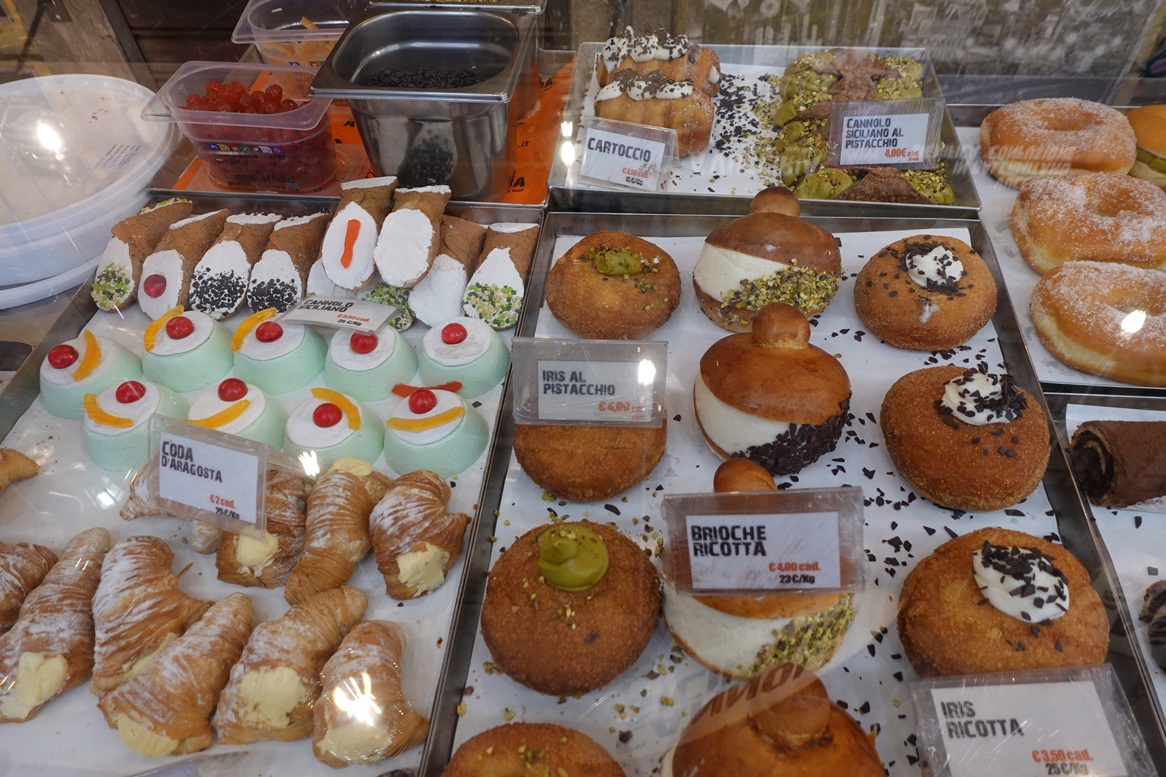
Some of the irresistible cakes on display at the A’AVUCCIRIA old Sicily & new food shop and bakery, Pavia
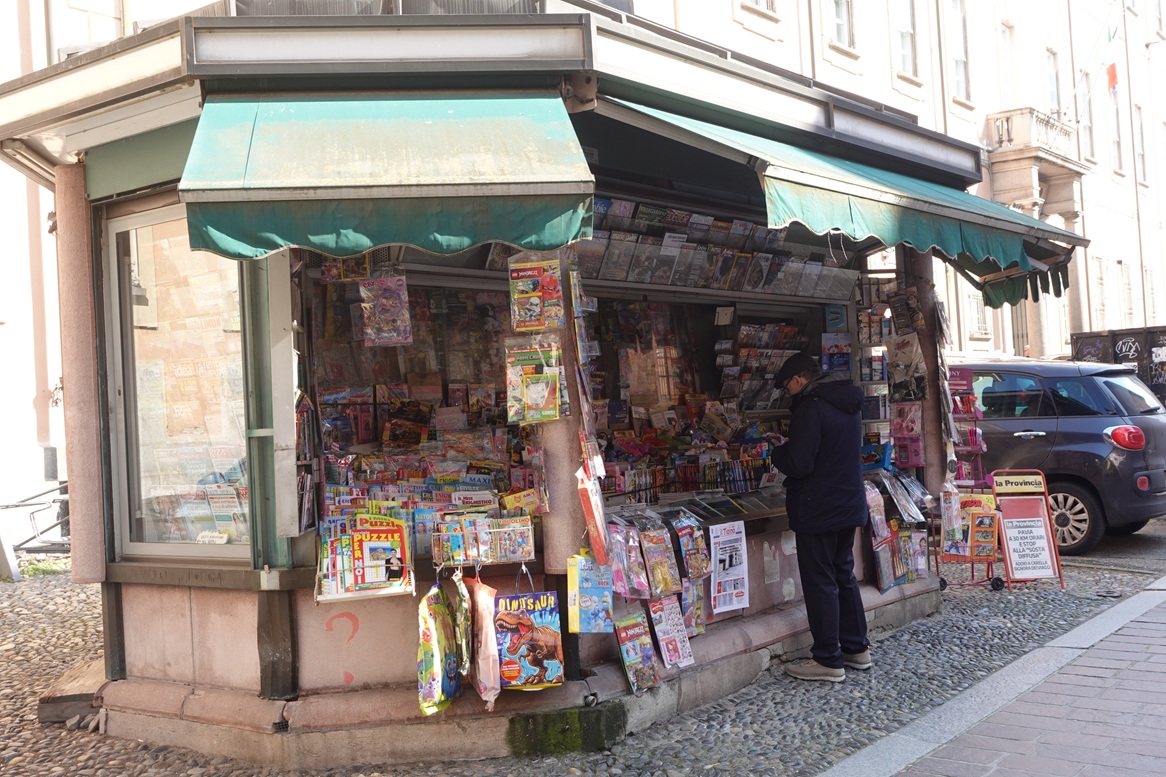
A typical Italian Edicola. This charming street stall can be found in all towns and cities of Italy. Apart from newspapers and magazines, they also offer toys, games and other items. Interestingly, the name derives from a religious word, aedicŭla, which is the diminutive of aedes, meaning temple.
This is the beginning of Corso Cavour, which traces the old Roman “decumanus” road, the west-east road of a Roman military camp, or castrum.

Duomo di Pavia (Cathedral), Santo Stefano protomartire e Santa Maria Assunta (St Stephen the Protomartyr and St Mary of the Assumption), Construction began in 1488 and was not completed, believe it or not, till 1933. On this site were pre-existing “twin” Romanesque cathedrals, Santo Stefano and Santa Maria del Popolo, from the 6th and 7th centuries.
The marble facing of the exterior was never completed. The church is on the Greek Cross plan, giving it the same length and width at the transept. It is 84m high, making it one of the largest buildings in northern Italy.

Memorial plaque to the victims of the Civic Tower collapse.
Next to the Pavia Cathedral are the ruins of the base of the Civic Tower (Torre Civica). The first documental reference to the tower dates to 1330, and it was enlarged in 1583 to 72m high. Four unlucky people were killed, and fifteen injured, by the falling tower, which collapsed at 8:55 a.m. on 17 March, 1989.

Photo of the Civic Tower before its collapse.
Image courtesy of Wikipedia
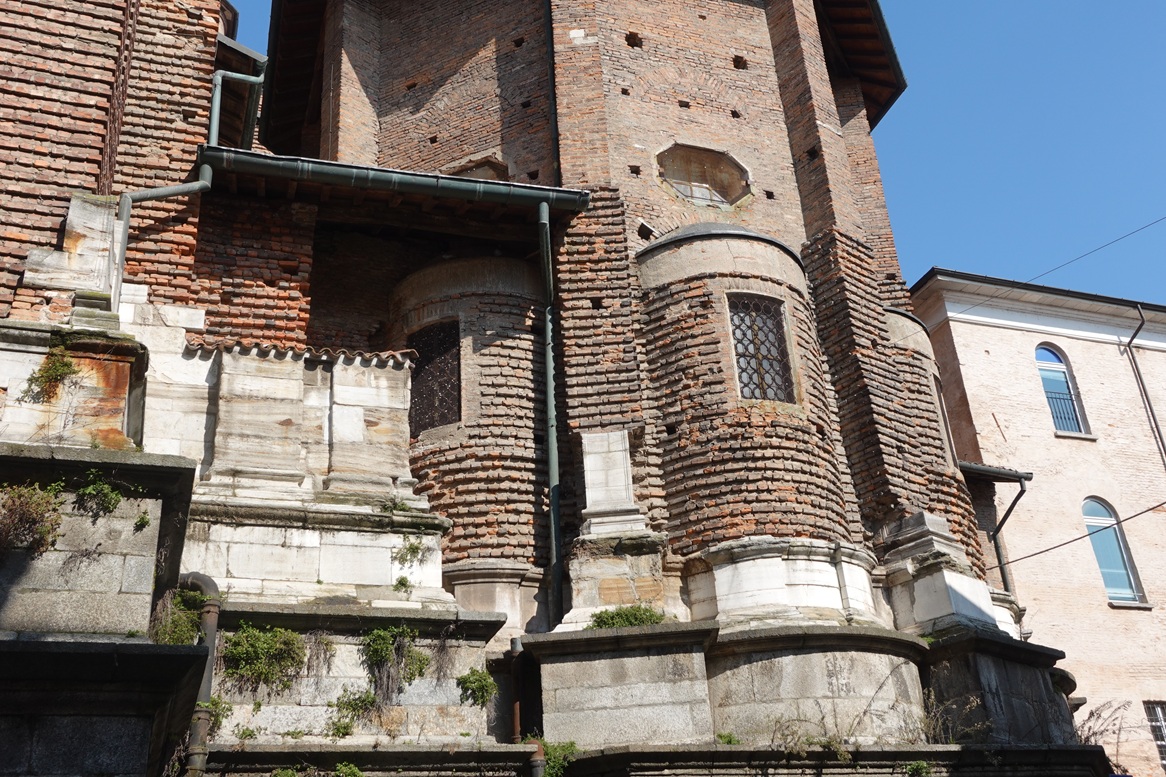
The rear of the Duomo, showing the incomplete marble facade.

Cathedral, Pavia, central nave.
This Renaissance style church of the 15th century and later replaced the previous Romanesque structures, but the crypt of Santa Maria del Popolo has been preserved, and dates back to the 11th century. Names associated with the design are Donato Bramante (1444 – 1514) and Leonardo da Vinci (1452 – 1519).
Bramante was the architect who introduced Renaissance architecture to Milan, and High Renaissance to Rome. His plan for St. Peter’s Basilica in the Vatican, Rome, formed the basis of the design executed by Michelangelo. Although he was not the main architect behind the Pavia Cathedral, the design adopted by Giovanni Antonio Amadeo and Gian Giacomo Dolcebuono, of the nave and two aisles, with semi-circular niches alongside, and a large, central dome, was influenced by him. However, the design of the crypt (1492) and the base section of the apse and sacristies are attributed to him.

The dome of the Cathedral di Pavia
The dome is octagonal and 97m high, and weighs 20 kilotons, making it the fourth largest by size in Italy, after St. Peter’s Basilica (136.6m tall), the Pantheon (43.3m height and width) and the Cathedral of Florence (114.5m high).
After the collapse of the Civic Tower, restoration work began on parts of the cathedral presenting structural problems. In the photo are evident the repairs undertaken to consolidate the cupola.
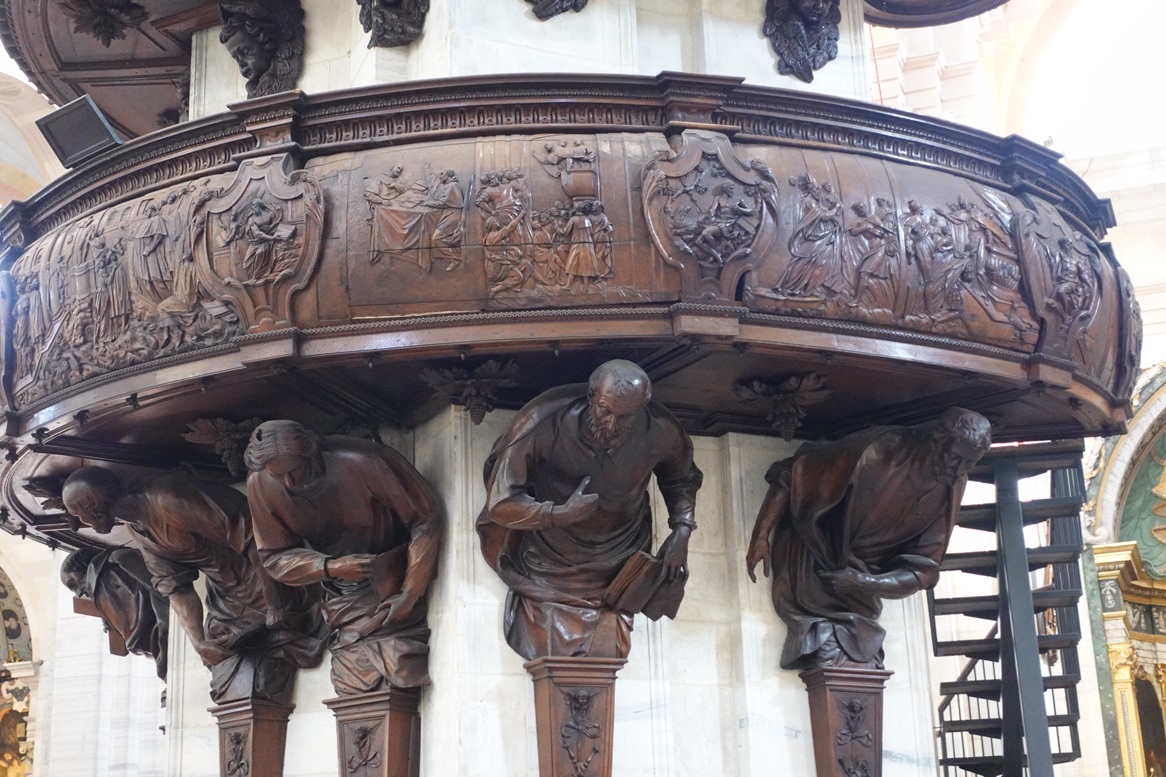
Wooden carvings around the rostrum on a central support column in the transept of the Cathedral of Pavia

Altare di Sant’Alessandro Sauli
Alessandro Sauli was born in 1534 in Milan, and died 1592 in Calosso, Piedmonte. A priest in Aleria and Pavia, he taught theology and philosophy at the University of Pavia. He was declared a saint by Pope Pio X in 1904.

A thorny history
The church supposedly holds three thorns from Christ’s crown. Tradition recounts the crown of thorns worn by Christ during the Passion was ‘found’ by Saint Helena, the mother of Constantine, around the year 327. She also supposedly found nails from the cross, which are integral part of the famous Iron Crown, which has been used to crown kings of Lombardy and Italy, including Napoleon, since the 800s CE, and is now housed in the Monza Cathedral.In a tradition dating back to 1645, during the Pentecost (49th day after Easter) vigil, the three thorns from this crown housed here in Pavia Cathedral are taken out for a spin in a procession. The ‘macchina delle spine’ (thorn apparatus) is located above the central altar, and the rig from which the thorn casket is lowered can be seen.
How the three thorns made their way to the cathedral is a true intrique. After Helena ‘found’ the crown of thorns around 327, it was conserved in Jerusalem, before being taken to Constantinople around 1063. Latin Emperor of Constantinople Baldovino II (1217 – 1273), also known as Baudouin II de Courtenay, pawned the crown of thorns with Venetian merchants. Louis IX of France subsequently bought the crown and took it to Paris, where it was placed in the Sainte-Chapelle. In 1327, Philippe VI of Valois loaned one of the thorns to Gian Galeazzo Visconti. The other two thorns were donated by the Byzantine Emperor Manuel II Paleologo during his visit to Pavia in 1400. (I guess this means some of the thorns were swiped from the crown before it was pawned by Baldovino?)
These relics were held in the Visconte Castle in Pavia till 1499, when, as Ludovico il Moro, Duke of Milan, fell from power as the result of the French invasion, they were transferred to the cathedral. One of the thorns was stolen by a French soldier when Pavia was sacked in 1527. However, the thief later repented, left it at Loreto, from whence it was taken back to Pavia.

Saint Syrus’ remains and above, a monumental ancona in white marble and alabaster base (1645-1650), representing Mary delivering the keys of the city to Saint Syrus. Saint Syrus was, it is believed, the first bishop of Pavia, during the 1st century CE. Legend has it he followed Peter to Rome, from whence he travelled to the Po valley to preach the Christian faith in all the major cities of northern Italy. One of his attributes is the conversion of Arian followers.
Arianism
A doctrine whose main proponent was Arius (256-336 CE). It holds that the Catholic Trinity is false, and that Jesus was distinct from, and begotten by, God. Isaac Newton was an Arian, incidently.Homoousianism (the belief that the Father, the Son and the Holy Spirit are one and the same) became the official version at the first two ecumenical councils. After this Arianism had to be suppressed, so was declared a heresy.
“Eucumenical” comes from Later Latin oecumenicus, meaning “general, universal”. In Greek, oikoumenikos means “from the whole world”. The First Council of Nicaea (today Iznik, Turkey) was convened by the Roman Emperor Constantine I, between May and July, 325 CE. The second ecumenical council was held in Constantinople in 381 CE by Roman Emperor Theodosius I.
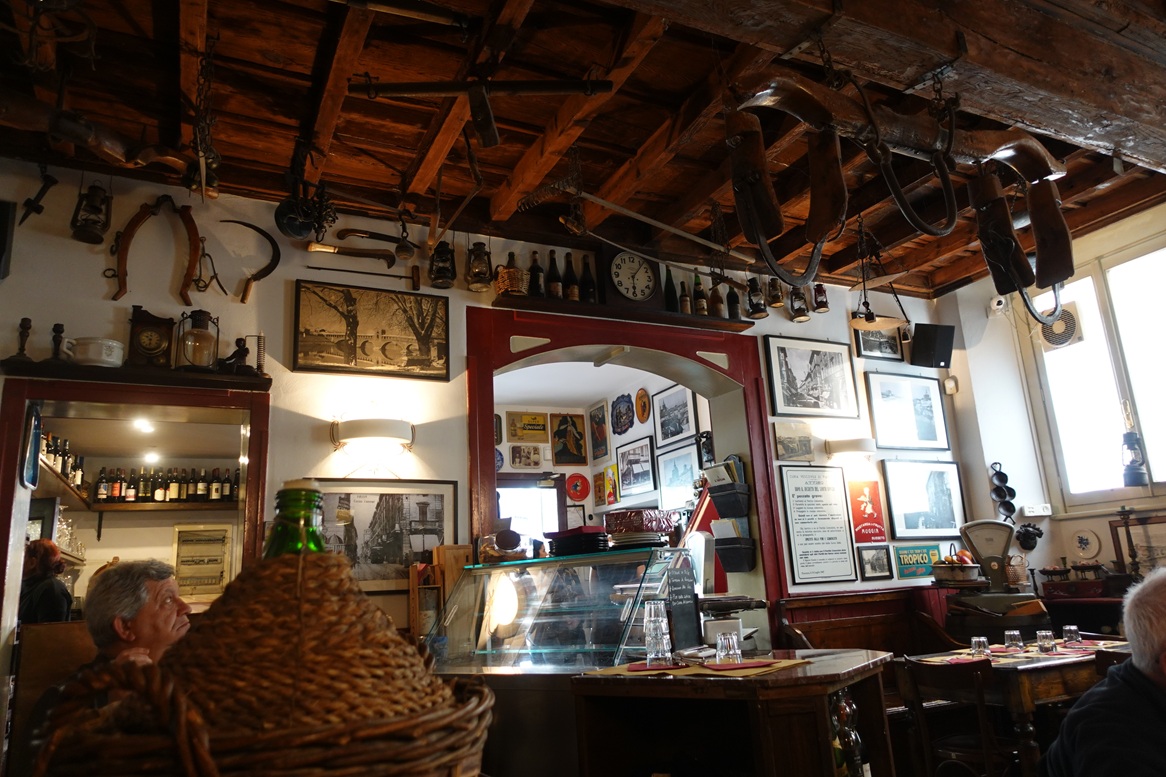
Il Cuplone Hostaria, Pavia
This charming family run restaurant near the Cathedral was very popular, and offers specialities from the Pavese, Lomellina e Oltrepò Pavese regions. The walls and ceiling are adorned with a vast collection of agricultural and household tools, as well as old photographs and memorabilia of the town and region. We highly recommend it.

Ponte Coperto (Covered Bridge) over the Ticino River, Pavia
This icon of the town of Ticinum (Pavia) dates back to the 14th century. It was bombed by the Allies, and partially destroyed, in September, 1944, but was rebuilt exactly as it was between 1949 and 1951. The chapel, built in 1746, in the centre of the bridge is the original, however. It remains the only brick bridge on the Ticino between Lago Maggiore and the Po.

In pre-Roman times, the Ticino entered the Po at the point where the bridge stands today. Through time, the confluence point moved a few kilometres, so the Romans built a bridge across the Ticino River at Pavia, which they called Ticinum. When the Romans lost the Battle of the Ticino in 218 BCE, to the invading Carthaginians, under Hannibal, they were forced to retreat towards Piacenza, and destroyed the bridge to impede the advance of Hannibal.
A bridge was built across the river in the first century CE, and the central pylon of this bridge is still visible when the water level is low. This bridge remained in service throughout the high medieval period, and was restored in 860 CE. It had a vital role as the node point at the intersection of two major trading routes across the Padana Plain: the fluvial route, navigating the two rivers to the Adriatic and Venice, and the north-south route connecting Genoa (and the Mediterranean) and Milan.
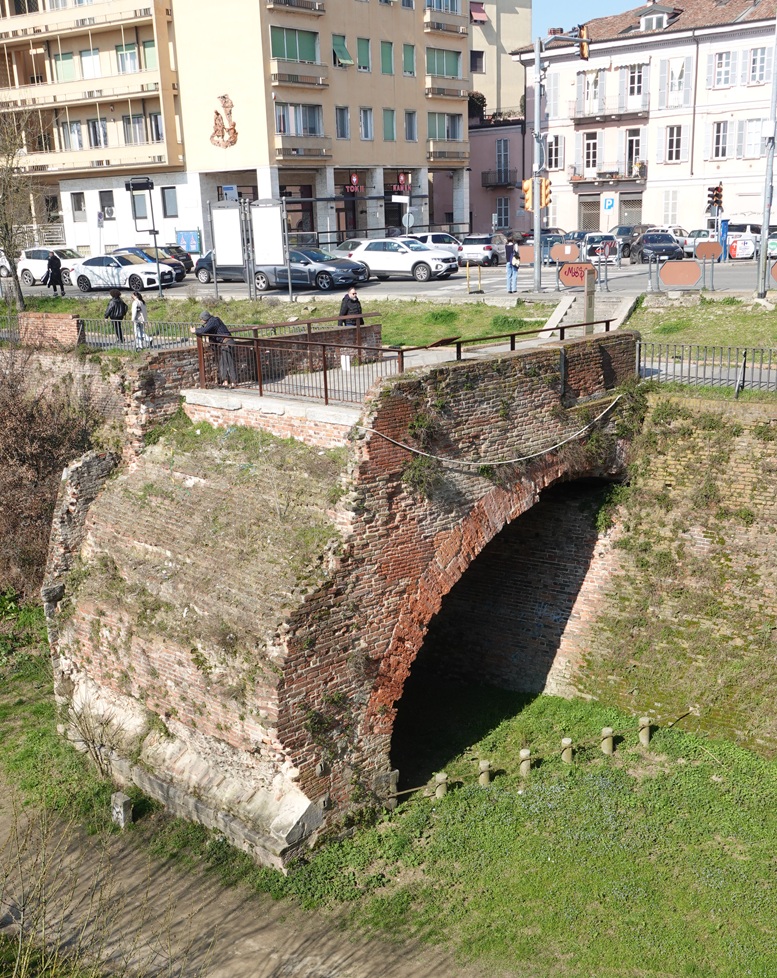
The bridge was replaced in 1351-4 at the same location as the Roman bridge. This bridge had two defensive towers at each end. Parts of the bridge became integral parts of the defensive walls and city gate, and underwent modifications. The Austrians attempted to blow up the bridge during the Italian Campaign against Napoleon, in 1796, but the explosives failed to ignite.

Image courtesy Wikipedia
How the bridge must have looked originally, Bernardino Lanzani, Sant’Antonio Abate protects Pavia during the siege of 1522, Pavia, Church of San Teodoro

View from Covered Ponte over the Ticino River, Pavia. The river is 248km long in total, and is the second-largest river in Italy by volume of water, and the main affluent of the Po River.
Pavia lies 35 km south of Milan, on the Ticino River, which flows from the Novena Pass in the central Alps, through the northern part of the Canton of Ticino, Switzerland, across the Magadino Plain into the northern end of Lago Maggiore (91km). It then flows out of the south of the lake (47km), through Lombardy to the west of Milan, to enter the Po River just south of Pavia (110km).
.png)
Map of the course of the Ticino River, courtesy of Wikipedia
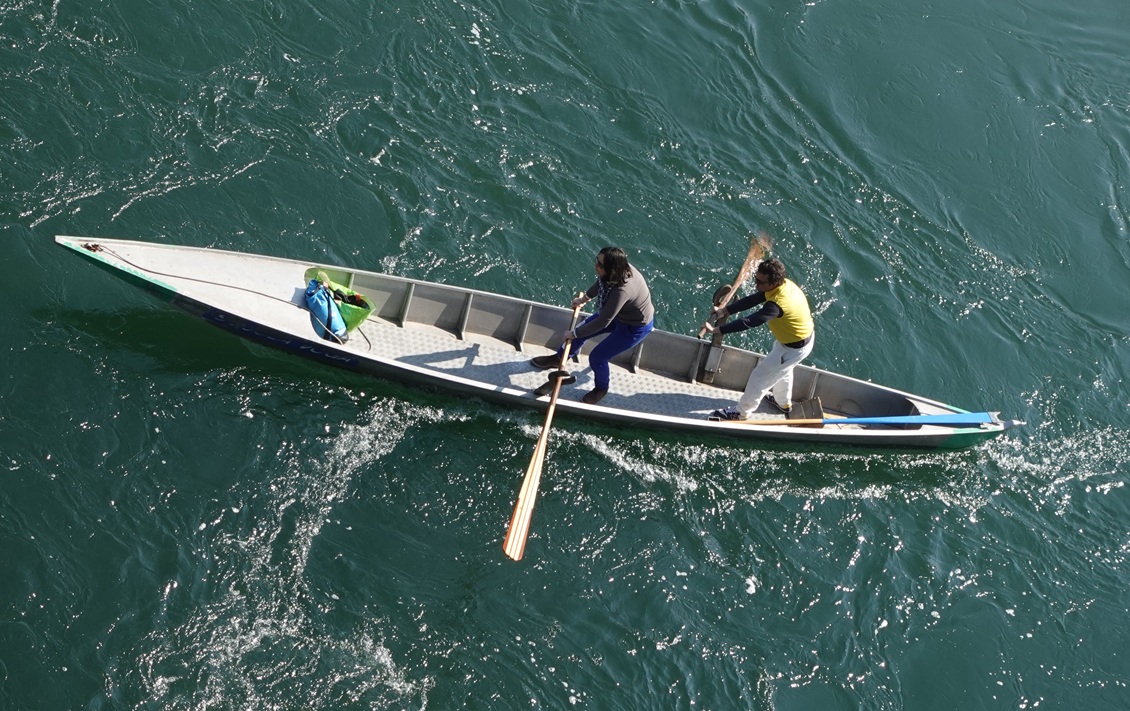
Boaters, using the traditional standing, single-oar technique, beneath the Covered Ponte, River Ticino

Strada da Nuova, the road which traces the original “cardo Maximus” road dissecting the Roman castrum (military camp), Ticinum (Pavia), from north to south. The west-east road of a castrum is called the “decumanus” road, and this corresponds to corso Cavour-corso Mazzini, which we took from the station to the Cathedral.
The town was started as a small, military camp to protect the wooden bridge built by the consul Publius Cornelius Scipio in 218 BCE over the Ticinum River, for the purposes of hunting for the invading Hannibal, during the Punic Wars. This made Ticinum the forward-most post the Romans had at that time in the Po Valley.
The town grew in importance as the Via Aemilia extended from Ariminum (Rimini) to Placentia (Piacenza), and forked to Mediolanum (Milan) and to Ticinum, before continuing to Augusta Taurinorum (Turin).
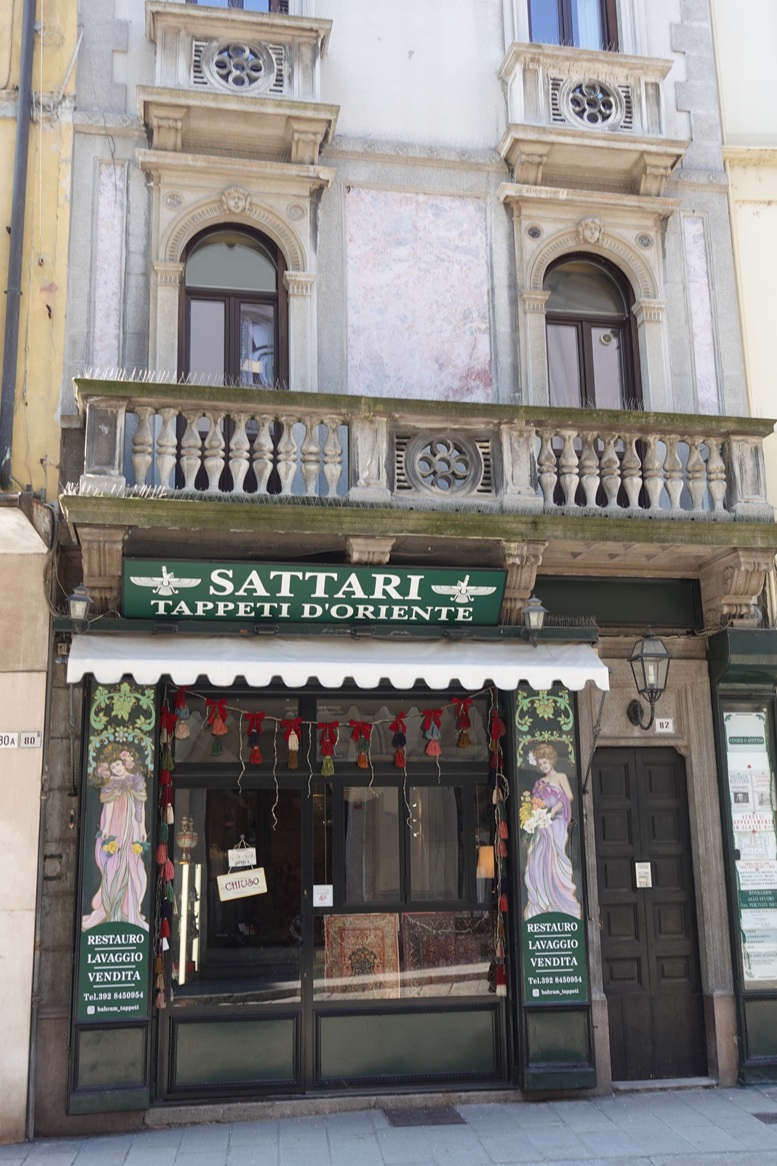
An Art Deco/Renaissance style building and shop front, Strada da Nuova, Pavia.
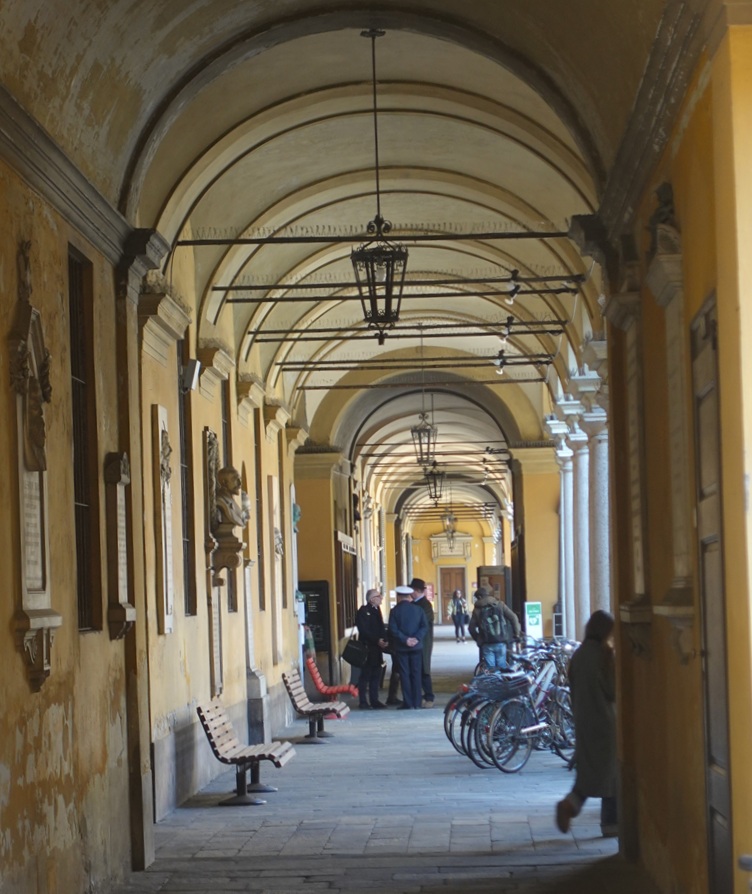
University of Pavia
Its campuses are scattered around Pavia, and there are 9 faculties and 18 departments. It has more than 20,000 students, 1,500 of whom come from abroad to study at this famous, prestigious, and highly-ranked university. 8 of the 20 doctoral programmes are in English.
After a period of stagnation, the university was revitalised by the Austrians, especially thanks to initiatives by Maria Theresa (1717-1780, reigned 1740-1780) and her son, Joseph II (1741-1790, reigned 1780-1790).
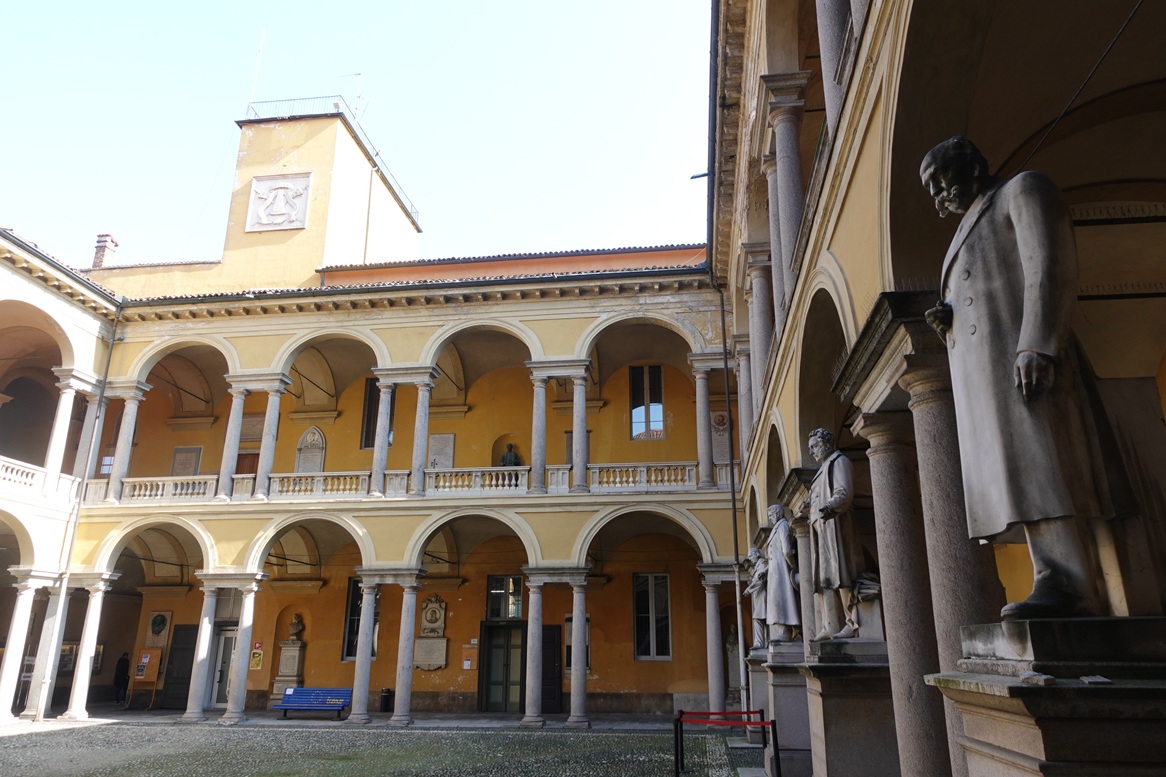
University of Pavia, campus on the Strada da Nuova.
The earliest record of teaching dates back to 825CE, and in 1361 the university was established officially by the Holy Roman Emperor, Charles IV (1316-1378, reigned 1355-1378), as a “studium generale”, making this one of the oldest universities in the world. It was the only university in the Milan and the greater Lombardy region till the end of the 1800s.
The University of Pavia is not, however, the oldest university in Italy. That is the University of Bologna, which began teaching in 1088, and is considered the oldest university in continuous operation in the world. It has over 90,000 students, making it one of the largest universities in Europe.
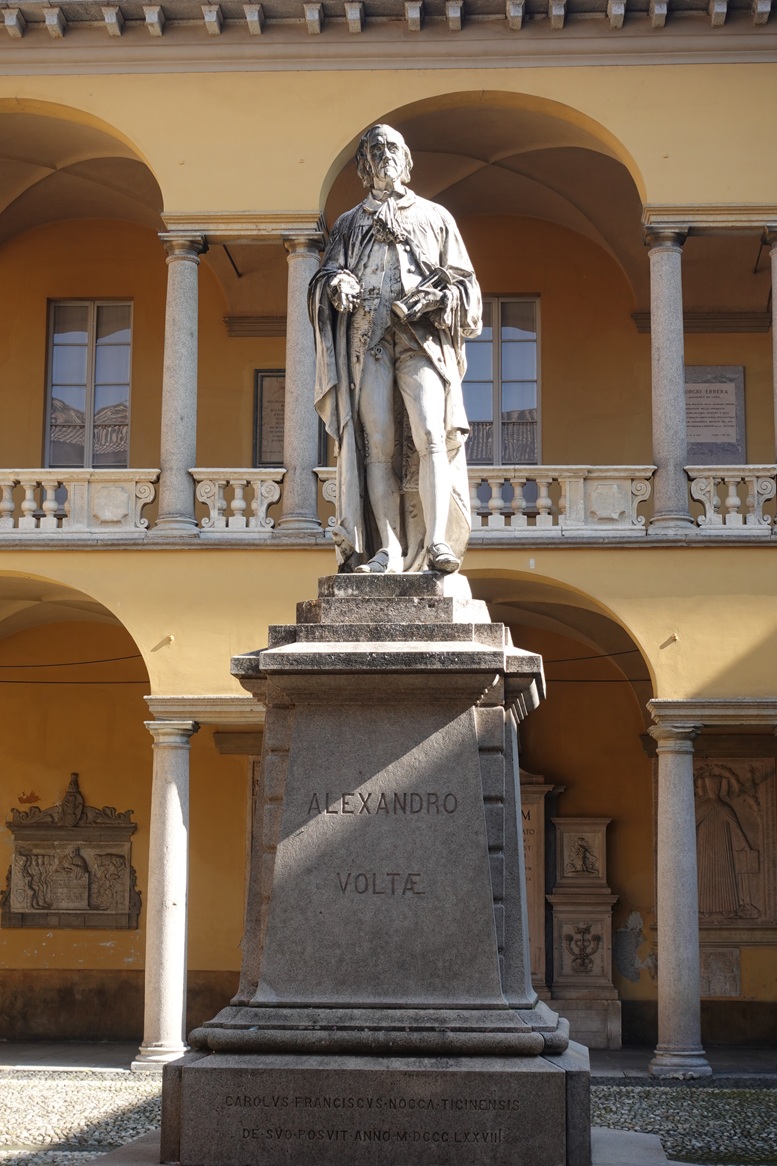
Statue of Alessandro Volta, University of Pavia. The physicist, Alessandro Volta (1745-1827), held the chair of natural philosophy from 1769–1804. He was a pioneer of electricity and power, and was the inventor of the electric battery (the voltaic pile in 1799), and the discoverer of methane. He was born and died in Como.
Among the other prestigious teachers and students of the university of Pavia was Leonardo da Vinci (1452-1519), who studied anatomy with Marcantonio della Torre, professor of anatomy.
Gerolamo Cardano (1501 – 1576) was a mathematician, engineer, philosopher, physician, astrologer and Italian illusionist. He is known as a pioneer in the theory of probability, binomial coefficients and theory, and a number of inventions are attributed to him, such as the mechanical lock, the cardanic support, which allows the free motion of the nautical compass, and the gyroscope.
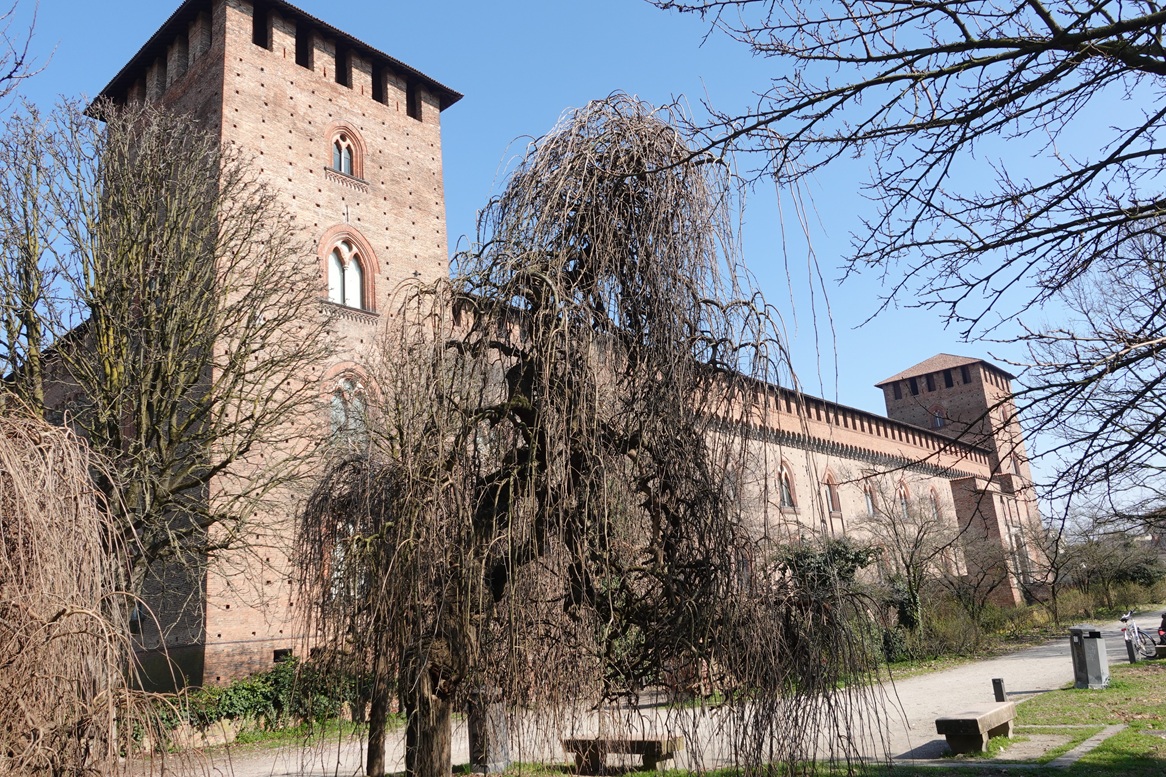
Castello Visconte, Pavia
Built in the 1360s by Galeazzo II Visconti, Lord of Milan, and used by the Visconte family as the regal court till 1413. A hunting park was created around the castle, extending as far as the Certosa di Pavia. Little of that park remains today.
In 1525, the Battle of Pavia was fought here, as part of the Italian War 1521-26, between the French under François I (1494-1547, reigned 1515-47) and the Holy Roman Empire, under Charles V (1500-1558, reigned from 1519), allied with the Spanish Habsburgs.
The battle was won by the Imperial army, and François was captured, and is notable for some military innovations. In particular, the use of firearms (arquebus) and pikes to bring down the heavy French cavalry. The employment of famously brutal mercenary German Landsknecht was also instrumental. The defeat of French ambitions to retake Lombardy, lost in 1521, resulted in a Spanish occupation, which lasted till 1706, when the Austrians came to power, in the power vacuum of the War of the Spanish Succession (1701-1714).

Image courtesy Wikipedia
Painting of Pavia and its defensive wall. The Visconti Castle can be seen at the northern end of Strada da Nuova.
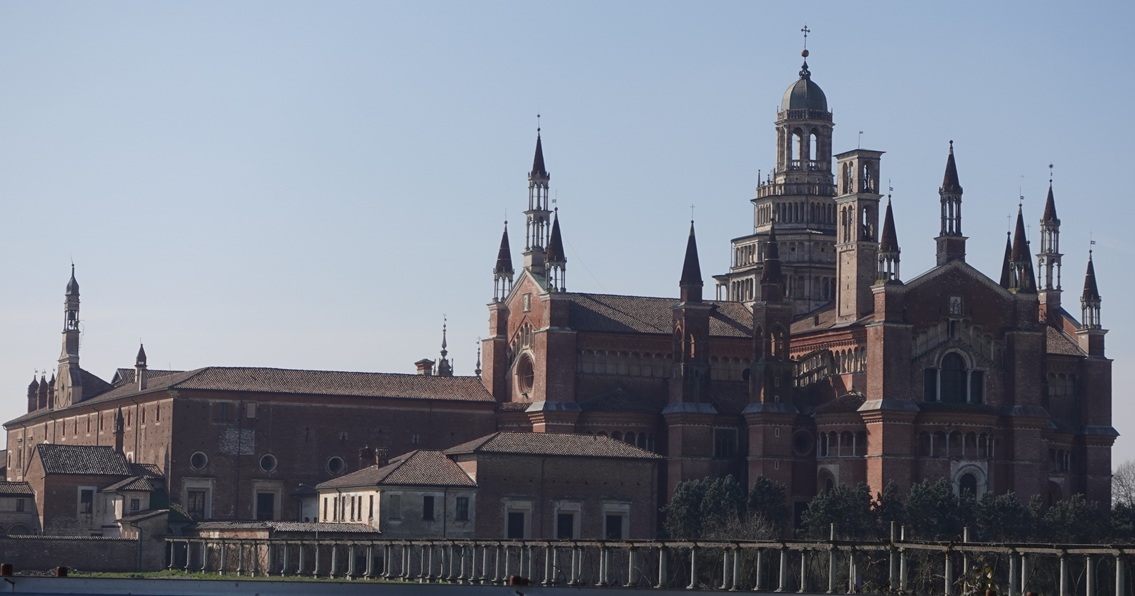
Certosa di Pavia: view from station side wall.
The founder of the charterhouse was Gian Galeazzo (1351-1402), the first Duke of Milan. He was Lord of Siena from 1390 to 1392, and again from 1399 till his death in 1402, at the age of 51. As a result, the monastery he founded at his wife’s behest was to be occupied by the Carthusian monks of Siena. From this results the clumsy anglicised name “Charterhouse”, or “certosa” in Italian.

View of the countryside around the Certosa di Pavia.
Located a few kilometers to the north of Pavia, the land between had been dedicated to the private hunting park of the dukes. Today, little remains of that project, but the landscape around is still flat, agricultural land, much as it would have been in the middle ages. The region of Lombardy is known for a variety of agricultural products, including wine, rice, cereals, and dairy products.

Main entrance piazza to Certosa di Parma.
After the vestibule gateway, we enter a long, rectangular plaza. On the right is the palace of the dukes of Milan, the Visconti, and in front is the façade to the church of the charterhouse.

Close-up of Visconte Palace on the south side of the main pizza to the Certosa di Parma. Note the coat-of-arms of the noble family who was financing the construction of the monastery.
The Visconte Family
Lords of Milan (Signori di Milano) from 1277 till 1395.Dukes of Milan from 1395 till 1447. Gian Galeazzo Visconti (1351-1402), was the first Duke of Milan, and the founder of the Certosa di Pavia. The death of Filippo Maria Visconti (1392-1447) in 1447, leaving no heir, allowed the Sforza dynasty to become the Dukes of Milan, through the marriage of Francesco Sforza to Bianca Maria Visconti (1425–1468) in 1441, the daughter of the last Visconte duke, Filippo.
The Sforza Family
The Sforza family ruled as the Dukes of Milan from 1450 till 1535. Ludovico Sforza (known as Ludovico il Moro, 1452-1508) was Duke from 1494 till 1499, when he lost his dominion over Milan as a consequence of the invasion of Lombardy by Louis XII of France. Ludovico died in captivity in France in 1508.Maximilian Sforza (1493-1530), the son of Ludovico, regained the title of Duke of Milan temporarily, from 1512 till 1515, following the ousting of the French by Imperial German troops, the Holy League, supported by a Swiss militia led by Jakob Meyer zum Hasen (1482-1531). In 1515, the French under Francis I returned and imprisoned Maximilian.
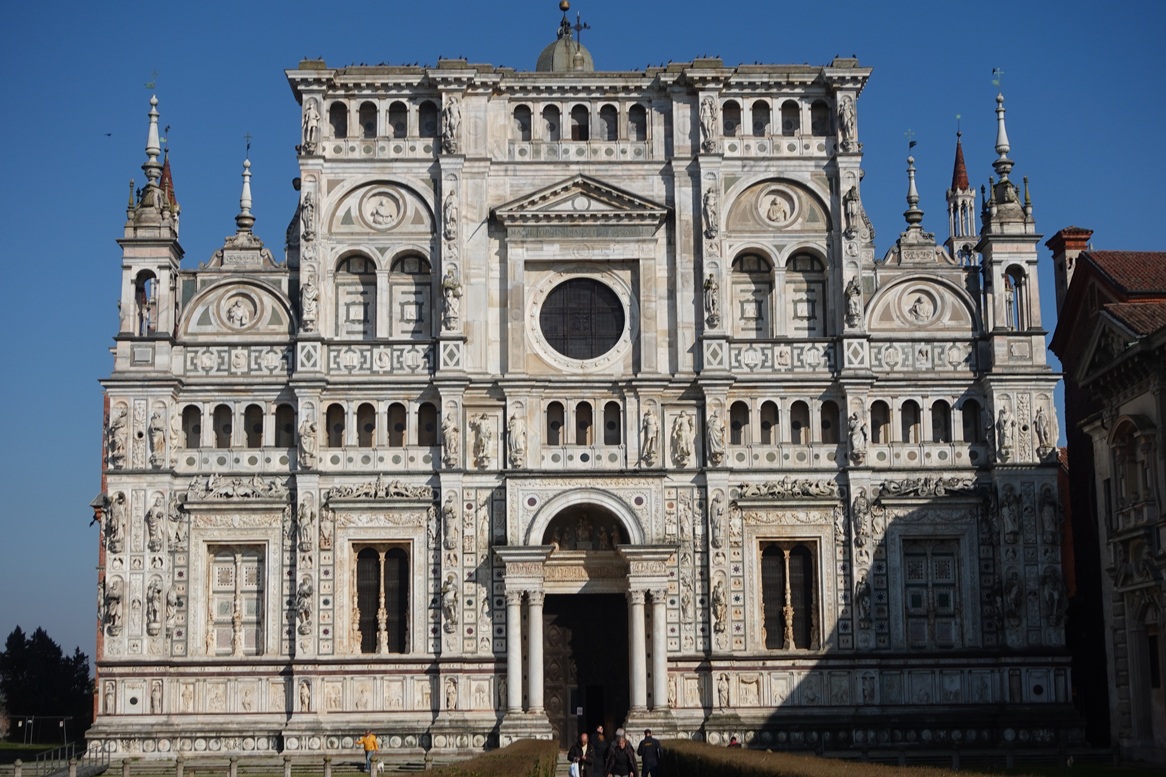
Church facade, Certosa di Pavia.
This beautiful, Renaissance facade was built in two stages, in two different styles. It is 32m high and 40m wide. The marble comes from Candoglia and Carrara, the same sources as that used for the Milan cathedral. Also used are serpentine of Orio, and black of Saltrio (on the southern border to Ticino). The inlay consists of red porphyry and antique green.
Pietra di Saltrio (the stone of Saltrio)
This calcerous sedimentary stone is excavated from the Brusada and Salnova quarries above Saltrio. It was used during the Roman era, it has both decorative and structural advantages. It is to be found, for example, in some of the columns of the Mole Antonelliana, in Torino, and the Staglieno Cemetery in Genova. It is also present in many buildings in Ticino, such as the San Lorenzo Cathedral in Lugano.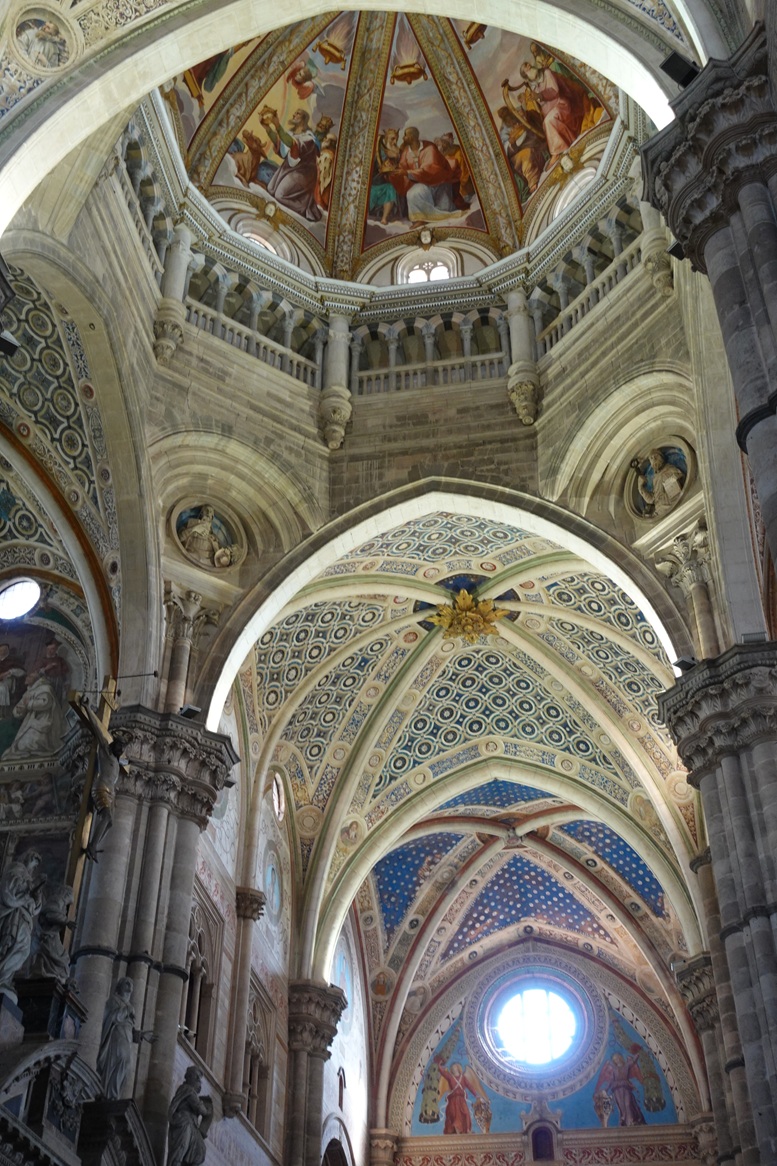
Church nave ceiling and walls, Certosa di Pavia.
The Certosa combines Gothic and Renaissance styles of architecture, and has a fine collection of artworks which are representative of the region of history. The architect originally engaged by Gian Galeazzo Visconti, in 1396, was Marco Solari (1355-1405), a Swiss-Italian architect, engineer, and sculptor. Solari was born in Carona, Ticino. He also contributed to the Duomo di Milano, in 1399. Giovanni Solari (1400-1482) continued his father’s work on both projects.

Church nave ceiling and walls, Certosa di Pavia.
Following a dispute with the builders’ guild of the Milan Cathedral (Fabbrica del Duomo), Gian Galeazzo decided to change his original plan to make Milan Duomo a dynastic mausoleum for his dynasty, and instead let that be a place for the burial of nobles and patricians of Milan, while the Visconte mausoleum would be the Certosa.

Church nave ceiling, Certosa di Pavia.
The Gothic nave was completed in 1465. The marble that was brought from Carrara made a circumnavigation of the Italian peninsula, before sailing up the Po River to Pavia.

View across the small cloister, Certosa di Pavia.
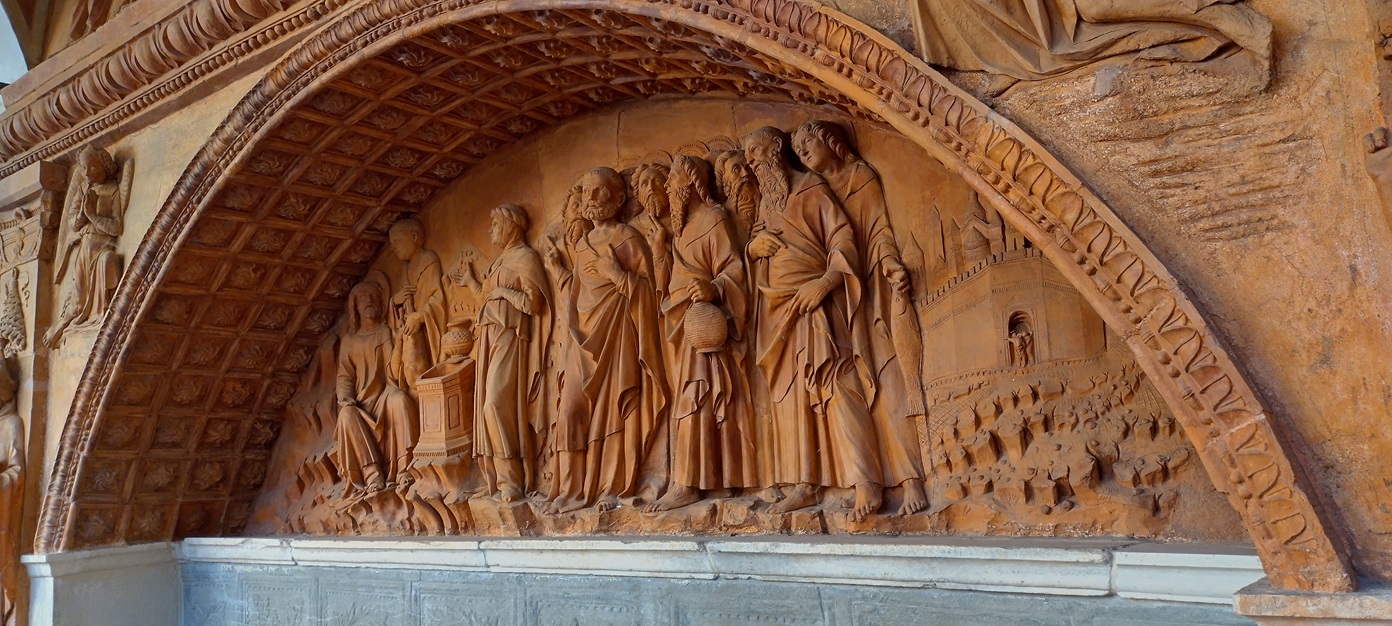
Basin terracotta figures above a wash basin, c. 1450-1475.
The monastery was closed in 1810, but reaquired by the Cathusians in 1843. In 1866 it became a National Monument, and sequestrated by the Italian State. Some Benedictines continued to reside there until 1880. In 1960, the current population of Cistercian monks arrived in the 1960s.
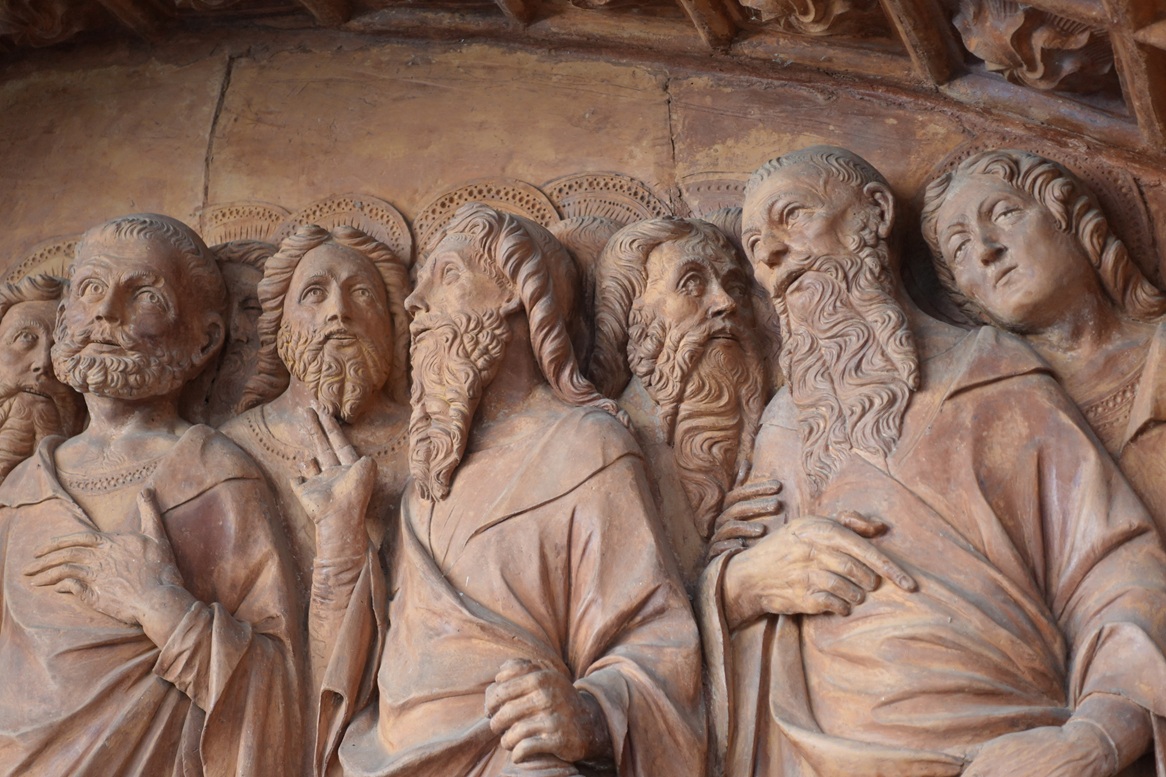
Close-up of the terracotta basin decorations, small cloister.
An interested footnote: in August, 1946, the body of the fascist dictator, Benito Mussolini, who had been summarily executed on 28 April 1945, near the end of the Second World War, was discovered in the Certosa. It had been illegally exhumed, and two of the Franciscan friars were charged with concealing the body. The body had been taken from its unmarked grave in a cemetery in the north of Milan by a fascist group, who moved it around various hiding places, until its discovery at the Certosa. It was eventually reinterred in Mussolini’s hometown of Predappio, Romagna. The grave, unfortunately, is the objective of pilgrimages by neo-fascists.

Refectory, Certosa di Pavia. This room is one of the original rooms built, and was used as a church. It is where the monks ate their meals, appropriately enough there is a fine fresco of the Last Supper by Ottavio Semini (c. 1530–1604) on the far wall, executed in 1567.

View of the monk cells around the Grand Cloister (Chiostro Grande, 125x100m).
The Certosa was home to 12 Carthusian monks initially. They lived an entirely cloistered existence. Any profit from their work in the fields and other income was used for the continued construction of the monastery. By the eighteenth century, the monastery possessed large estates, between Pavia and Milan, including the Castle of Carpiano and a large palace in Milan, for a total of 2,325 hectares (23 km2) of irrigated land.

Detail of the exquisitely detailed terracotta adornment by Rinalso de Stauris, 1463 – 1478, on the small pilasters around the portico of the large cloister. Around the Large Cloister are sculptures by the Mantegazza brothers and Giovanni Antonio Amadeo.
Travel Diary
We have lunch in a charming restaurant, decked out with antique farm implements and photographs of old Pavia. There is a fixed menu with a few options, and we pay only Euro 20. It was excellent, so no wonder it was full to the brim by the time we left. We find the Strada da Nuova, which still marks the route of the original ancient Roman road which dissected their Castrum, Ticinum, the rectangular defensive town which withstood many attacks and sieges throughout the Middle Ages. At the south end of this street, we discover the old Ponte Coperta. At least it is a mainly reconstructed version of the ancient bridge, which unfortunately did not survive the bombing of 1944 intact.
We then walk north along the Strada da Nuova to the castle, which has a museum, closed today, of course. We make it back to the station just in time to take the train the 8 km to Certosa di Parma. Out here in the very flat countryside lies the famous Certosa, built by the Viscontes in the late 14th century and 15th century. This enormous and authentic complex has housed monks almost continuously since its inception, and even has tours led by a monk.