Romania-Bulgaria 2023
Day 1: Thursday 24 August 2023
Lugano – Sibiu, Romania

Map of Romania, showing our route. (Courtesy Wikipedia)
The Carpathian Mountains are 1500km long, stretching from the eastern end of the Czech Republic, through Slovakia, Poland, Ukraine, Romania, and Serbia. Half of the range is within Romania itself. The highest peaks are the Tatra Mountains in Slovakia (over 2600m), and in Romania they exceed 2500m. The largest European populations of species of brown bears, chamois and lynxes are within Romania. Romania also has one-third of all European thermal and mineral waters.
Romania has the largest area of virgin forest in Europe (excluding Russia), with the Southern Carpathians, in Romania, boasting the largest unfragmented forest area in Europe. Illegal logging is a major problem. The name may come from archaic Polish, karpa, meaning “rugged irregularities”, deriving from the Proto Indo-European root sker, meaning “mountain, rock, rugged”.
The highest mountain in Romania is Moldoveanu Peak (Romanian: Vârful Moldoveanu, pronounced [ˈvɨrful moldoˈve̯anu];), at 2,545 metres. It is located in Argeș County, in the Făgăraș Mountains of the Southern Carpathians. Moldoveanu Peak gave its name to a star In December 2019: located 536 light-years away in the constellation Corona Borealis, the star XO-1 is now officially called Moldoveanu.

A view of our hotel from the steps leading up to the main squares of Sibiu.
Like many towns which changed hands between different empires or countries, Sibiu has an alternative name. In this case, the Germanic name is Hermannstadt. The Latin name was Cibinium. In Transylvanian Saxon it is Härmeschtat. The town is on either side of the Cibin River, which flows into the Olt River, with 615km the longest river entirely within Romania. The Olt River flows through a gap in the Southern Carpathian Mountains, to the River Danube, which in turn makes its way, as the border to Bulgaria, to the Black Sea.

The Passage of Steps, Sibiu.
This historic route from the lower part of town to the upper, where there are the two main squares, consists of two staircases, replete with archways, high brick retaining walls, and even flying buttresses. In the midst of the medieval centre, with many winding alleyways and historic buildings, provide such picture-perfect views.
Sibiu is a popular tourist destination for both Romanians and foreigners, who are attracted to its well-preserved historical architecture, culture, and cuisine. It is undergoing the process of becoming a UNESCO World Heritage Site, and was the European Capital of Culture in 2007. In 2021 the population was 134k, with a metropolitan area of 267k. There is a ski resort not far away.

Piata Mare – the main square in Sibiu
Being between powerful neighbours, Transylvania, and therefore Sibiu, has changed hands many times: First the Romans (hence the name, Romania). The town was founded around 1147 by Saxons from the Holy Roman Empire and France. It was under the Hungarians from 1191 till 1570, after which it became the Principality of Transylvania till 1804, when it passed under the Austrians/Austrian-Hungarians. From 1920 till after the Second World War it was a sovereign state, the Kingdom of Romania, then a republic 1947-1989, and now is simply Romania.
The term Transylvania comes from Latin for ‘beyond the woods’.

Heavy on the meats is the old peasant’s plate.
Romanian cuisine varies according to region. In the south, Wallachia, there is a stronger Ottoman influence, while in Transylvania, there is a Germanic and Hungarian influence. However, Romania has also developed some of its own, unique characteristics.
Among the specialities are the ciorbă soups, with a characteristic sour taste. One of these is calf foot soup, soured by lemon or sauerkraut juice, vinegar or borș, made from bran.
There is a plum brandy, țuică.
Piata Mica (Small Square) Sibiu
The city’s Germanic name, Hermannstadt, was used from 1321. Before that, since 1223, it was known as Villa Germanni. This is either in honour of archbishop Hermann II of Cologne, or the supposed founder of the city, Hermann of Nuremberg.
The German term for Transylvania is Siebenbürgen, meaning seven citadels. Hermannstadt was the most important of these seven cities in Siebenbürgen.
For a limited period, 1570-1699, the town was under dual vassalage, between Hungary and the Ottoman Empire. This means Transylvania was semi-independent, but ruled by Hungarian princes, and paying tribute to the Ottomans, who were controlling the lands to the south of the Carpathians, with the occasional raid to the north.

The Eyes of Sibiu (Ochii din Sibiu) are trapezoid, rounded, or elongated-shaped ventilation ducts in the rooves of buildings in Sibiu, and a few other locations. With the earliest records of the Eyes dating back to the 15th century, this Baroque architectural tradition has continued to modern times, and is now a major tourist draw.
In recent times the Eyes have become a symbol of the anti-corruption movement Vă vedem din Sibiu (“We see you from Sibiu”).

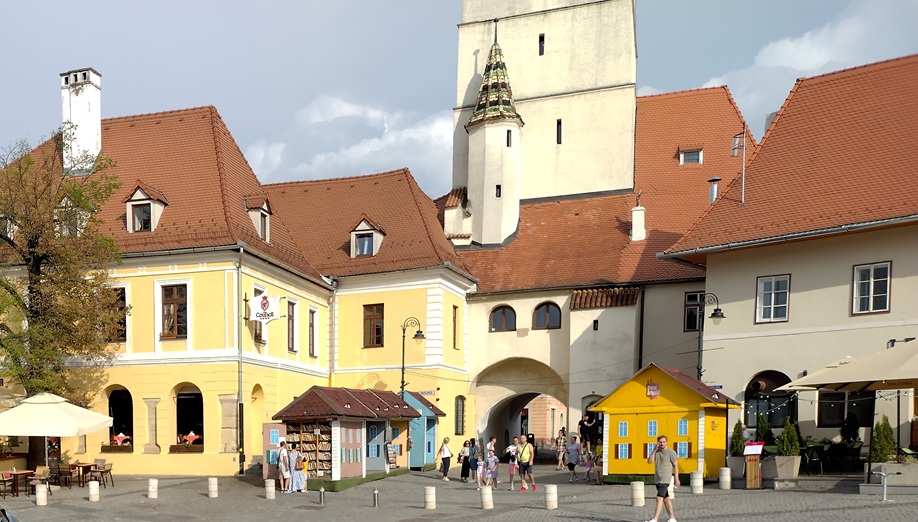
Market in Sibiu’s Small Square (Piața Mică)
The tower in the photograph is of the Council Tower of Sibiu. It sits between the two main squares in the historic centre, the Great Square (Piața Mare) and the Small Square (Piața Mică). This 12th century tower has been rebuilt several times, and is the city’s symbol.

A Christmas Market is held in Sibiu, and this town was the first to offer this popular attraction in Romania. It is ranked among the 15 most beautiful Christmas Markets in Europe. Connected to the market are efforts to promote the region’s unique culinary and gourmet culture.
Travel Diary
Early start 4:30 am (Cindy earlier!) to leave at 5:20. to take the 6:02 train from Lugano to Malpensa Terminal 1. We checked in yesterday on line, so we could wander around, drink coffee and have some sugary brioches, before boarding. The flight to Vienna arrived 25 minutes early! Cloud and haze spoilt the views a lot of the way but still the scenery was fantastic. We think the long and very wide waterway we see threading through the terrain must be the Danube River. The plane width was 4 seats per row, 2 engines. Short lay over in Vienna. Passport control, not entering the EU from Italy, but the officer asked to see my Swiss Residence Permit. Ah yes, Brits are extra-community now. Feeling demoted, humiliated and soiled, I catch up to Cindy who had sailed through on her Swiss passport. Schengen zone clearance, I guess.
Both arrival and departure were by bus. We were invited to check in the cabin size suitcase free of charge, since the flight to Sibiu was full to the gills, and there may not have been enough overhead luggage space. The flight was short, entering a stormy patch, before landing with full engine reversal on the short runway to the small, cosy airport terminal. In the passport control queue we chatted with a pretty young woman with a curiously shaped large backpack. She had just returned from the US Tennis Open in NYC, where she had represented Romania, ’not so well.’ She was joined at the baggage claim by a shorter man, looking super fit and dapper in classic white tennis shorts and fashionably bulging calf muscles.
No buses in sight in the carpark, so we took a taxi. The driver spoke basic English, having spent 6 years in London, working in interior construction.The taxi ride was a chaos of new and old, drivers as wild and disrespectful as Italians. Rain was promised but did not show. Our driver had decided to return to Romania at the birth of his first child. ’I want to live in my own country.’ He dropped us off 20m from our hotel, just outside the pedestrian zone in the old town. Fare was 62 Leu (Fr12) and we gave him 100 (Leu that is, not francs!).
Our hotel is above a bar/restaurant in a very old, very inviting building with wooden beams and white stucco walls, with bold enough attempts at retaining a rustic look. The friendly staff with smiles and English in bits and pieces greeted us. We struggled even with ’thank you’ because of the pronunciation (muzza-mesc). Up 2 floors, past an extensive set of bookshelves of exchange books, to a tight but well furnished room with an enormous bathroom with a view of the rooftops and Evangelical Church towering overhead. After a brief rest, we dressed in sandals and shorts – it was quite warm – and walked up steps to the 2 adjoining squares, Piata Mica (small) and Piata Mare (big) to explore. Very interesting mix of architectural styles, with onion-domed spires, 18th century regal buildings (memorabilia of the Hungarian occupation) and steep, tiled roofs, pigeons precariously perched. Some rooves look very dilapidated, others well-conserved, careful to retain an authentic look.
Dinner started with a delicious appetizer and got heavy after that as we ordered the peasants’ plate, which apparently just means a lot of meat! The cost, Leu 160 or Fr 32. There was a very pleasant market on the level zone above the wide, descending road under the ‘Bridge of Lies’. At least 2 outdoor restaurants had a pianist playing gentle jazz. We strolled till 9pm. We were tired so we had an early night.