Valle del Vedeggio, 2025
Day 1: Monday 21 April 2025
Torricella – Mezzovico

Itinerary of route “Itinerario 1” of the excellent series “Luganese e valli”, by the AAT, Associazione Archeologica Ticinese.

Map of our route. We took our time, enjoying the beautiful sunshine, after a week of heavy rain. The path wound past Monti di Torricella on the left, and “Ur Bar”, a steep rocky outcrop on the right, where one of the defensive towers once stood during the middle ages. These towers and fortresses have largely disappeared, their stones scavenged and used for structures, such as houses and dry walls we still see today. They were built by the Italian dukes to defend against the rampaging Swiss from the north. The vital routes across the Alps, primarily the Gotthard Pass, saw many conflicts for control, even a naval battle between Milan and Como on the Lake of Lugano (Ceresio), during their war of 1118–1127.

Castello Trefogli, Torricella, Ticino
Michele Trefogli was born in 1838, and after studying architecture at the Brera Academy, left for South America in 1860. He achieved great success in Lima, Peru, becoming the state architect. He married and had five children. He returned to Ticino in 1900, where he completed this grandiose property by 1906. It was nicknamed “ul castell”, or Castello Trefogli. In 1926, Michele returned to Peru, where he died two years later.
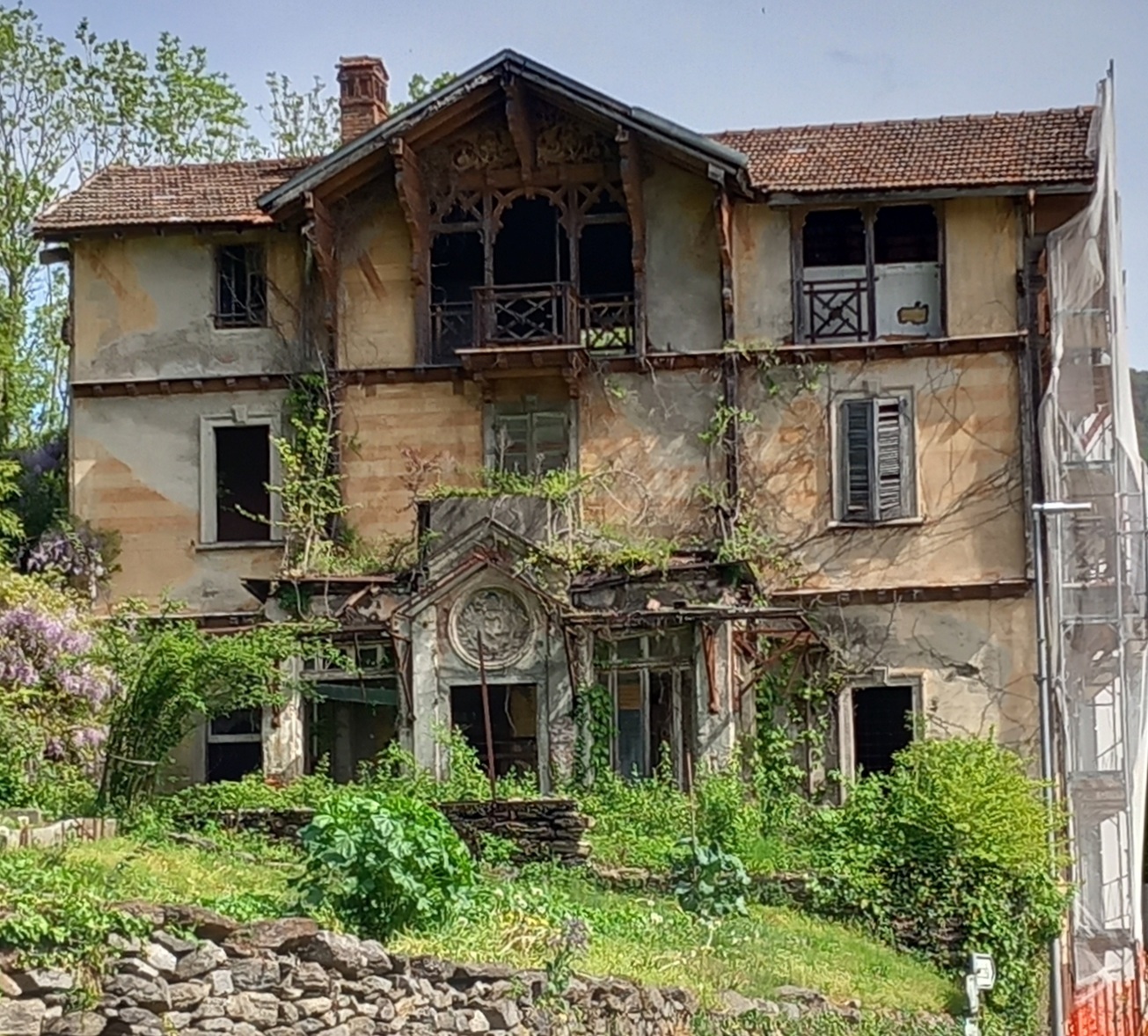
Derelict, but interesting, house in Torricella.

Chiesa dei SS. Maurizio e Biagio a Torricella
The first church was built in 1361, and the current church dates to 1586. The frescoes in the interior are by Francesco Bellotti, 1719.
Saint Biagio (Blaise of Sebaste) was a third century Armenian bishop tortured and martyred in 316 CE by the Romans.
.jpeg)
San Biagio (Blaise of Sebaste) by Antonio del Castillo y Saavedra.
Image courtesy of Wikipedia
San Maurizio (Saint Maurice), who was martyred in 287 CE, was a Roman general, head of the legendary Egyptian-Roman Tebana Legion, and venerated as a saint by the Catholic Church. After refusing to persecute Christians, he was martyred during the second persecution of Diocletian (CE 242-311, emperor from 284).

San Maurizio by Teodorico di Praga (XVcentury)
Image courtesy of Wikipedia

View across Valle del Vedeggio, towards the east and Tesserete/Sala Capriasca, from Torricella. The Denti della Vecchia (Old Woman’s Teeth) can be seen in the distance. The highest point of this mountain chain is 1492m a.s.l.
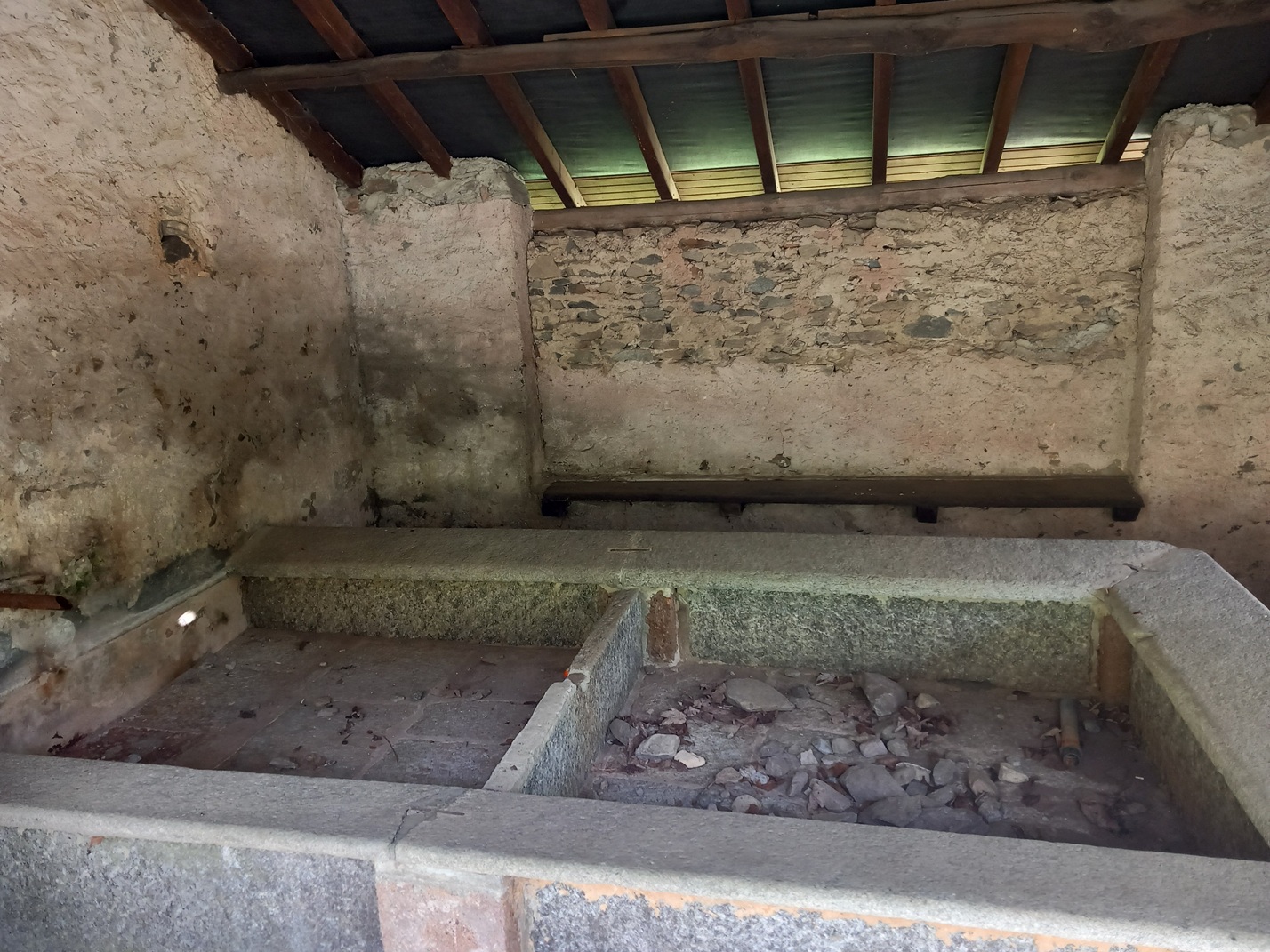
A probably medieval communal laundry basin. Sigirino, Ticino.
In 1799, a Russian force of 22,000 men, under Aleksandr Vasil’evič Suvorov, passed from Torricella-Taverne through Sigirino, on their way to fight the French, under Andrea Massena. We visualise the army queueing to use this font for mixed purposes, as they pillage the villages, and deprive the locals of their winter stores and animals, leaving in their wake many deaths and hardships for years to come.
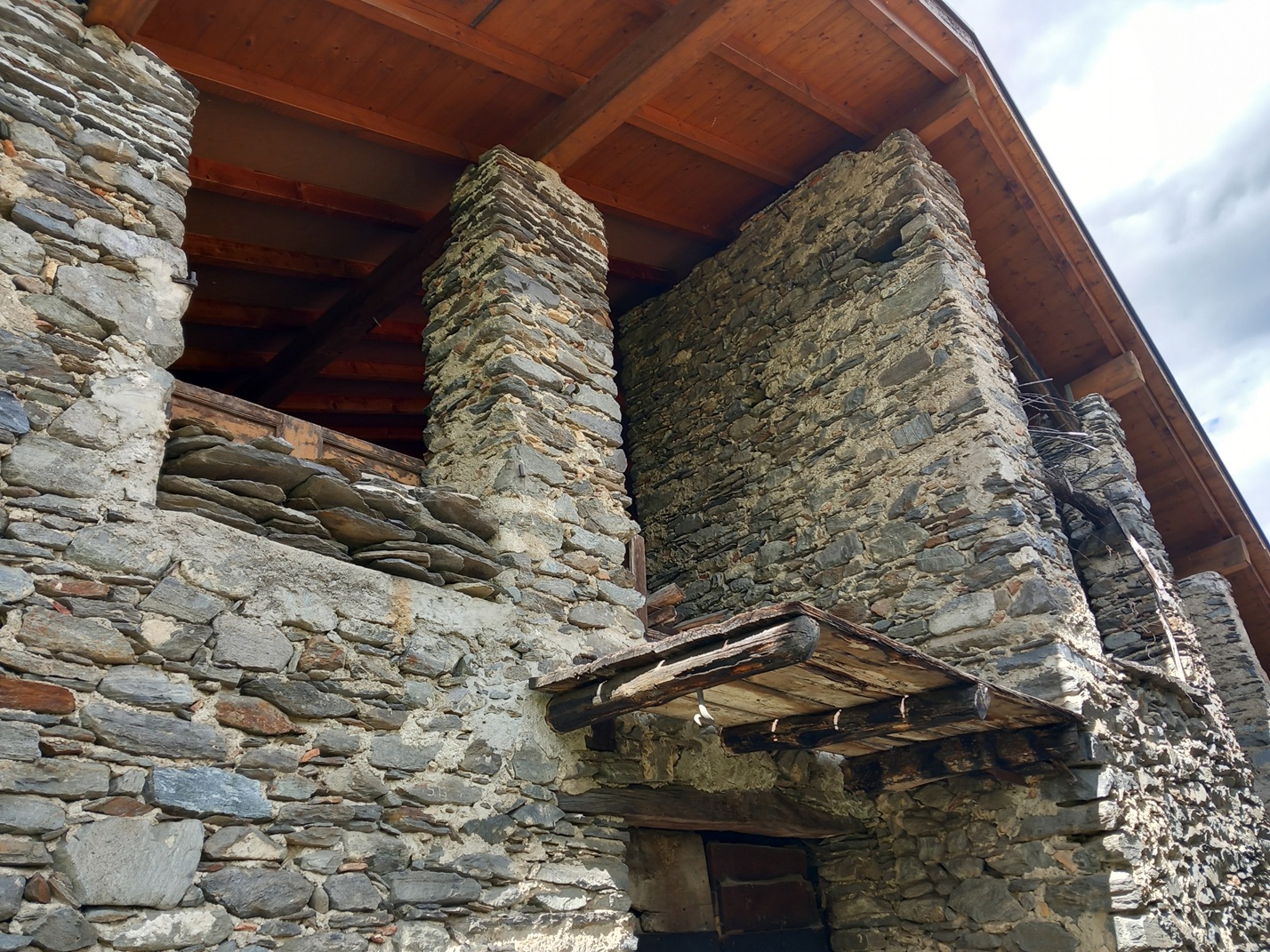
The old part of Sigirino maintains a number of interesting buildings in the old style. The variety of stone types attests to the rich geology of the Alps. Even the roads are painstakingly built of durable round stones acquired from the fast-flowing river, the Vedeggio, or its many tributaries coming down the steep mountainsides all around us.
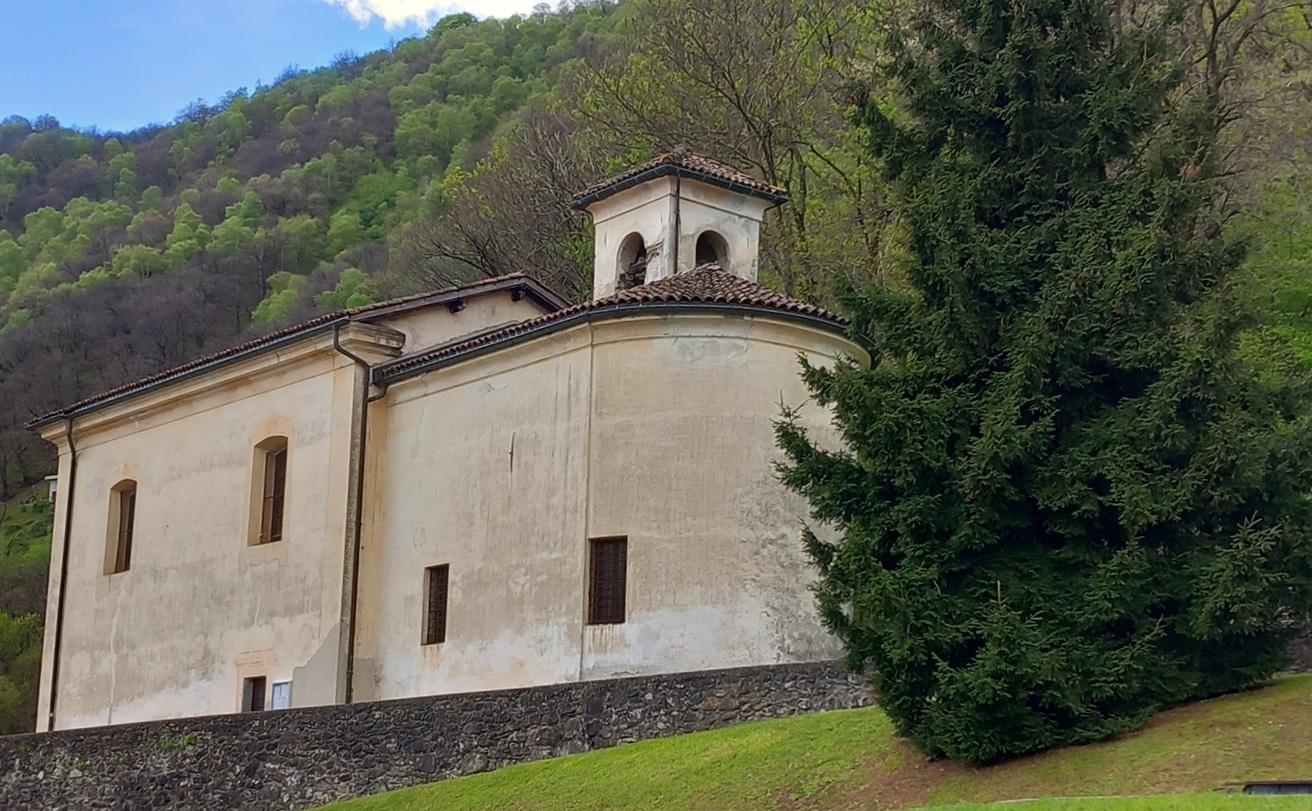
Oratorio di San Rocco, Sigirino, built in 1578-1599.
Saint Rocco
Rochus of Montpellier, known as Saint Roch (b. Montpellier, France, 1345/1350 – d. Voghera, Italy, 1376-1379), was a French pilgrim and thaumaturge*, venerated as a saint by the Catholic Church and patron saint of numerous cities and towns.He is the most invoked saint, from the Middle Ages onwards, as a protector from the terrible scourge of the plague, and his popularity is still widespread, so much so that a recent study identified Saint Roch as the second most invoked saint, by European Catholics, to obtain healing from COVID-19.
His patronage has gradually extended to the farming world, animals, major disasters such as earthquakes, epidemics and very serious diseases; in a more modern sense, he is a great example of human solidarity and Christian charity, in the sign of voluntary work. Over the centuries, he has become one of the best-known saints on the European continent and overseas, so much so that he is the most represented on holy cards, but he has also remained one of the most mysterious.
* Unlike theurgy, which focuses on invoking divine powers, thaumaturgy is more concerned with utilizing occult principles to achieve specific outcomes, often in a tangible and observable manner. It is sometimes translated into English as wonderworking.
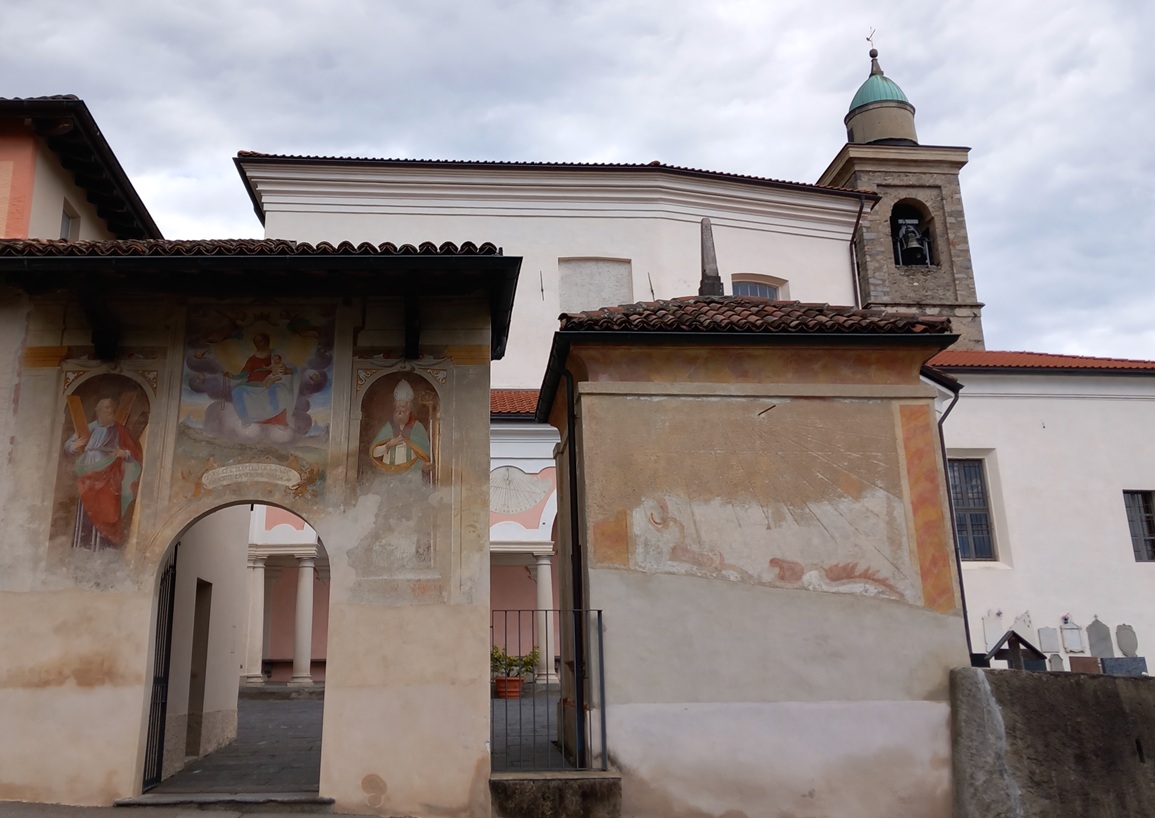
S. Andrea Church, Sigirino, Ticino
This impressive church dominates the skyline over the Valle del Vedeggio, north of Lugano. It has a beautifully manicured cemetery, and an ossary (now minus the bones), at the entrance. This boasts a bizarre 1687 fresco of Maria providing milk from her breasts to souls trapped in purgatory.

Maria the Consoler (Maria consolatrice), providing succulence to the suffering souls in purgatory.
Above the entrance is a 1662 fresco of Death refusing gold being offered by the king.

Fresco over the entranceway to Chiesa di S. Andrea. The church was first mentioned in a document in 1292, and has been recently renovated. A major alteration occurred in the 17th century, which explains the late-baroque appearance of the interior.

Late-Baroque interior of S. Andrea Chiesa, Sigirino. The church is first mentioned in 1292, and like all the churches of Valle del Vedeggio, underwent a number of major alterations through the centuries, adding 19th and 20th century affrescoes. The altar dates from the 16th century, and the campanile, the clock tower, from the 17th.
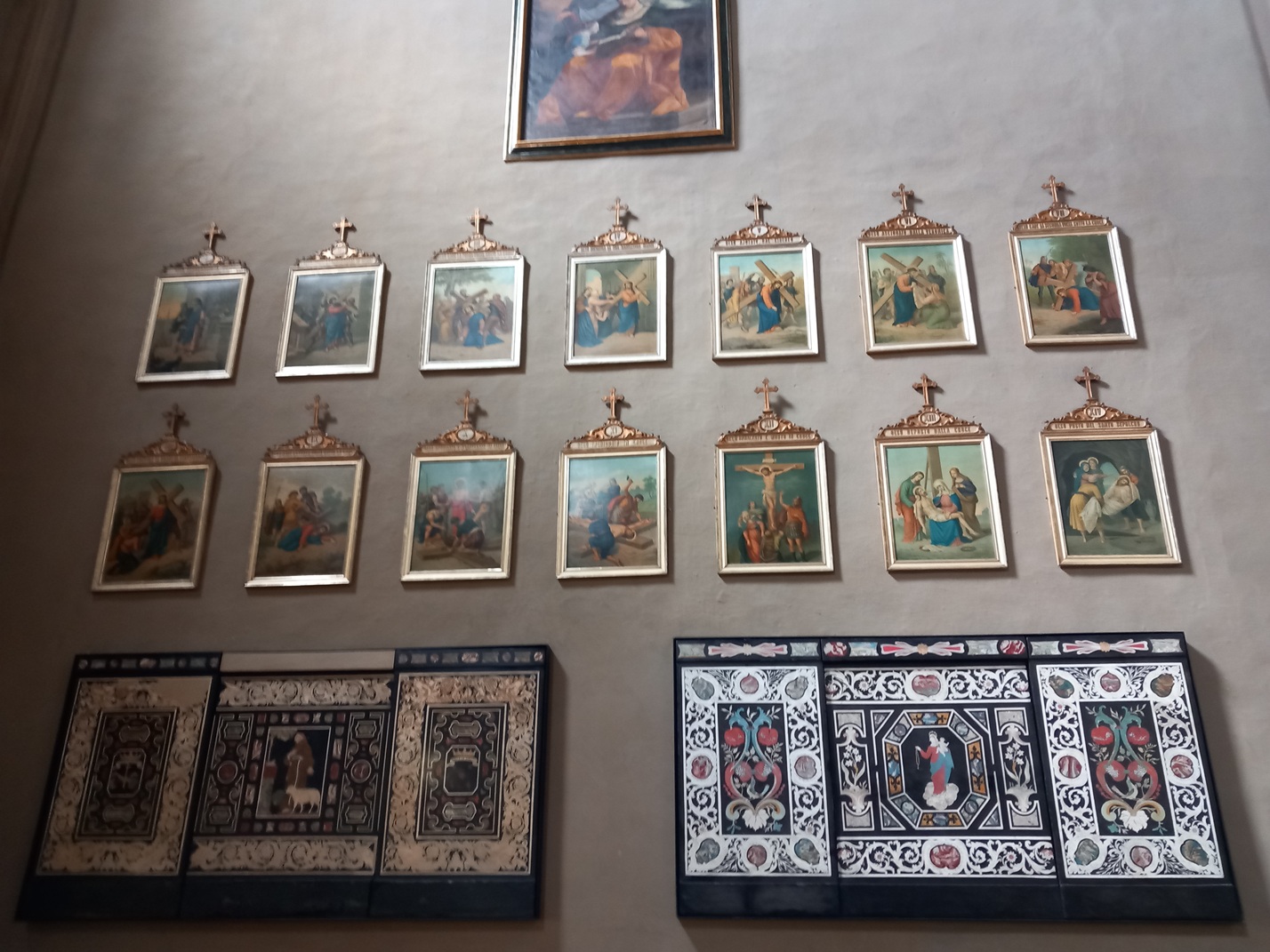
Gruesome series of paintings, depicting scenes of the crucifixion, over the church entrance. Two brightly decorated wooden triptyches balance the composition.
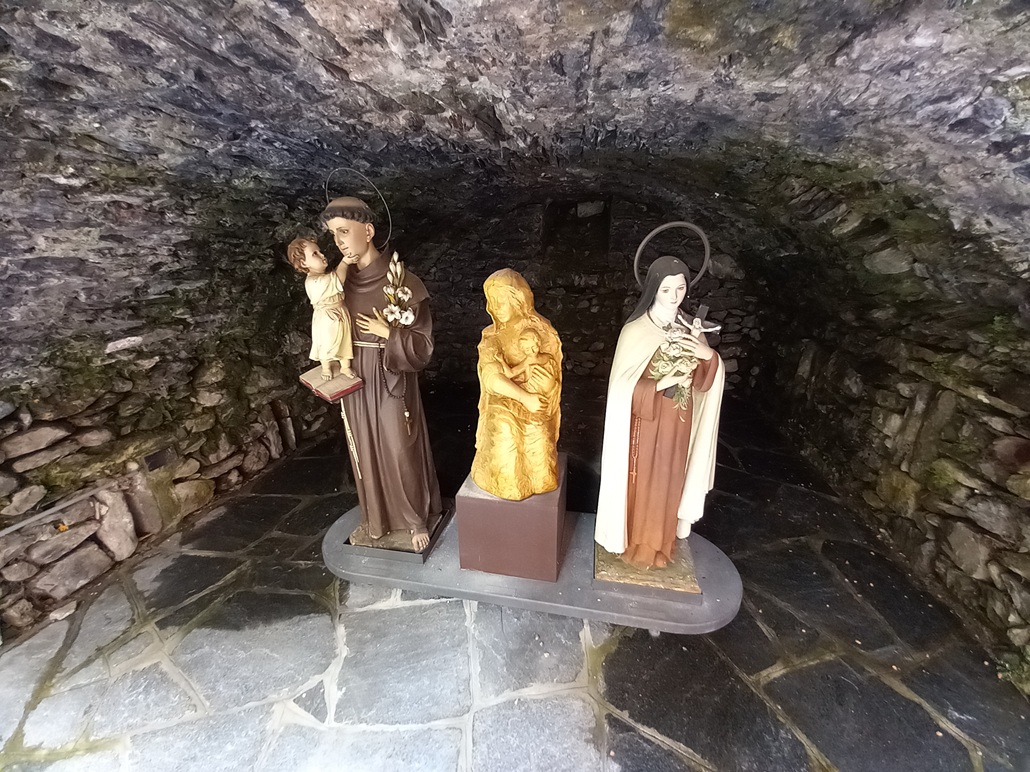
A grotto scene outside Chiesa di S. Abbondio, Mezzovico. The figure on the left is Saint Abundius (Santo Abbondio), raising a dead child to life.
Abundius was born in Thessalonica, modern day Greece. He attended the Council of Constantinople in 448, and participated in the suppression of heresy at Chalcedon (Istanbul) in 451, and the Council of Milan in 452. He is considered to be the author of Te Deum. He became Bishop of Como in 448 CE, and died in 469 CE. His relics are conserved beneath the main altar of the Romanesque Church of Sant’Abondio at Como.

Interior of the S. Abbondio Church, Mezzovico. While we were in the church we heard the news that Pope Francis (b. 1936) had died that morning. The church caretakers came to ring the bells.

Interior of the S. Abbondio Church, Mezzovico

Medieval fresco, S. Abbondio Church, Mezzovico. It is pleasant to see that many ancient frescos have been left in their authentic condition, despite many renovations of the buildings around them.
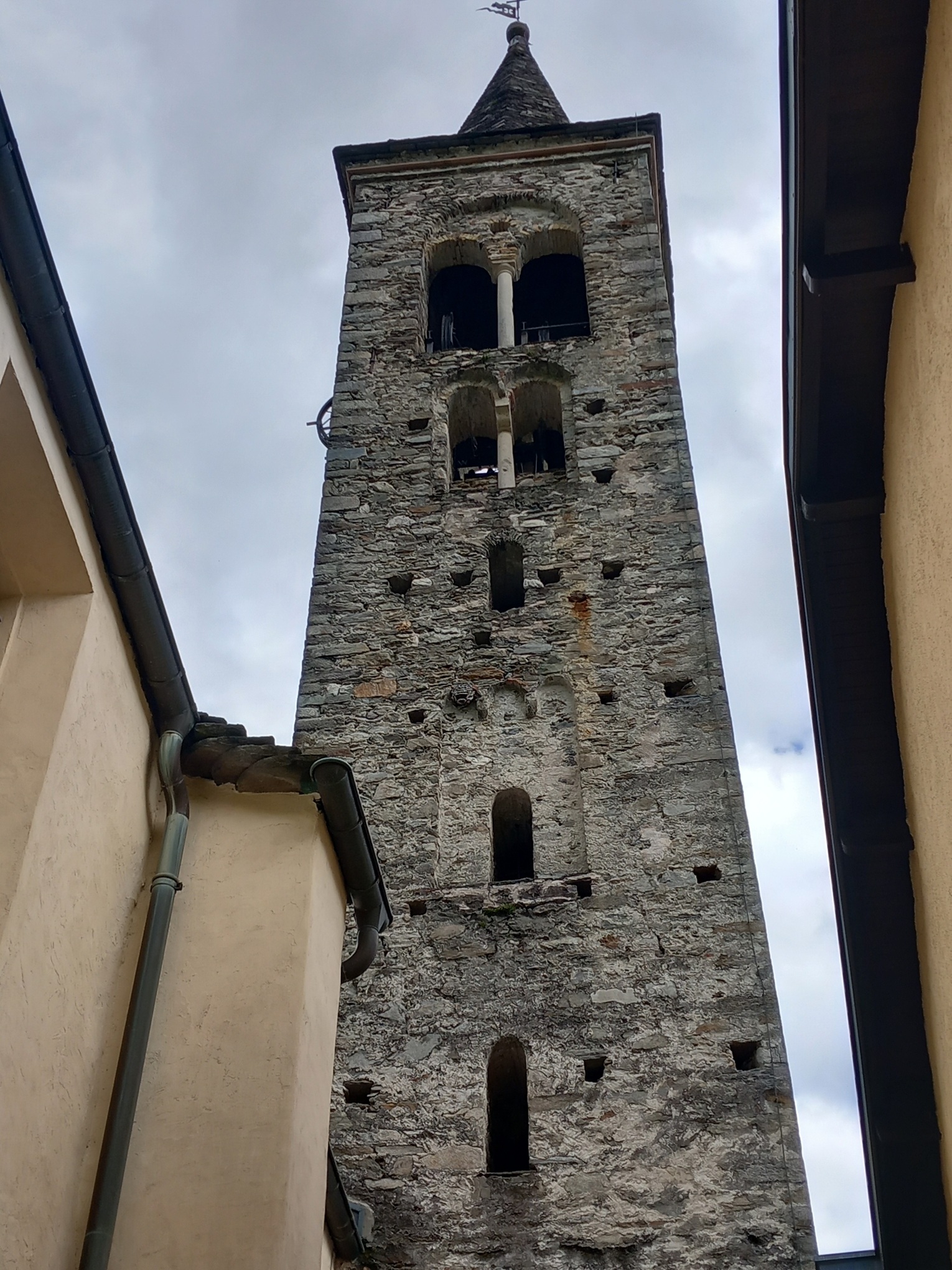
Bell tower, S. Abbondio Church, Mezzovico. These were rung while we were there in commemoration of the passing of Papa Francesco this morning.

Exterior of the Oratorio della Madonna di Loreto, built in 1683.
Legend has it that angels carried the house of Mary to the Marches in Italy. This and a copy of a statue of the Madonna, a replacement for the original lost in a fire, are housed in the Basilica della Santa Casa in Loreto, a popular pilgrimage destination.
In 1920 Pope Benedict XV declared the Madonna of Loreto patron saint of air travellers and pilots. Good to know in these days of mass airborne tourism!

The sacred Black Madonna statue and relics of the House of Mary are housed in this sumptuous construction within the Basilicata, the Santa Casa di Nazareth. Image courtesy of Wikipedia

The interior of the “Santa Casa” (Holy House), with the venerated statue of the Madonna di Loreto. Image courtesy of Wikipedia

A S. Antonio Abate (Saint Anthony Abbot) Church, Vira, 14th century with modifications over several centuries.
As opposed to Saint Anthony of Padua (1627-1630, Portuguese), this Saint Anthony was born 12 January 251, in Koma, Eygpt, and died 17 January 356, at the age of 105, at Mount Colzim, Egypt. He is venerated in both the orthodox and western churches. He is also known as Anthony the Great and Anthony of the Desert or Hermit, and even Father of All Monks, amongst other epitaphs.

Interior of the S. Antonio Abate (Saint Anthony Abbot) Church, Vira. On the left is a statue of Francis of Assissi, and on the right Saint Abundius (Abbondio).
Saint Anthony the Great was a leading inspiration for Christian monasticism, but not actually the first Christian monk. He was, however, the first to go into the wilderness (c. 270 CE). Accounts of Anthony enduring supernatural temptation during his sojourn in the Eastern Desert of Egypt inspired the depiction of his temptations in visual art and literature.
If you have a skin disease, get a message through to this monk, whose name is given to St. Anthony’s fire, a sobriquet for shingles and suchlike diseases.

The distinctive spire of the S. Antonio Abate (Saint Anthony Abbot) Church, Vira.